


And the printer itself can be repurposed once it reaches the end of its life
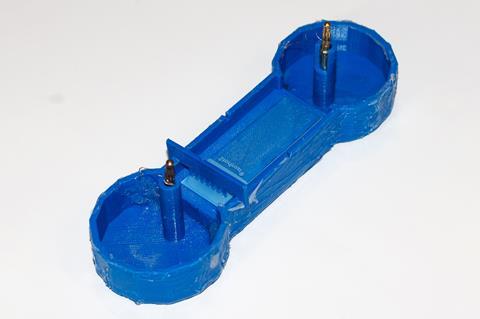
Earl Prinsloo at Rhodes University in South Africa notes that starting his own independent research group in the early 2010s was challenging. ‘Trying to raise funds for items of equipment is ridiculous. I mean there are a lot of hoops someone has to jump through,’ he says. This could include applying for grants or getting permission from a university department to purchase or install equipment, for example.
To overcome this issue, and spurred by his own interests, Prinsloo’s group decided to purchase a relatively inexpensive 3D printer. ‘From there it was the point of saying “let’s see what we can do”,’ Prinsloo says. The team started experimenting by printing gel combs, which create wells in electrophoresis gels. These typically cost around £80 for five, explains Prinsloo, adding that his team were able to print them at a cost of several pence. ‘Electrophoresis has always been the cornerstone technique for identification and analysis of isolated DNA, RNA and proteins,’ Prinsloo says. Yet, buying an electrophoresis gel tank can set a lab back up to 4000 rand (£185). For Prinsloo, designing and 3D printing his own version seemed like an obvious solution to overcome these costs.
‘You can buy a kilogram of material for 350 rand. The [printed] unit comes out at less than 50g once printed,’ explains Prinsloo, adding that this drastically reduces the cost of these systems. Equally, printing their own tanks means that the team aren’t stuck with ‘the constraints of the supplier,’ and can, for example, adjust the volumes or shape of their systems, making them bespoke to their experiments.
However, Prinsloo highlights that 3D printed objects are often not very watertight, meaning water can disrupt the layers during electrophoresis experiments. The team overcame this by coating the polylactic acid plastic used to print the tank with a silicone gel. Comparing their printed tanks to commercial versions, using an existing power supply as a control, the team found that their system was as waterproof and also led to better band separation in a shorter time.
Prinsloo soon began making multiple of these electrophoresis units to help the university’s teaching labs adapt to an increasing number of students. ‘We need to provide the students with sufficient laboratory experience but without limiting access to the actual items within a lab,’ he explains.
Repurposing the printer
Prinsloo and his lab are now looking at how to repurpose the 3D printer once it’s out of action. ‘We can take the motors and the electronics apart and build carrier systems so that we [can] build a programmable rocker [using] a raspberry pi [control board],’ he explains. ‘It’s again cost reduction from something that costs 2000 rand to just under 80 rand.’ ‘It doesn’t look as cool with some nice, rounded edges… but it’s functional,’ he adds.
‘A lot of the papers that we tend to read with low-cost scientific equipment get targeted at low-income countries,’ explains Prinsloo. ‘As I start speaking to a lot of colleagues at conferences in what wouldn’t be considered a low-income country… you start finding out that yes, they have similar problems.’ He adds that the printing plastic costs the same for everyone, making 3D printing an accessible approach for many labs.
‘[3D printing] was kind of something that’s just built upon the frugality of the lab initially,’ explains Prinsloo. ‘But then trying to work towards something that is functional, compatible and at the same time provides … teaching moments for the students as well.’
‘I think that buying things from suppliers serves a purpose,’ Prinsloo says. ‘But at times, and especially with budgetary restrictions globally, we actually need to now start looking at alternative approaches.’ ‘The running joke from the lab [now] is that you don’t actually finish a degree in my lab unless you’ve [printed] something. Whether it’s a shaker platform that goes into an incubator or even just a simple little magnetic stirrer,’ he says.


How researchers are producing high quality science at lower cost
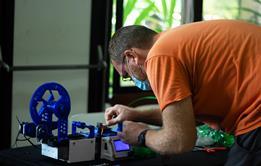
Group leaders are no longer just academics; they’re also accountants balancing an increasingly tight budget. In this collection, several scientists share creative ways that they’re saving money, without compromising the quality of their research.
- 1
 Currently
reading
3D printing can create bespoke lab equipment for a fraction of commercial cost
- 3
- 4






No comments yet