From all-around support to tailored recruitment, a University of Nottingham initiative offers a blueprint for improving neuro-inclusion in the technical workforce

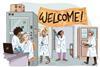
Group of people in a lab with a welcome sign above the door

Source: © Claudia Flandoli

The NEO programme offered part-time admin and technical roles to neurodivergent individuals who struggled to find or stay in work, providing training and support that enabled many participants to settle into long-term employment

It’s ‘a bit of a funny story, really’, says Elijah Carr about how he first came across the Neurodivergent Employment Opportunities (NEO) Now programme at the University of Nottingham, UK. Visiting his old special needs school for a reunion, his former science teacher suggested he should consider the new initiative, designed for neurodivergent people struggling to find or stay in work. ‘I was thinking it was just going to be a bit of a cleaning job’, Carr recalls. Two years later, having completed the programme and graduated with a BTEC, he is now in a permanent role as technician in analytical services at the university’s school of chemistry, working, at times, on machines ‘that cost more than [his] house.’

Rachel Van Krimpen started as director of equality, diversity, inclusion and people at the University of Nottingham’s faculty of science with a clear mandate: to focus on neurodiversity. Conversations about neurodivergence in higher education are gaining momentum, often focused on better accommodating students and existing employees. Yet only three in 10 autistic people in the UK are employed, despite three in four wanting to be.

With project manager Helena Sidgwick, coordinator Jules Bellingham, faculty operations director Dean Farrelly and head of technical services Martin Dellar, Van Krimpen put forward a quietly ambitious plan: NEO Now, a 10-month programme offering neurodivergent people paid, part-time positions in entry-level admin and technical roles at the faculty of science.

Three cohorts and 15 participants later, 73% of former ‘NEOs’ are now in long-term employment, the majority at the university. When one of them shared ‘I can finally excel as myself’ in a follow-up study, Van Krimpen recalls, ‘we were like: ‘Yes! That’s what we wanted from this.’

A matchmaking game

If leadership quickly agreed to the scheme, prospective managers worried about workload and their ability to supervise employees with additional needs. ‘A workshop can be a dangerous place, and I didn’t want to be responsible for something happening to somebody’, recalls Rich Wilson, senior technical specialist at Nottingham’s school of chemistry, stressing that he knew ‘literally nothing’ about neurodivergence at the time.

Aware they needed to create a ‘more knowledgeable and supportive culture’ for the whole of the faculty, Van Krimpen’s team designed a neuro-inclusion awareness workshop which was attended by over half of all employees. Future NEO teams then received additional training ahead of the placements.

A neuro-inclusive recruitment process was developed in parallel, prioritising meeting the person, understanding their skills and interests, and finding them the right placement. Convinced by the team Wilson agreed to a two-day trial with a keen 19-year-old. Immediately, ‘I was blown away with him’, he recalls. ‘He just fitted in straightaway’.

Step-by-step work

Woman watching another woman pour liquid from one flask into another

Source: © Claudia Flandoli

Tests for manual dexterity helped to match participants with placements that they would thrive in

Not every placement was a success at first. After the pilot group of three participants in 2023, trial placements and new requirements were introduced for the subsequent cohorts, including basic literacy, numeracy and computing skills, and, for those in technical roles, a certain level of manual dexterity.

Once in the right positions, however, many NEO participants thrived – particularly those in technical roles. ‘It matches with my interests, […] science and science experiments,’ says Carr about his work. ‘I don’t know if that’s because of my personality or the neurodivergence, but I like solving puzzles.’ Wilson’s team were impressed with their new colleague’s ‘natural flair’ for glassblowing and electronics, but above all, with his ‘ability to adapt and question’, Wilson says. ‘I think it’s one of the important skills that you need in the job that we do.’ Both Wilson and Carr’s manager, senior technical specialist Kevin Butler, took it slow with their new recruits at first, developing their skillset one step at the time. ‘You’ve got to build the relationship’, advises Wilson, who snatched a few minutes for a bit of a chat with his trainee as often as possible: ‘They’ve got to trust you.’ For Carr, who was just entering the workforce, this process of easing in was ‘the best part of the programme’.

Building in support

At the start of the placement, Bellingham regularly checked on participants and managers to address potential issues; it wasn’t long, however, before this need for tailored support dwindled and people asked her to come less often

‘From the management side, the biggest thing was [that] people were a bit anxious about doing it right’, adds Van Krimpen, especially if they needed to convey that expectations weren’t met. Bellingham would offer advice, model how to give feedback and when necessary, mediate conversations with NEO participants.

‘Carr’s needed very little […] adjustment to help him fit in with the team’, remarks Butler, praising Carr’s diligence and conscientiousness and noting that his colleagues try to give him a bit of space in their crowded shared office: ‘We all have […] our things that we do in certain ways, and we all make allowances for that, so why should it be any different for anyone else?’

Navigating office chit-chat and social dynamics proved challenging for certain participants. ‘You have to either put your effort into trying to put a face on for people, so they think you’re normal,’ explains Carr, ‘but at the same time, you have to kind of push it so you express yourself.’ When needed, Bellingham provided one-on-one support to clarify the unwritten expectations of a work environment: ‘We’ve moved away from just assuming that it’s obvious’, says Van Krimpen, ‘because why would you know that stuff if you’ve never worked in an office?’

Lasting impact

When the first NEO cohort launched, 5.9% of employees in the faculty declared a disability. A year later, the number had climbed to 8.4%, an increase Van Krimpen attributes to more inclusive recruitment and, importantly, existing employees feeling safer to disclose.

‘The benefits of [the initiative] weren’t just for those individuals from the NEO programme, but for other staff as well’, she says. Certain NEO managers, for instance, felt better equipped to support other neurodivergent employees, while Butler enjoyed the opportunity to ‘take a step back’ with his team and think: “Actually, just because we do it one way, is that the best way to do it?”’

Uncertain future

Group of people in a canteen

Source: © Claudia Flandoli

As well as practical skills, the NEO programme has also helped some participants grow more confident and comfortable in social situations

‘I would like to see the programme expand,’ says Carr, hoping other neurodivergent people can get the same opportunity to enter the workforce. Beyond building his career skills, he also credits the scheme for getting better at socialising. ‘A bit quiet’ at the start, he now regularly joins his colleagues for lunches and after-work meetups, feeling he is ‘a part of the team’.

Wilson saw his recruit ‘just flourish’, growing in confidence and enjoyment, and ultimately transitioning to a permanent, full-time contract. The young man struggled with this change in work pattern, however, and decided to step away a few months in. At the time, his mum shared with Van Krimpen that ‘ the fact people had believed in him to that extent was really transformational’.

When the programme was paused in 2025, Van Krimpen saw a chance to scale it up. She submitted an invited proposal expanding the programme at six universities and multiple industry partners – only for the grant body to then freeze the fund.

‘It’s a really difficult context to be advocating for these programmes,’ she acknowledges, given the widespread financial crisis that plagues higher education. In early May, nearly 2700 employees at the University of Nottingham were notified they were at risk of redundancy, including many in the chemistry department.

Still, Van Krimpen chooses pragmatic optimism. The technical workforce is ageing, and securing a diverse crop of new technicians is urgently needed. ‘This is a relatively low budget approach to making that investment,’ she says, ‘and it has that long-term payoff in terms of committed, skilled, internally developed colleagues moving into the sector and making a significant contribution. So I think the value proposition is there.’