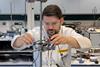
Robert Crapnell at Manchester Metropolitan University manages two research labs and was awarded this year’s RSC Technical Excellence Prize
Career progression in a technical role is challenging, says Robert Crapnell at Manchester Metropolitan University in the UK. Taking a more academic route or shifting to industry are the main routes for those wanting to work with a particular instrument or use a specific technical skill set, he adds.
‘It’s a reason why you lose talent, and I think it’s a serial problem at a lot of universities,’ he says. ‘Suddenly all the skills are lost within a certain lab and it can take a really long time to build those skills back up.’ He adds that group leaders may have the academic knowledge of how certain techniques work but may not be as comfortable with the physical aspects of experiments.

In 2024, Crapnell began managing the university’s electrochemistry and polymer research labs, moving on to the university’s new technician pathway at the end of last year. ‘It’s essentially a way to keep talent at the university within the technical services,’ he says.
Crapnell describes his role as having several pillars. One strand involves him writing book chapters and manuscripts, and preparing for academic conferences. ‘I’m [also] the technical advisor to a lot of the academics in the two labs,’ he says, adding that he helps write the technical sections for grant proposals to buy new equipment. Additionally, he manages the labs’ social media accounts, trains new people entering the lab and fosters internal, national and international collaborations with other research groups.
A variety to visualise
Crapnell found his love for electrochemistry as an undergraduate student at the University of Hull, UK. ‘I could visualise what was happening at an electrode surface and … the electron transfer processes,’ he says. ‘It was just something that clicked in my brain quite quickly.’ He has since explored many of electrochemistry’s applications – from fuel cells to biosensing to detecting scaling ions in water – and such variety is another reason why he enjoys working in the field.
After completing his PhD in 2018, Crapnell started a postdoc position at Manchester Metropolitan. His supervisor moving universities 18 months later caused him to switch groups within the department – a decision he made to stay closer to his family. This saw him learning how to create spools of 3D printing plastic – known as filaments – from waste polylactic acid and polypropylene and turning these materials into into feedstock for electrodes.

‘Buying classical electrodes is relatively expensive still,’ he says, adding that 3D printing electrodes can reduce costs from several hundreds of pounds to just a few pence. Changing the electrodes or the plastic materials used to 3D print is also easier if the team makes them in-house. For example, Crapnell now helps make new thermoplastic composites by adding conductive fillers – such as graphene, carbon nanotubes and carbon black – which makes the non-conductive plastic suitable for electronics and electrochemistry.
‘My office is connected to the lab … so I’m always around to help if projects are getting stuck,’ he says. His role also includes ordering chemicals, maintaining equipment and making sure that ‘everybody is respected in the labs’.
Training, growth and making
He particularly enjoys directly working with researchers. ‘I see them grow on a daily basis … and then when they leave, it’s that excitement of seeing what they can produce using the techniques that we’ve developed and embedded in the lab,’ he says. Teaching students how to use equipment in small groups or one-to-one is also more comfortable for Crapnell than giving lectures or classes to larger cohorts in the university.
Yet, Crapnell stresses that ‘the constant revolving door of new researchers coming into the lab is quite a challenge’. There are often 15 to 25 researchers in the lab at any one time, making it difficult to make sure that everyone has had the correct training.
Crapnell was awarded this year’s Royal Society of Chemistry Technical Excellence Prize for his work on additive manufacturing and demonstrating leadership across Manchester Metropolitan’s chemistry department. ‘It’s a nice validation that I’ve managed the transition well – away from being a sole researcher to somebody that can lead research for a whole lab,’ he says.
Outside the lab, Crapnell enjoys using his 3D-printing skills to make things for his children, including adaptations for his son’s toy cars and name badges for party bags. ‘By learning that 3D printing skill set, or making filaments, I could then bundle it all together at a later date into a new role,’ he says. ‘Learn as many things as you can during every stage of what you’re doing because you never know when the new skill set is going to become an advantage later on.’
‘I’m getting that joy of being in and around research every day, seeing the research [and] helping contribute to it. But I’m also getting the joys of participating in it myself,’ Crapnell says. ‘I said to one of my colleagues the other day: “If I could have written a job description for a role [that I would want], I would have just written my job.’


No comments yet