
Mason Wakley tells the full story of how Henri Kagan and Kensō Soai’s work on non-linear effects and asymmetric autocatalysis won the 2026 Nobel prize in chemistry
- Henri Kagan and Kensō Soai were awarded the 2026 Nobel prize in chemistry for discoveries that showed how tiny imbalances between molecular mirror images (enantiomers) can be amplified into a single dominant form, helping explain the origin of biological homochirality.
- Kagan’s pioneering work on non-linear effects in asymmetric catalysis demonstrated that the relationship between catalyst and product chirality is not always linear, providing a framework for understanding how small enantiomeric imbalances can be enhanced during chemical reactions.
- Soai’s discovery of the Soai reaction, the first known example of asymmetric autocatalysis, showed that a reaction product can catalyse its own formation while dramatically amplifying chirality, offering the strongest experimental support for theoretical models of how homochirality could emerge from near-racemic mixtures.
- Beyond its fundamental importance, the research has influenced practical asymmetric synthesis, including more efficient routes to pharmaceutical compounds, while continuing to drive debate about reaction mechanisms and the chemical origins of life.
This summary was generated by AI and checked by a human editor
‘The Nobel Prize in Chemistry stolen from Henri Kagan’ read the headline of a 2001 article in the French newspaper Le Monde. Didier Astruc, an organic chemist at the University of Bordeaux, France, wrote the article after the Nobel committee announced that it was awarding that year’s chemistry prize to William Knowles, Barry Sharpless and Ryōji Noyori for their work in asymmetric catalysis. Astruc argued that not recognising Kagan, who also helped establish the field, harmed the French chemist’s reputation. In his view, Kagan was the true pioneer of asymmetric catalysis – reactions that preferentially lead to one enantiomer over the other.
Spurred by Astruc’s comment, France’s science minister Roger-Gérard Schwartzenberg wrote to the director of the Nobel Foundation in protest. As Nature noted at the time, this was an ‘unusual move’ for a minister. Several other scientists backed Astruc’s view, while others described the minister’s protest as ‘grotesque’.
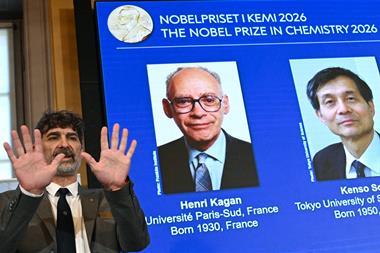
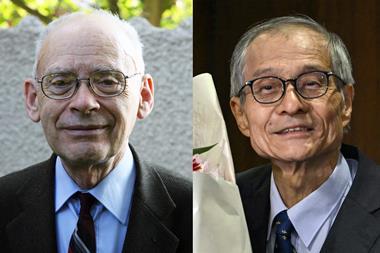
After a 25 year wait, Kagan and Japanese chemist Kensō Soai have now received the Nobel prize in chemistry for their work on non-linear effects and autocatalysis in asymmetric reactions. Astruc told Chemistry World that the announcement is an ‘immense release’ and ‘follows years of frustration of our community after the absence of this distinction in 2001’.
This year’s prize should make people recognise the importance of the chirality of molecules
The combined work of Kagan and Soai demonstrates that it is possible to convert a near-equal mixture of two mirror-imaged molecules – or enantiomers – into only one form. Crucially, Soai discovered a reaction where the product was also the catalyst. As well as shifting how organic chemists think about chiral molecules and reactions, their discoveries show that there is a plausible mechanism by which life’s chemistry could have become homochiral.
Speaking at the announcement of the prize, Soai says that most people take the fixed handedness of life’s molecules for granted. ‘This year’s prize should make people recognise the importance of the chirality of molecules,’ he said.
Kagan shows that chirality can take a non-linear path
In 1953, Charles Frank – a theoretical physicist at the University of Bristol in the UK – created a mathematical model showing how homochirality could arise from a near-equal mixture of enantiomers. At its heart, his model relied on a chemical that catalyses its own production in an enantioselective reaction. He also proposed that forming one enantiomer should inhibit the creation of the other, otherwise known as mutual antagonism.
At the time, there were a few examples of autocatalytic reactions, including acetic acid catalysing the hydrolysis of ethyl acetate into the acid and ethanol. However, it wasn’t until the 1970s and 80s that chemists like Sharpless would develop lab-based asymmetric reactions. Equally, finding reactions that were both autocatalytic and asymmetric was key to proving Frank’s theory.
Researchers had previously shown that varying the ratio of enantiomers in a reaction mixture changed the makeup of the products. The prevailing idea was that increasing the proportion of one isomer would lead to more of the product with the same handedness. For simple systems, this linear relationship holds true, as such reactions typically involve a metal catalyst binding to only one substrate. This then made it hard for chemists to imagine a scenario where a racemic mixture could become enantiomerically pure – a possible route to explain how life has handedness.
Yet Kagan wondered whether the linear relationship worked for all reactions, particularly those involving metal catalysts binding to two or more substrates. So he and his team began investigating such reactions. This included two titanium-catalysed oxidations – a Sharpless oxidation of the monoterpenoid geraniol and oxidation of methyl p-tolyl sulfide – as well as a proline-catalysed Hajos–Parrish reaction, which generates a cis-ketol from a triketone.
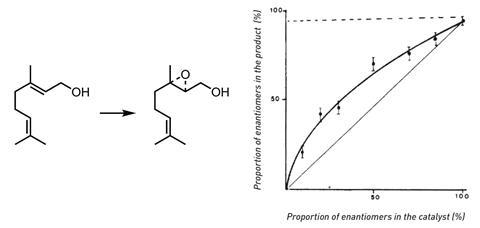
By varying the ratio of one enantiomer to the other – also known as enantiomeric excess – Kagan found that these reactions bucked the linear trend. In the Sharpless oxidation, the enantiomeric excess of the products was more than that of the reactants, which Kagan dubbed a positive non-linear effect. For the other two reactions, Kagan observed the opposite outcome.
There is no free lunch
To explain the results, Kagan and his team proposed that the two substrates were binding to the metal centre in three possible ways: two homochiral species that had two R or two S substrates, or a mixed heterochiral RS form. The homochiral RR and SS catalysts generate the R and S enantiomer respectively, while the heterochiral species produces either in the same quantity. Depending on the relative stability of the dimers, this can artificially alter the ratio of either enantiomer in the final product.
For example, in a reaction where there is more S than R isomer, most of the R molecules will be part of the RS dimer. If then the heterochiral catalyst is stable, and hence unreactive, this will reduce the amount of R-handed product relative to the S enantiomer, leading to a positive non-linear effect.
‘There is no free lunch’, however, as Scott Denmark at the University of Illinois in the US points out. ‘You also lower the rate because the effective concentration of the catalytically active SS is lower’. While non-linear effects allow chemists to shift the ratio of enantiomers in a reaction, Denmark adds that it can also act as a ‘mechanistic probe’ to understand the type of catalytic species in a reaction. This is thanks to work from Donna Blackmond at Scripps Research in California, US, who linked the reaction rate to the enantiomeric excess of the catalyst. She also developed other mathematic models related to non-linear effects.
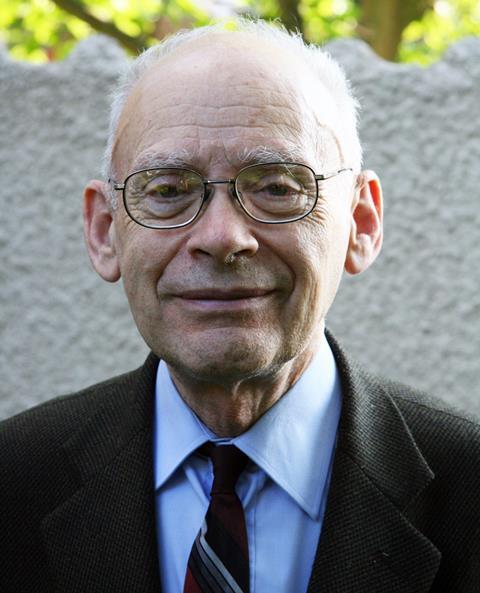
Christian Girard, a former post-doc in Kagan’s lab and now at the Ecole Nationale Supérieure de Chimie de Paris in France, told Chemistry World in a webinar two days after the announcement that ‘people said that Kagan was thinking outside of the box’. ‘But he was not thinking outside the box – there was no box,’ say Girard. ‘He was really thinking outside the normal space of organic chemistry’.
Prior to working in Kagan’s lab, Girard had done a PhD with Stephen Hanessian at the Université de Montréal in Canada, where he was working on the use of samarium iodide to reduce carbohydrates. He said that Kagan had previously suggested a simple method to the compound and so applied to his group for a research position. Samarium iodide is now known as Kagan’s reagent.
Girard initially felt intimidated by ‘the idea of working with someone so famous in asymmetric synthesis’. But, when Girard visited the lab, he said that Kagan was the complete opposite of what he thought: ‘I found him smiling, easy-going [and] with sparkling eyes,’ he says.
The Soai reaction demonstrates asymmetric autocatalysis
By building on the work of Kagan, chemists soon began exploring whether other reactions followed a non-linear path. A couple years after Kagan’s work, researchers in Japan found that the addition of diethylzinc to benzaldehyde, catalysed by a sterically constrained amino alcohol, led to a significant positive non-linear effect. One example of this type of reaction boosted the enantiomeric excess of the products to 98%.
Soai was one of the researchers also exploring these reactions and, in 1990, he discovered a unique case. He found that the alkylation of pyridine-3-carbaldehyde with diisopropylzinc, along with the alcohol product as the catalyst, was autocatalytic – the first example of asymmetric autocatalysis. However, the enantiomeric excess of the products was lower than that of the catalyst.
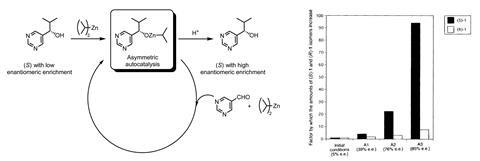
So, over the next few years, Soai sought out similar autocatalytic reactions that would instead amplify the enantiomeric excess of the products. And in 1995, his search was over. By switching out the initial pyridine substrate for pyrimidine-5-carbaldehye, Soai was able to boost the enantiomeric excess of the products from 2% to 55%. After several rounds of more aldehyde substrate and catalyst, he pushed the enantiomeric excess further to 90%.
Chemist Kurt Mislow pointed out that a racemic mixture is never exactly 50:50, as there will be small fluctuations over time that change the ratio. ‘Soai found a mechanism for amplifying that tiny imbalance at the molecular level to make it macroscopically detectable,’ Denmark told Chemistry World during the recent webinar. He adds that this reaction – which now bears Soai’s name – is the ‘only demonstration’ of a reaction that fulfils Frank’s conditions for how chemical homochirality could occur.
Irena Stará at the Czech Academy of Sciences in Prague told Chemistry World that she first met Soai by chance in 2008 at a chirality conference, which then sparked a long-standing scientific connection between the two. ‘I asked him how from all the possible systems he chose this specific one which is so unusual,’ she says. ‘He only smiled rather mysteriously and I understood that I [would] never [get] the secret out of him’.
Over the years since Soai’s discovery, chemists have investigated how the structure of the substrate and dialkylzinc reagents influenced the Soai reaction. For example, Soai used an alkynyl derivate of a pyrimidine carbaldehyde. In one experiment, he started with an enantiomeric excess of the substrate of just 0.00005%. Yet, after three runs with more reactants, the final products had an enantiomeric excess of over 99.5%. This is around a 630,000-fold amplification of one enantiomer.
Denmark notes that the Soai reaction is also stochastic, meaning that the reaction can still amplify or decrease the ratio of enantiomeric products, without necessarily needing a chiral catalyst. Daniel Singelton at Texas A&M University in the US calculated that to sway the reaction there needs to be only around 60,000 molecules of one chiral enantiomer catalyst in a reaction size of 1ml – a concentration of just 10–16M.
Researchers have since shown that circular polarised light, organic crystals and isotopic changes in the substrate can also steer the balance of enantiomers. Yet, as Soai noted in his 1995 paper, ‘the detailed mechanism of the autocatalytic steps in our reaction, and in particular, whether an inhibitory mechanism is present, remains to be clarified’.
Decoding the Soai reaction’s mechanism
‘We want to understand the mechanism [of the Soai reaction] because if we want to design new autocatalytic reactions, we have to understand it,’ says chemist Oliver Trapp at LMU Munich in Germany.
In the case of the Soai reaction, Denmark explains that the zinc alkoxide monomer is the active catalyst. ‘Now what matters is the stability of the heterochiral dimer and the homochiral dimer,’ he says. If the homochiral catalyst dissociates more readily, this will lead to more of a given enantiomer. Therefore, understanding the structures and stability of these catalysts has been a goal for researchers.
Blackmond first modelled the kinetics of the Soai reaction in the early 2000s. Her analysis showed a catalytic transition state that involved four molecules bound together, or a tetramer. Computational calculations later suggested that this tetramer had a square–macrocycle–square (SMS) structure, made of two Zn2O2 square dimers connected by two pyrimidial rings.
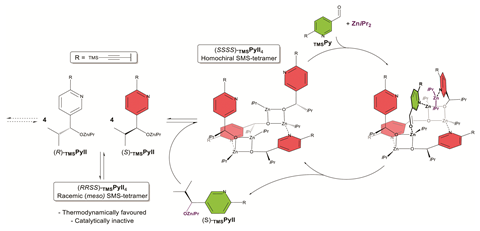
Denmark says NMR experiments has allowed him to observe such a tetramer structure in solution. ‘The Cambridge Crystallographic Database is full of zinc alkoxide structures, and they’re almost all tetramers [as] they’re very stable,’ says Denmark.
He explains that during the Soai reaction, the aldehyde substrate and diisopropylzinc interact with unsaturated zinc ions in the catalytic species. In the homochiral catalyst, the two squares of the SMS catalyst face each other, meaning that substrates can react. However, steric interactions in the heterochiral catalyst prevent the substrates from coming close enough. According to Denmark, this is ‘the only molecular rationalisation of how the Soai reaction works’, which explains why different dialkylzincs or aldehyde substrates react differently.
Meanwhile Trapp’s team is proposing a different mechanism. By using in-situ high-resolution mass spectrometry under inert conditions, the researchers have been able to detect the various intermediates of the Soai reaction. One of the key structures in the reaction, Trapp suggests, is a chiral zinc hemiacetalate complex.
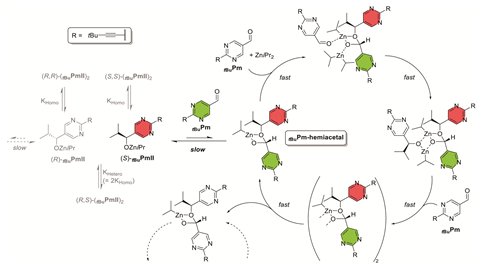
In Trapp’s mechanism, the alcohol ligand first reacts with dialkylzinc to form an alkoxide, before slowly reacting with an aldehyde substrate to produce the hemiacetalate. This structure then catalyses the reaction between another aldehyde and dialkylzinc, generating another hemiacetal in the process. Once formed, the hemiacetal can dissociate into the zinc alkoxide product and aldehyde, or enter the catalytic cycle once again to further amplify the amount of a given isomer.
Trapp notes that the mechanism backs up the experimental observation that the Soai reaction works better at lower temperatures, as the formation of the hemiacetal is disfavoured at higher temperatures. Equally, he says that the mechanism means that they can calculate the enantioselectivity in each amplification step. It also rationalises why molecules with pyrimidine groups work better in the Soai reaction than substrates with pyridine rings, explains Trapp: pyrimidine rings are more electron-withdrawing, which stabilises the hemiacetal intermediate.
The contrasting mechanisms from Denmark and Trapp highlight that figuring out what’s going on at the molecular level in the Soai reaction remains contentious and is still an active area of research.
From laboratory curiosity to antiretroviral drug synthesis
While much of the work since Kagan and Soai’s discoveries has focused on understanding the mechanism behind their reactions, chemists have started to find ways of applying their work.
For example, Erick Carreira at ETH Zürich in Switzerland developed an autocatalytic asymmetric synthesis for a key ingredient en route to the antiretroviral drug efavirenz. The Swiss pharmaceutical research company Lonza AG approached Carriera’s group in the late 2000s to help design a more efficient – and cheaper – synthesis for the drug, which was set to come off patent.
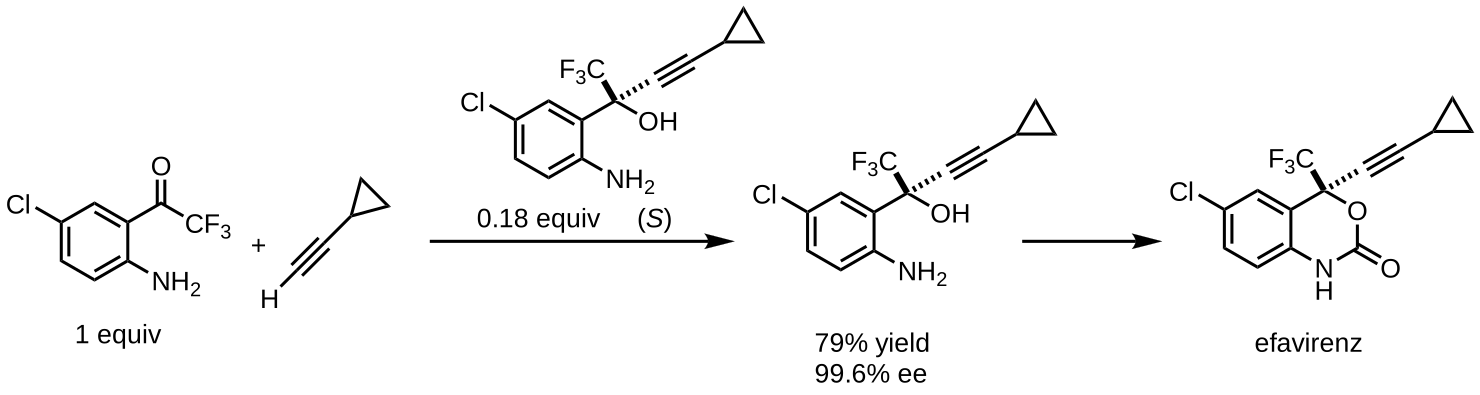
The existing route originally developed by Merck combined a metalated acetylene and a ketone, along with diethylzinc and a chiral alcohol catalyst, to produce a key alcohol intermediate. While the reaction had a 95% yield and led to near-exclusive formation of the S isomer, Carreira notes that it relied on using stochiometric equivalents of all reagents, which made the reaction expensive.
Inspired by the ideas of Kagan and Soai, Carriera’s team decided to add the chiral alcohol product to the mixture. Doing so further pushed the ratio of enantiomers in favour of the S isomer and cut the amounts of other reagents needed by up to 75%. Carriera describes that using this type of reaction led to a ‘meaner, leaner, faster, better, more economically viable process’. At the time, the team also noted that crafting a catalytic, enantioselective process that paralleled Merck’s existing strategy made it easier and cheaper to register the drug’s synthesis.
Carriera’s work is one of the only examples where industry has used a version of the Soai reaction. However, Trapp thinks that chemists will start trying to convert existing asymmetric reactions into autocatalytic versions. ‘This is something that is so far somehow missing in the field,’ he says.
What it tells us about the origins of life
The announcement of this year’s chemistry Nobel prize prompted discussion about its relevance to origins of life research. As Singleton explains, the biological origin of homochirality and molecular self-replication ‘are two central stumbling blocks for any theory of the origin of life’.
Somewhere along the journey of life evolving from simple molecules to whole organisms, its chemistry became homochiral. The amino acids and sugars that are the building blocks of life only exist in nature in S and R configurations, respectively. Most DNA strands have a right-handed helical chirality (although some left-handed Z-DNA has been observed in nature).
Soai demonstrated that chemistry’s underlying principles have no conflict with the simple generation of self-reproducing chirality
‘The Soai reaction demonstrated clearly and for the first time that both of these bottlenecks can be overcome readily in a single ordinary reaction,’ says Singleton. ‘If, on a prebiotic Earth, appropriate achiral precursors were continually generated, then asymmetric autocatalysis could intrinsically provide both asymmetric amplification and maintenance of optical activity [chirality] ,’ he says. ‘After that, getting to life “just” involves adding efficiency-gaining steps to a cycle of asymmetric autocatalysis.’
The Soai reaction itself is not what took place on prebiotic earth, however; the reaction is sensitive to water, which is of course life’s medium. ‘But that is irrelevant,’ says Singelton. ‘Soai demonstrated that chemistry’s underlying principles have no conflict with the simple generation of self-reproducing chirality,’ he says. ‘No cute magic-like explanation is needed or even helpful.’
Carreira thinks that ‘chemistry often gets accused … of not dealing with big problems like physics and biology [do]’. ‘I think that’s an unfair criticism,’ he says. The ‘unique question that Soai and Kagan put their finger on is one of those big-picture questions as it relates to a very fundamental process of how optical activity arose on a prebiotic Earth,’ he adds.
It’s nice to see the chemistry Nobel go to fundamental science
While the work of Kagan and Soai has spurred research into the origins of life and its homochirality, it is unlikely that scientists will come to a definitive conclusion as to what happened on Earth around four billion years ago. But that doesn’t make their work any less important for changing how chemists think about molecular chirality. ‘What I found very rewarding is that this Nobel – and there have been others – was awarded for something very fundamental, that’s really cool science and so that’s refreshing,’ says Carriera.
This year’s Nobel prize in physics also went to fundamental research, for Francis Halzen’s work detecting high-energy cosmic neutrinos at the IceCube Neutrino Observatory in Antarctica. Denmark points out that while there has been some criticism about this year’s chemistry prize not having societal impact, he doesn’t ‘see the physicists worrying about a Nobel prize that is for the standard model’ – a theory that explains how the buildings blocks of the Universe interact.
Carriera likens this year’s chemistry prize to that of George Olah, whose studies of carbocations using NMR won him the Nobel prize in chemistry in 1994. ‘Is there anybody that does carbocation research today?’ asks Carriera. ‘Probably a handful of people. [But] you could argue, thanks to that work, Benjamin List can do asymmetric Brønsted acid catalysis, with carbocations as intermediates,’ he says. List, along with David MacMillan, won the 2021 Nobel prize in chemistry for establishing the field of organocatalysis. Carriera says that Olah’s work ‘set the stage for God knows what many years later’.
‘Sometimes [the Nobel prize] needs to go to the sexy thing that just everyone’s talking about, but it’s nice to see it go to fundamental science as well,’ he adds.
Mason Wakley is a science correspondent at Chemistry World






No comments yet