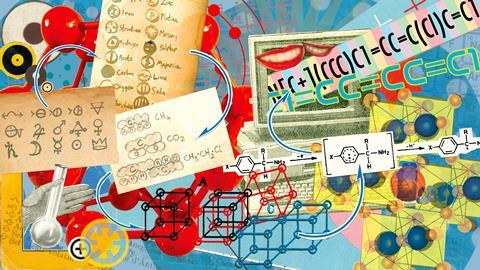

From Dalton’s circles to Lewis structures and curly arrows, the symbols chemists use to describe matter have always been contested. As artificial intelligence transforms how chemical data is stored and processed, the question of how best to represent chemistry is more pressing than ever.
- Chemical notation has evolved alongside chemistry itself, progressing from alchemical symbols and early affinity tables through Dalton’s atomic symbols, Berzelius’s chemical formulae, structural formulae and Lewis bonding theory to create the framework chemists use today.
- The development of notation has actively shaped scientific thinking, not merely recorded it. Representations such as structural formulae, valency diagrams and bonding models influenced how chemists interpreted reactions, molecules and the nature of chemical bonds.
- Modern chemical communication relies on multiple complementary representations, with different branches of chemistry using different depictions of the same substance depending on the question being addressed. This flexibility is useful but can also create misunderstandings, particularly in education and interdisciplinary work.
- The growing importance of digital chemistry and AI is exposing limitations in current notation systems. Variations in how chemical information is represented make data extraction and machine interpretation difficult, prompting calls for better standardisation alongside wider sharing of raw experimental data to support future AI-driven discovery.
- This summary was generated by AI and checked by a human editor
Keeping a record of experiments and results is a key part of the scientific method – even the secretive alchemists had their own cryptic language. But while alchemical symbols were used to codify and conceal their practitioner’s findings, chemistry, which emerged from this protoscience during the 17th century, was perceived as more of a collective endeavour. This new community needed their own universal language to share ideas and theories – a special chemical notation – but what to show and how to show it was a controversial issue.
Competing representations battled it out over the intervening centuries, finally culminating in the systematic notation we recognise today. Yet chemistry continues to evolve, and with it the language and symbolism to explain these new concepts, making the question of effective notation more relevant than ever.
A brief history of chemical notation
‘Notation really only started when people began to distinguish specific chemical substances in a technical sense,’ says Hasok Chang, a historian and philosopher of science at the University of Cambridge in the UK. ‘These early chemists had a sense that they were dealing with ideas that ordinary people just didn’t talk about.’
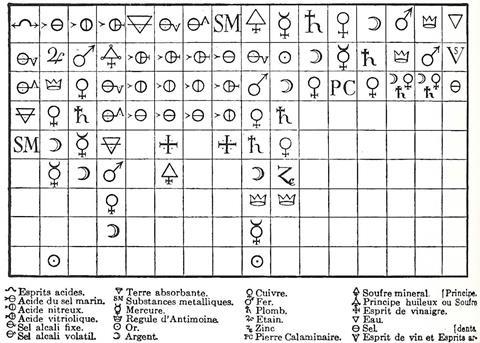
Perhaps the first example detailing this new language was French chemist Étienne François Geoffroy’s Table des Rapports (affinity table), published in 1718. This grid-like arrangement of symbols showed the relation between different groups of substances – acid spirits, alkali salts, metal substances and absorbent earth – using the position of each to indicate the displacement behaviour of various combinations. ‘The columns are codifications of all the experiments and observations they had made, so it’s the need of convenient scientific thinking, as well as a shorthand,’ explains Chang.
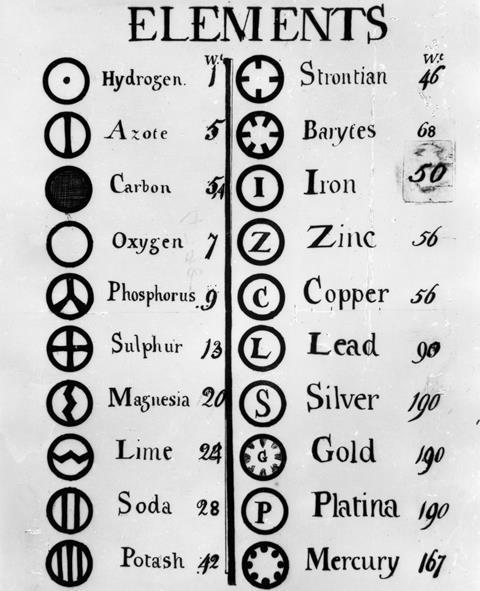
By the beginning of the 19th century, the concept of distinct chemical elements was firmly established and in 1808, John Dalton proposed his controversial atomic theory, suggesting all matter was composed of varying combinations of atoms. His famous list of chemical symbols represented each element as a circle containing an individual identifier, but disagreement regarding what constituted an element and whether they really existed as collections of atoms at all meant many contemporary scientists were unwilling to use this new notation.
Swedish chemist Jöns Jacob Berzelius was a strong proponent of Dalton’s ideas, however, and built upon his atomic concepts to propose the system of chemical symbols and formulae we still use today. ‘These little bits of formula embodied his whole theory about how chemical reactions worked,’ explains Chang. ‘The way you write ideas down has real biases built into them, so Berzelius’s formulas were really very good at smuggling his theories into the community.’ Consequently, Berzelius’s ideas – notably his electrostatic explanation for the formation of compounds – remained dominant for much of the early 19th century.
The emergence of organic chemistry as a distinct subfield in the 1830s marked the beginning of a new direction. Chemists were faced by a confusing jungle of substances, all similar in constitution but subtly different in properties. In 1850 Alexander Williamson proposed ‘type theory’ as a means to categorise these myriad chemicals. Substances were classified according to a central atom (for example, compounds containing oxygen were water-type) and the hydrogen atoms either side could then be replaced to make relatives of this parent molecule, denoted by a large curvy bracket. ‘The bracket was just an idea of chemical bonding and nobody was taking it literally in the physical sense,’ says Chang. ‘But then, something interesting happens: they start doing experiments on the basis of this idea, namely substitution reactions.’
From croquet balls to structural formulae
In turn, chemists quickly developed a more convenient notation to describe and explain these results: German chemist August Hoffman famously used croquet balls connected by wooden sticks to illustrate the replacement of different groups around a carbon centre during his lectures at the Royal College of Chemistry in London. But these sticks and brackets, first adopted for convenience, soon left chemists thinking about the physical reality of what connected the atoms in organic compounds.
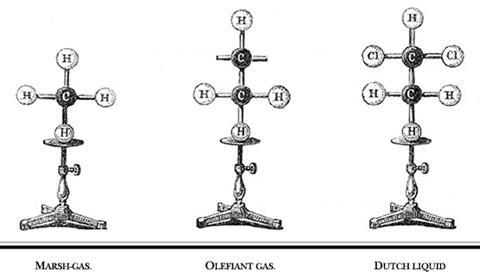
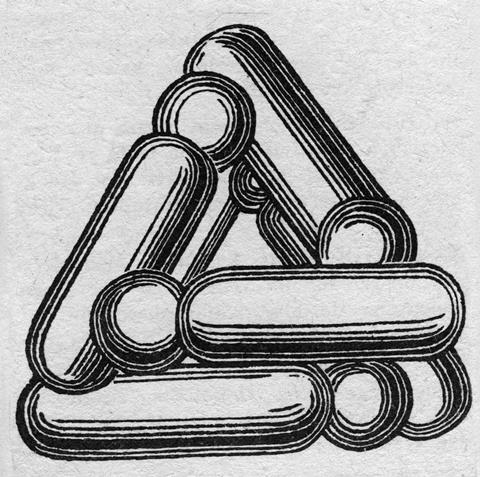
It was around this time that chemists were first beginning to agree on the concept of valency. Initially proposed in 1852, by 1857 August Kekulé had extended the idea to assign a fixed valence number to each individual element. The following year he published sausage diagrams to represent structural formulae using these valencies, with the sausages neatly stacking when the formula was correct. These diagrams were only ever intended as an abstract representation, says Chang: Kekulé meant them to illustrate the concept of valency rather than represent the connectivity or structure of the wider molecule.
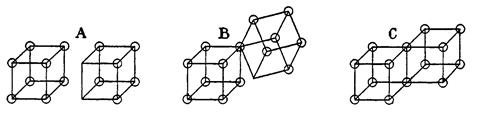
The true nature of the linkages between atoms remained a mystery until the beginning of the 20th century, the recent discovery of electrons having provided a new potential mechanism for matter to interact. Gilbert Lewis was an early pioneer in this field, informally proposing the cubical atom model to explain bonding via electrons as early as 1902, over 10 years before Bohr’s model of the atom introduced the concept of electron shells.
Just a few years later, he reported his seminal theory of electron pair bonding and the concept of Lewis acid–base chemistry was born. Electron pairs were represented as a colon, with those shared between adjacent atoms constituting a chemical bond. Over the next 20 years, the colons were gradually replaced with lines for convenience, forming the fundamental basis of how we continue to illustrate organic chemistry today.
Iupac and standardising the system
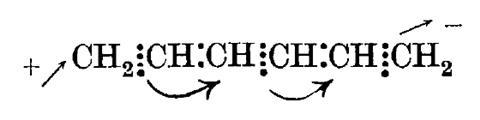
But that’s not the end of the story. As chemistry advanced in the intervening years, its notation likewise evolved to reflect the more nuanced understanding of matter. Robert Robinson proposed curly arrows to denote the movement of electrons in organic mechanisms during the 1920s, and a flurry of stereochemical projections soon after helped chemists begin to represent the 3D structures of molecules. The advent of new chemical techniques provided a further window into this molecular world, and emerging fields like protein and polymer chemistry soon developed their own notations too.
Today this ongoing evolution is overseen by the International Union of Pure and Applied Chemistry (Iupac), the global body responsible for standardising communication across the field. However, for most of chemistry’s history, the scientific discourse relied on informal consensus, creating quite the jumble of ideas throughout the chemical literature.
Perhaps the first attempt to address this confusing mix was the Karlsruhe Congress of 1858, when chemists from across Europe met in an effort to agree upon a single set of atomic weights and molecular formulae. Although no formal consensus was reached within the meeting itself, a pamphlet distributed by Italian chemist Stanislao Cannizzaro soon after became the informal standard, setting the stage for the construction of the periodic table the following decade and the subsequent more systematic approach to theory and notation.
Iupac itself was founded in 1919 by chemists from academia and industry, with the goal of introducing international standardisation across the whole breadth of the subject to facilitate discourse across borders and disciplines. Today they are the curators of chemical communication, providing guidance on everything from compound names to pictorial representations of new concepts and standardised values for physical constants. The ongoing exchange with the chemical community enables Iupac to adapt and expand the chemical notation to meet the subject’s ever-changing needs, with fresh projects and new guidance published on a rolling basis.
How do you draw benzene?
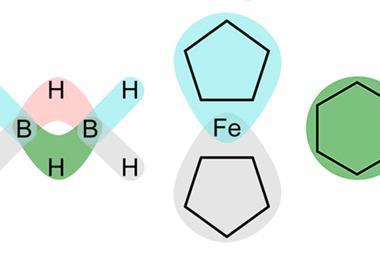
The ever-deepening understanding of fundamental concepts such as bonding creates its own problems in how to effectively convey this information. Part of the difficulty lies in the fact that chemistry is at once very visual and yet simultaneously entirely abstract: so much is understood and inferred, rather than seen with the eyes, making pictorial representations an incomplete, and often biased, version of the reality. ‘Chemists are experts at using completely inconsistent theories and representations at the same time to get a useful result,’ says Jeremy Frey, a physical and digital chemist at the University of Southampton in the UK and current president of the physical and biophysical chemistry division at Iupac. ‘We will simultaneously describe a molecule in multiple ways which cannot possibly be consistent at the same time, but which at different parts of the chemical process are important.’
Each of these representations are correct and they convey the same chemical entity, but with a different back story
An obvious example of this confusing phenomenon is benzene. Organic chemists are principally concerned with the movement of electrons and therefore represent the structure in the manner most convenient for mechanistic arrows: alternating double and single bonds. Conversely, physical chemists have little interest in these reactions and instead present benzene as a circle within a hexagon to convey the delocalised nature of the electrons. Meanwhile, computational studies often find an orbital depiction most appropriate for their analyses. ‘Each of these representations are correct and they convey the same chemical entity, but with a different back story to different communities,’ says Edwin Constable, a supramolecular and materials chemist at the University of Basel in Switzerland and current president of the chemical nomenclature and structure representation division at Iupac. ‘The exact meaning you extract from these symbols depends on the question you’re asking.’
This is a problem which appears to be unique to chemistry, perhaps in part due to the sheer range of contexts the subject handles, notes Frey: the variation in scale, timeline and conditions is simply too great for any single system to address alone. ‘On either side of us we’ve got physics, which is characterised by precision, and biology, which embraces and thrives on its lack of precision,’ says Constable. ‘We as chemists have been conditioned by the atomistic view of chemistry and we’re starting to realise that it’s not enough – it might describe components, but it doesn’t describe their mutual interactions and increasingly, chemistry is getting to a level of complexity where that detail is needed.’
How do we deal with that multipolar world where it is entirely reasonable to describe a single entity in two different ways?
Of course, these alternate illustrations are a practical means for different fields to approach their respective problems. But the assumptions embedded within each of these representations risk blinding chemists to other possibilities and restricting thinking according to a single interpretation. This is particularly a problem in teaching, Frey adds, where students can latch on to a specific idea implied by the standard notation without realising it’s an approximation of reality.
This flexible approach to representation also creates serious problems as more and more chemical information becomes digitised. ‘When you start to digitise chemical information, you discover you can’t actually convert the data effectively until you define the concepts properly,’ explains Frey. ‘How do we deal with that multipolar world where it is entirely reasonable to describe a single entity in two different ways? We’re going to have to work out how to label chemical information in such a way that the systems can cope and I don’t think we have the answers to that yet.’
The AI data challenge
Ultimately, effective digitisation will be essential for expanding the application of AI in chemistry and not simply a question of what is machine-readable, although a significant part of the challenge is ensuring that this pictorial information is accessible to AI models.
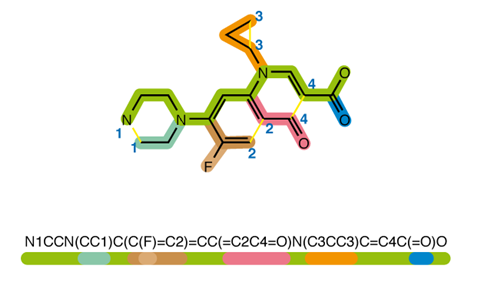
A lot of the data in papers are held in plots, tables and reaction schemes, with seemingly every journal presenting this collective information according to a subtly different set of conventions. ‘People have been trying to address this varied data presentation with different kinds of specialised models trained to extract, for instance Smiles , from images, structures and their associated legends,’ explains Kevin Jablonka, a digital chemist at Friedrich Schiller University Jena in Germany. Smiles – the simplified molecular input line entry system – is a way to encode chemical structures using simple letters and numbers. ‘However, this [conversion] doesn’t work reliably for all the flexible ways chemists in different subfields record information. We can probably do it for one journal’s articles, but not the full breadth of the literature.’
Even within a single set of conventions, there is often still room for significant variability: a phenyl group in an organic molecule could appear as a hexagon with either a circle or alternating double and single bonds, or a simple abbreviation such as Ph, Ar, or even just R. Each is an entirely reasonable way to denote this structural unit, yet accounting for these possibilities must be embedded within the AI model and extrapolating the same challenge across all of chemistry’s common motifs quickly becomes an almighty undertaking.
But the difficulties don’t end when the structures are converted to Smiles or an equivalent format processed by an AI model. Fundamentally all representations in the literature are a simplification of the true reality. ‘All the drawings we use are a convenient fiction which is useful to reason about certain aspects of chemistry, but the reality is still something else because we have to make a series of assumptions to make those fictions workable,’ says Jablonka. ‘Even the most basic details like shape rely on assumptions in order to work. If you don’t assume that the nuclei are fixed – the Born–Oppenheimer approximation – there is no shape for a molecule.’
The raw measurement is the closest to reality that we can get
The intuitive act of reducing a concept down into a form that can be expressed on paper means there is always an unavoidable loss of information during the process, shaped by a human bias as to which aspects of the system are most important in that particular circumstance. Where the choice of this crucial factor is obvious, it’s possible to design a model with tailored input data that focuses on this particular component. But, if the intention is to take a more speculative approach, with no fixed ideas about the key contributing elements to the specific phenomenon under investigation, it’s far more challenging to create a good model using such biased data, notes Jablonka.
‘The closer you can get to the actual source, the less you lose,’ he says. ‘The raw measurement is the closest to reality that we can get.’ The solution, he proposes, is to incorporate much more raw data within the literature and associated supporting information – NMR spectra, crystallographic data and even ChemDraw files. ‘With these raw measurements, I could then ask a system or a set of models to get me a representation to focus on what I care about the most,’ he says. ‘In principle, we have the tools to do this and that way you can adapt the representation you present to the consumer of the information, which would be way more useful for everyone.’
So is the future of chemical notation more standardised or less?
In true chemistry style, the answer is both contrasting options at once – the push towards digitisation simultaneously rendering it more systematic and yet infinitely more personalised.
Victoria Atkinson is a science writer based in Saltaire, UK













No comments yet