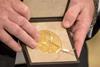
It’s that time of year when the Nobel prize committees announce this year’s Nobel laureates. Each laureate will receive 12 million Swedish kronor (£900,000), a framed artwork and a medal, awarded at the Nobel prize ceremony in December. But the process of choosing a Nobel laureate is shrouded in mystery. So, how is one of science’s most prestigious prizes awarded?

Firstly, what are the Nobel prizes?
Each year in October, a collection of prizes recognises those in science, literature and peace whose discoveries or actions have had the greatest impact on society. The prizes honour Alfred Nobel – a Swedish chemist, inventor and engineer, who famously invented dynamite. His last will – signed in November 1895, around a year before he died – stipulated that his 31 million Swedish kronor fortune, about £190 million in today’s money, should be split between five different fields – physics, chemistry, physiology or medicine, literature and peace. In 1969, the Sveriges Riksbank Prize in Economic Sciences joined the list of prizes as part of the 300th anniversary celebrations for Sweden’s central bank.
A maximum of three people can win the prize. Bengt Nordén, former chair for the Nobel committee for chemistry, told Chemistry World in 2015 that ‘one person is ideal because then you make someone an icon for representing something’.
What is the process of choosing a Nobel laureate and how long does it take?
The overall process takes around 16 months to complete. The Nobel committees get the ball rolling by sending out confidential requests for nominations in the September of the year before the next awards. Nominators then have until 31 January to put forward who they think should win the prize. Once all the nominations are in, the Nobel committees spend the next few months whittling down the list and investigating the researchers nominated. ‘It takes time to evaluate and confirm that this was the really big groundbreaking discovery and the person nominated is the right one,’ explained Nordén. A group leader, for example, may be associated with a discovery, but it may have been the work or idea of a postdoc or PhD student in the group.
Once the committees reach a consensus, the prizes are announced from the first Monday in October at 11.45am Swedish time each day, in the order of: physiology or medicine, physics, chemistry, literature and peace. The prize in economic sciences is announced in the following week.

The new Nobel science and literature laureates then attend an award ceremony at the Stockholm Concert Hall in Sweden on 10 December – the anniversary of Nobel’s death. There, the King of Sweden presents them with an 18-carat gold medal and a diploma. The ceremony for the Nobel peace prize takes place on the same day but in Oslo.
Can anyone win a Nobel prize?
There aren’t any formal conditions that dictate whether someone is eligible or not to receive a Nobel prize, except that nominators can’t put themselves forward.

Nordén explained that many people think that scientists are awarded the prize as a lifetime achievement award, which is not the case. He said that when he was involved in the process, the committee had a few criteria of their own to help them decide. ‘The achievement should somehow open a door or open our eyes, we will see things in a different way,’ he said. ‘There should [also] be a substantial impact for the field of chemistry,’ Nordén said, adding that the impact of a laureate’s work should have a ‘richness of consequences’ and stand the testament of time.
In contrast to Nobel’s will, prizes are no longer awarded just to discoveries made in the previous year. Nordén explained the reason for this is time: time for discoveries to have consequences and time for the committee to evaluate a nominee.
Who can put researchers forward for a Nobel prize?
Only those who receive a confidential invitation from a Nobel committee can nominate for the following year’s prize. Nordén said that the committee used to send out around 3000 invitations and receive about 300 responses each year. He added that they tried to send invitations all around the world, particularly to those earlier in their careers ‘who are much more alert and aware of what’s happening’. Nominators can submit several suggestions for people or topics that they think should be awarded a prize.
The Nobel chemistry committee stipulates that those who can nominate include: members of the Royal Swedish Academy of Sciences; past Nobel laureates in chemistry or physics; chemistry professors from the Nordic countries; those who have been a chair of at least six universities or university colleges selected by the Academy of Sciences elsewhere in the world; or anyone else that the academy sees fit. Nordén said the list of invitees changes each year: ‘If you are not active, you are removed from the list.’
The committee then keep details of nominations secret for 50 years. While the committee may not recognise a researcher or a field with a prize in a given year, it is not uncommon for them to win the prize in a later year. For example, Linus Pauling was first nominated in 1940, and many times in the following 14 years, before finally winning the Nobel prize in Chemistry in 1954.
Chemistry World will be covering the chemistry Nobel prize live as it happens from 8am BST on Wednesday 7 October so we hope you’ll join us then. Following the awarding of the prize we’ll be hosting a free webinar on Friday 9 October 3pm BST with an expert panel to celebrate and unpack the science that won the newest chemistry laureates the most prestigious prize in the field. We’ll also be running an all things Nobel prizes newsletter on Wednesday that you can sign up for.


No comments yet