
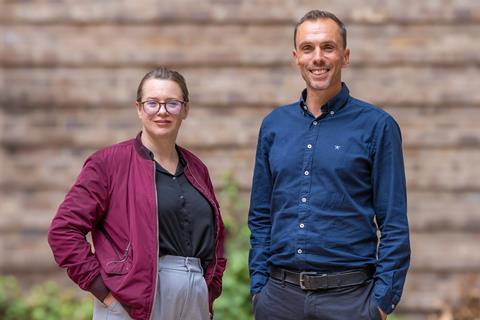
Since 2018, computational chemist Abbie Trewin at Lancaster University, UK, has been working on what she calls ‘a new form of carbon’. The material is porous and amorphous, but also highly conductive thanks to a network of interconnected carbon-carbon triple bonds. That creates high energy binding sites that can trap lithium ions – a property that can help prevent lithium dendrite formation on battery anode surfaces. Having now developed a one-pot synthesis method for the material, Trewin and her colleague Gene Lewis have spun out from Lancaster to form Gavion.
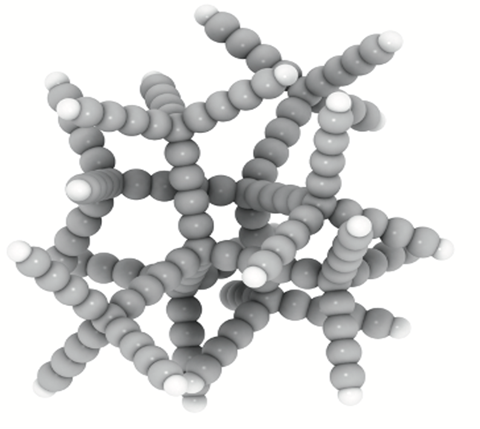
Making the porous material starts with carbon tetrabromide ‘nodes’ that react with silyl-alkynyl linkers to build up a 3D network. Trewin notes that using linkers with different numbers of adjacent alkyne groups can create materials with different pore sizes, in a similar way to creating metal-organic frameworks (MOFs). Earlier this year, another research group in Sweden published a synthesis of thin films of a crystalline version of a similar material.
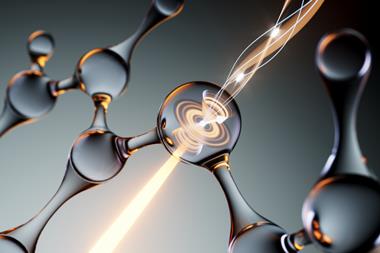
Trewin explains that the conductivity comes from overlap of the alkyne orbitals around the nodes, which allows electrons to quantum tunnel ‘from one linker to the other’. She notes that increasing the linker chain length increases the conductivity ‘because you reduce the number of times [an electron] has to go across that tunnelling barrier’.
The team has found that the material’s conductivity, combined with its porous structure, means that when added to graphite anodes ‘it acts like a sponge’, soaking up excess lithium ions and stopping lithium dendrites from forming.
In experiments that push batteries through several thousand charging and discharging cycles at temperatures ranging from –10°C to room temperature, Trewin notes that cells that use plain graphite anodes tend to short-circuit as dendrites eventually form a direct connection between the anode and cathode. However, adding as little as 1% of the porous material into the graphite anode overcomes this issue, while also improving the battery’s overall capacity.
Improving a battery’s performance has tended to focus on tinkering with the cathode materials, with the anode ‘kind of left alone’, Lewis says. He notes that using ‘1% drops really nicely’ into battery manufacturing processes. ‘It de-risks the whole formation of electrodes’ without requiring significant process changes. ‘You want to make something better, but what you don’t want to do is completely change the incumbent industry,’ he says. Gavion’s material aims to do just that.
Finding the right application for the material was initially a challenge, given the wide variety of uses for lithium-ion batteries, each with their own set of demands and performance requirements. ‘Does it go to cars? Does it go to drones? Does it go into [energy] storage?’ Lewis asks. The team has chosen to lean into ‘the safety and longevity’ of batteries for energy storage, which is a fast-growing market.
The team can currently produce 50g batches of the porous carbon, which is enough to make pouch cells, says Lewis. ‘We’re currently [at] PhD prices today,’ he says, adding that it costs around £20 to make enough to mix into a kilogram of graphite, which itself costs around £5. While this is currently not economically viable, scaling up the synthesis of Gavion’s additive to kilogram scale should help lower costs as reagents can be purchased in bulk. However, the material is already cheaper than other additives such as lanthanum titanate that are currently being used at commercial scale.
Lewis says that the team has interest from companies based in the US, UK and China to use the material in their batteries. As well as scaling up, Gavion is investigating whether the material also works in sodium-ion batteries or using recycled graphite anodes.
‘I think it’s [been] a little bit challenging coming from a non-Golden Triangle institution,’ says Trewin, referring to area between Oxford, Cambridge and London where funding and support to take ideas from the lab to market tends to be more concentrated in the UK. ‘But we found that once we’ve got through the door and talking to people, [the reaction to our material has] been great.’
Gavion
Founded: 2025
Location: Lancaster, UK
Employees: 2
Origin: Spin-out from Lancaster University, UK
Funding: Currently seeking pre-seed funding
References
1. A Rowling et al,ACS Appl. Mater. Interfaces, 2024, 16, 47631 (DOI: 10.1021/acsami.4c09710)
2. C Mollart et al,ACS Omega, 2026, 11, 56979 (DOI: 10.1021/acsomega.6c03870)
3. A Rowling et al,RSC Adv., 2026, 16,18283 (DOI: 10.1039/d6ra02730j)
Additional information
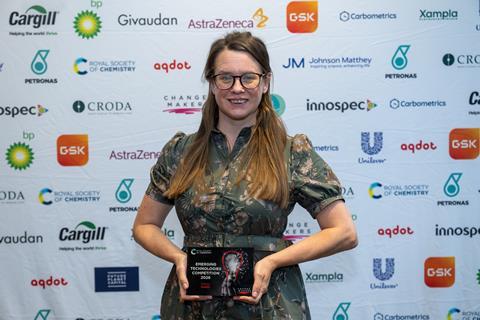
Gavion won the energy category in the Royal Society of Chemistry’s 2026 Emerging Technologies Competition and has received venture acceleration support from the RSC’s Change Makers programme.
The Change Makers sustainable polymers in liquid formulations (PLFs) cohort is now open for applications from start-ups: Sustainable PLFs cohort







No comments yet