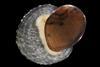
Chemical analysis of limpet shells reveals how these organisms migrate across thousands of miles between deep sea hydrothermal vents. The results help to explain how community make-up in these extreme ecosystems can be so similar despite being separated by vast distances.

Like the rings of a tree, limpet shells’ layers provide a record of the environmental conditions in which the animal has lived. Earlier stages of life are recorded at the shell’s apex and more recent stages at the lip. By analysing the chemicals present in these layers, researchers at the University of Tokyo have revealed new insight into where limpets live at different life stages.

Limpet and larva

Source: © 2026 Yahagi et al. CC-BY-ND

(Left) A vent-dwelling limpet retaining its brown larval shell. (Right) A swimming larva with two earlike structures called velum

The team, led by marine scientists Takuya Yahagi and Yasunori Kano, gathered limpets from hydrothermal vents in the west Pacific. The group’s previous work suggested that limpet larvae likely spend their early days near the surface of the ocean, before being dispersed by ocean currents and settling back in the depths and developing into their adult form.

This led them to focus on oxygen isotopes. Oxygen-18 accumulation in calcium carbonate shells is temperature dependent, with a higher uptake of oxygen-18 in cooler waters. By analysing the ratio of oxygen-18 to oxygen-16 present in shell layers, the researchers determined the temperatures the limpets were exposed to at various points in their lives. They also looked at barium and manganese content, elements uncommon in surface waters but abundant in the superheated water jetting out from hydrothermal vents.

NanoSIMS

Source: © 2026 Yahagi et al. CC-BY-ND

Limpet shells were analysed using the nanoscale secondary ion mass spectrometry (NanoSIMS) instrument at the University of Tokyo’s Atmosphere and Ocean Research Institute

The findings confirmed that the limpet shells’ early layers were formed in a warmer environment, consistent with the ocean’s surface waters. The more recent layers contained higher concentrations of barium and manganese, indicating the limpets had later settled in the deep sea near the vents.

The results are an important step in building our understanding of how life disperses in deep sea environments, which are at risk of damage by mining and other human activities. Writing in Science Advances, the team notes that investigating the migrations of vent-endemic animals is ‘indispensable to evaluate their population resilience and to integrate conservation methods into future human activities in the deep sea.’