
Scientists in Italy have developed a way to form imine bonds in water with the speed, efficiency and selectively of a click reaction. By using a zinc complex to subvert the bond’s low hydrolytic stability , the method could make imine chemistry easier to apply in bioconjugation and responsive molecular systems.1
The ease with which amines and aldehydes form imine bonds under mild conditions, coupled with the wide availability of starting materials, has made imine chemistry central to supramolecular chemistry. ‘The imine bond … is a dynamic covalent bond widely exploited across chemical systems, ranging from materials and supramolecules to sensors,’ notes Leonard Prins, from the University of Padova.
Despite these advantages, imine bonds are well known for their poor hydrolytic stability, which limits their applications in aqueous environments. ‘Making single imines in water is fundamentally challenging, because water is produced in the formation of an imine so Le Chatelier’s principle favours the reverse reaction (imine hydrolysis) when there are lots of water molecules around,’ explains Kate Jolliffe, a supramolecular chemist at the University of Sydney in Australia, who wasn’t involved in the study.
Now, Prins, Deepak and their co-workers have shown they can address this problem by functionalising their amine precursors with 1,4,7-triazacyclononane (TACN)·Zn(ii). The complex binds and pre-organises the aldehyde precursor, which activates the carbonyl for nucleophilic attack and stabilises the imine via coordination. Using this strategy, highly stable imines formed within two hours, particularly at neutral pH and micromolar concentrations.
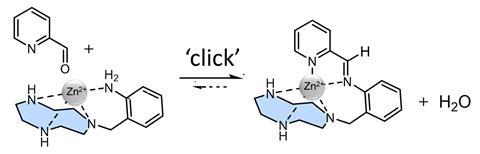
The work builds on the group’s earlier demonstration of near-quantitative imine bond formation in water through the condensation of salicylaldehyde derivatives with TACN·Zn(ii)-functionalised anilines.2 In the new study, the researchers extend the scope of the reaction by showing that simple amines can also be used and by introducing additional aldehyde precursors, including those based on pyridine. Incorporating a pyridine unit increases the electrophilicity of the carbonyl group, resulting in a reaction that takes hours rather than days and imine bonds with higher thermodynamic stability. They also demonstrated that they could use their system to form imine bonds in complex biological environments, such as Escherichia Coli cell lysate.
‘Establishing the imine bond as a click reaction in water opens the door to constructing the aforementioned systems in a solvent that was previously considered prohibitive,’ comments Deepak.
‘The ability to cleanly form a single imine bond in a cell lysate demonstrates that bioconjugation is a clear application of this work,’ comments Jolliffe. ‘Expanding the range of dynamic bond forming reactions that work in water is an important step forward but for further applications in supramolecular chemistry and molecular recognition, the introduction of additional functional groups will need to be investigated.’
References
1 Deepak et al, Chem. Sci., 2026, DOI: 10.1039/d6sc06874j
2 T Marchetti et al, J. Am. Chem. Soc., 2026, 148, 4615 (DOI: 10.1021/jacs.5c20524)



No comments yet