

Researchers in Germany have discovered a molecule that receives quantum information precisely, potentially disrupting today’s leading quantum computing technologies. Designed by scientists at NVision Quantum Technologies and nearby Ulm University, this is the first such molecule to serve as a quantum bit, or qubit, individually connected by light.
What is a qubit?
Conventional computers run on binary logic – encoding information as 1s and 0s in various ways such as the orientation of magnetic poles in a computer’s memory chip. These 1s and 0s, or bits, can then be harnessed to perform computational calculations through the use of logic gates. These gates allow a current to flow when the gate’s logic rule is met.
A quantum bit, or qubit, is the quantum computing equivalent of a classical computing bit. Qubits still encode information as 1s or 0s, but encode them in states of a quantum object such as the up or down spin of an atom. However, while a classical bit can only be in one of two states (1 or 0), a qubit can be in a superposition of states, which effectively allows the two states to be mixed in any proportion. This means quantum computers should, in theory, be able to handle information more efficiently.
This potential has theoretical chemists excited because using a quantum object to model other quantum objects (such as atoms and electrons) should be much more efficient. Quantum computing therefore enables us to simulate molecules without having to make a compromise between accuracy and computational cost that is typically required when trying to simulate molecules with a classical computer. (For a more complete discussion of quantum computing examining the limitations and necessary simplications required to explain the concept we have a feature on the topic.)
‘We can tune its properties with synthetic chemistry and deposit it as a thin film on photonic integrated circuits made with existing foundry processes,’ says Ilai Schwartz, chief technology officer at NVision. This ‘opens a manufacturable route towards large-scale quantum computers’, he says.
Single molecules have lagged other qubit technologies, such as trapped ions, superconducting circuits and neutral atoms. To date, quantum computers using these technologies can connect up to 6100 qubits but have detected and corrected errors arising from noise and interference on a maximum of eight qubits. To be truly useful, they must reach at least hundreds of thousands of qubits. This is likely to involve linking together small quantum computing units with light to control errors.
Before this study, researchers had demonstrated reading out information about the spin of electrons or nuclei in single molecule qubits with laser light. However, it wasn’t previously possible to read information from – or ‘address’ – an individual molecular qubit. Quantum computing needs this individual addressability, but scientists had to read groups of molecules together, averaging their values.
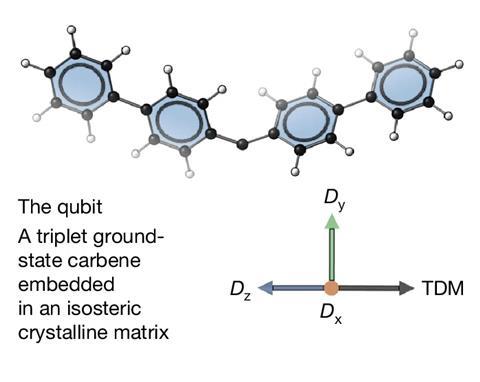
Now, the Ulm-based researchers have designed a molecule – di([1,1′-biphenyl]-4-yl)carbene – that provides four properties needed for an individually addressable qubit. Firstly, when they shine a laser on it to read out information, it fluoresces only when its electrons are in one of three spin states, and not in the others. Secondly, those spin states are stable for long enough to be used for quantum computation. Thirdly, it fluoresces brightly enough to be read and fourthly its colour is stable enough to enable quantum entanglement.
The researchers synthesised the molecules directly from a precursor, embedded in a di([1,1′-biphenyl]-4-yl)methanone crystal. This will allow NVision to precisely position qubits in quantum computing chips.
This is a ‘high-quality molecular qubit architecture’, according to David Awschalom from the University of Chicago, US. It ‘enables a spin–photon interface at the single-molecule level’, something that is ‘a significant step towards integrating molecular qubits with scalable optical communication platforms, with applications in quantum sensing and communication’.
Danna Freedman from the Massachusetts Institute of Technology, US, goes further, calling ‘demonstrating single-molecule addressability’ in a molecule and controlling its spin ‘a huge step for the field’. ‘It propels molecules forward as core elements of quantum technologies.’
NVision plans to develop molecular qubits to serve in an architecture it calls photonic integrated quantum circuits (PIQC), where is will play two roles. Firstly, light interacts with their electron spins, as in this study, connecting them with other qubits. Secondly, they want the spin on the nuclei in the molecules’ atoms to serve as long-lived memories. They are already working on achieving this, for example by including a nitrogen atom in molecular qubits, as the most common isotope of carbon doesn’t have a nuclear spin.
‘There are a lot of interesting companies out there doing impressive things but one of the biggest questions that every modality now faces is: can it scale to hundreds of thousands of qubits?’ says Schwartz. ‘We believe answering that needs a fundamentally different approach and that is what PIQC is designed for. With this work we’ve shown the building block and our next step is already underway: putting our molecules onto photonic chips with our partner HyperLight. Real engineering challenges remain but because we build on existing foundry processes we don’t need to build new factories to get there.’
References
S Roggors et al, Nature, 2026, DOI: 10.1038/s41586-026-11147-6












No comments yet