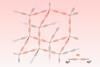
Porous diamond is the latest addition to the growing list of carbon allotropes. The new structure, termed diamondiyne, expands diamond’s rigid 3D lattice by incorporating alternating single and triple bonds between the connection points and is the only other carbon form capable of covalently bonding across all three dimensions. The unusual mix of sp and sp3 carbon centres may lead to unique optical and electronic properties, the full range of which have yet to be explored, say the authors.
Allotropes of carbon are a longstanding curiosity of chemistry. Originally limited to just diamond and graphite, an explosion of discoveries over the last 50 years has prompted renewed interest in these alternate structural forms and theoreticians have since predicted 1635 distinct carbon allotropes. Diamondiyne was first proposed in 1991, but the reactive monomer unit proved difficult to assemble into an organised crystal structure and the allotrope was never successfully synthesised. However, drawing from techniques used to build covalent organic frameworks, Karl Borjesson and his team at the University of Gothenburg in Sweden have now leveraged reaction kinetics to closely control the assembly process, yielding this elusive allotrope for the first time.

The basic unit of diamondiyne is tetraethynylmethane – an sp3 carbon centre, tethered to four alkyne groups. Each sp3 centre is, therefore, separated by an alternating sequence of single and triple bonds, retaining diamond’s highly ordered symmetry but dramatically expanding the footprint of the crystal lattice. Left unchecked, the monomer triple bonds quickly aggregate into an amorphous clump so Borjesson’s team localised the key coupling step at a liquid–liquid interface, slowing the reaction to a manageable molecule-by-molecule addition process.
They first dissolved a stable silyl-protected form of the monomer in chloroform and then added a copper fluoride catalyst to an aqueous phase above. At the surface between these two layers, the fluoride deprotected the silyl group to reveal the active tetraethynylmethane monomer, while the copper then facilitated the coupling reaction to form the crucial diyne bond. Overall, this sequence creates a kinetic preference for being at the membrane which enforces an order in the way it assembles, explains Borjesson. Simulations also revealed a substantial energy penalty for defect formation, further driving the reaction sequence towards the ordered diamondiyne structure.
So far, the team have been able to generate films of up to around 5cm2 and they are just beginning to explore the properties of this new material. ‘We know that it’s porous, we can predict that the surface area is very large and we could guess that the optical band gaps are probably quite large since we have an sp3 carbon node in the system,’ says Borjesson. However, we need to make more and higher quality material to elucidate these promising properties further, he adds.
These preliminary findings, notably the combination of 3D structure and mixed hybridisation within a stable film, have already caught the attention of other researchers in the carbon structures space. ‘This is an impressive study that expands the landscape of carbon allotropes,’ says Wei Xu, a nanostructures chemist at Tongji University in China. ‘While its predicted characteristics suggest potential opportunities for advanced carbon-based materials, further experimental investigations will be necessary to determine its intrinsic properties and practical applications [and] future efforts should focus on improving the scalability and controllability of diamondiyne synthesis.’
References
Y Yang et al, Angew. Chem. Int. Ed., 2026, DOI: 10.1002/anie.4062963


No comments yet