
Bringing together two different AI models built to ‘think’ in entirely different ways reduces failures and hallucinations that can arise when they perform an important chemical task – retrosynthesis.
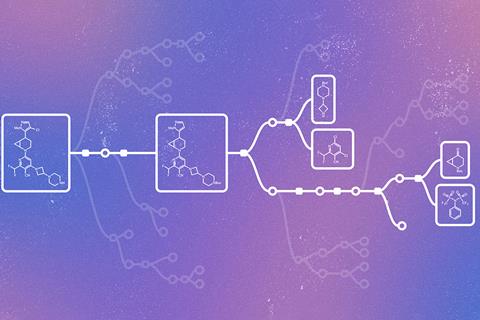
‘We find that different models have different strengths and that combining them can yield considerable performance improvements over any single model alone,’ says Marwin Segler, senior director at Microsoft Research AI for Science in Cambridge, UK. The combined tool, Retrochimera, can also be fine-tuned cheaply and quickly to work with new databases of reactions.
Segler and colleagues asked PhD chemists if they preferred suggested retrosynthetic steps from a reference dataset or from Retrochimera. The chemists opted for Retrochimera’s suggestions about two-thirds of the time. ‘This is to our knowledge the first time a model is demonstrated to provide predictions that are more aligned to chemists’ preference than its test-set reference reactions,’ the researchers write.
AI learns the language of chemistry
Retrosynthetic analysis helps chemists plan how to make molecules they’re interested in, working backwards from the target structure. Researchers have long explored AI tools’ use in this context, but their usefulness had previously diminished rapidly with molecules whose structure differs significantly from their training data.
What is AI?
Artificial intelligence (AI) is an umbrella term often used to encompass a variety of connected but simpler processes.
AI is the ability of machines and computer programmes to perform tasks that typically only humans could do, such as reasoning, responding to feedback and decision making.
Generative AI is a newer variant of AI that analyses and detects patterns in training datasets to generate original text, images and videos in response to requests from users. ChatGPT, Microsoft Copilot, Google Gemini and more recently X’s Grok are all examples of chatbots that use generative AI.
Neural networks are an interconnected array of artificial neurons, akin to biological brains, that identify, analyse and learn from statistical patterns in data.
Machine learning is a subset of AI that allows machines to learn from datasets and make predictions based on new data, without programmers explicitly asking it to do so. Machine learning models improve their performance as they receive more data.
Deep learning is an enhanced type of machine learning that uses neural networks with many layers to analyse complex data from very large datasets. Applications of deep learning include speech recognition, image generation and translation.
Large language models or LLMs are a type of deep learning trained on large amounts of data to understand and generate language. LLMs learn patterns in text by predicting the next word in the sequence and these models are now able to write prose, analyse text from the internet and hold dialogues with users.
Testing many different types of AI to explore their potential to accelerate molecular design, Segler’s team saw that their strengths and weaknesses could be complementary. One type that they tested is a transformer, found in the most common large language models like ChatGPT. In written language, transformers learn a word’s meaning from how commonly it’s surrounded by other words.
In the new study, one of the AI ‘personalities’ or submodels of Retrochimera is a retrosynthetic transformer called R-Smiles 2. The Smiles in its name refers to Simplified Molecular Input Line Entry System, a way to use letters and symbols to represent chemical structures.
‘Smiles, like natural language, is a sequence of symbols governed by rules,’ says Segler. ‘In natural language, the symbols are words and the rules are grammar. In Smiles, the symbols are atoms, bonds, ring closures and more, while the Smiles syntax defines which sequences are valid molecules.’ As such, transformers ‘can learn the structure of both natural language and Smiles’.
The retrosynthetic tools that Segler and colleagues were testing included a completely different type of AI called graph neural networks (GNNs). GNNs are common in social networks and in chemistry applications, because they are good at representing structured objects. Therefore, for the other AI submodel of Retrochimera, the researchers developed a GNN called Neuralloc.
Cutting hallucinations by more than half on industrial reactions
Both submodels take a single molecule as input and output a ranked list of reactions that could be used to make that molecule, Segler tells Chemistry World. After extensive training on common and rare reactions, Retrochimera also learns how to rank the combined lists.
Team members from Novartis in Basel, Switzerland, enabled the researchers to use Retrochimera directly to do retrosyntheses on 10,444 reactions from the drug company’s internal database. The collaboration also included scientists from GSK in Stevenage, UK, who provided over 650,000 reactions from its database for training, validation and testing. With the GSK data, the researchers explored whether retraining or fine-tuning Retrochimera would help its performance.
The combined AI tool consistently outperformed both the individual submodels, especially on rare transformations. The cross-checking between submodels decreases the number of hallucinations, or strange suggestions, by more than half.
‘We’ve also found that fine-tuning the model on internal datasets can further improve performance, which is important for the actual applications in pharma and chemistry companies,’ says Segler. And because Retrochimera is modular, new component models can be added over time, which Microsoft expects will further improve performance.
‘Retrochimera is an impressive, carefully validated piece of work and arguably the strongest single-step retrosynthesis model to date,’ says Philippe Schwaller from EPFL in Switzerland. ‘The gains on rare reactions and the lower rate of hallucinated reactions matter a lot in practice.’
He notes that previously retrosynthetic AI was judged by how well it reproduced a recorded answer. ‘That’s a flawed yardstick, because there is rarely a single right answer,’ Schwaller says. He hopes blinded evaluations by expert chemists ‘becomes the standard’.
In the year since the newly-published paper was submitted, Segler notes, Microsoft has advanced its internal models in partnership with collaborators. Meanwhile, RetroChimera ‘remains highly competitive in independent benchmarks despite being released last year, in a fast-moving field, whilst also being very cost effective’, he says. Microsoft is also developing other tools, such as Qfang for predicting reaction conditions, and an AI agent called Clio that incorporates Retrochimera, Segler highlights.
References
K Maziarz et al,Nature, 2026, DOI: 10.1038/s41586-026-11160-9









No comments yet