
Neurodivergent students are more likely to struggle to reason consistently through structural chemistry problems than their non-neurodivergent peers, a new study has found. Although this resulted in lower overall accuracy, these same students showed greater self-awareness about their learning and reasoning behaviours, with many developing individualised strategies to compensate for these difficulties. A deeper understanding of these alternative thought processes, and their associated strengths and challenges, could inform the design of more inclusive courses and assessment processes and reduce the barriers faced by neurodivergent individuals in chemistry education.
Neurodiversity is the natural variation in how individuals process and respond to information and encompasses a variety of identities including ADHD, autism and dyslexia. Each of these differences can influence the way that an individual approaches problem solving, sometimes to their advantage and at others to their detriment, but the specific impacts of neurodiversity within a chemistry context are unknown.
Chemistry demands a wide range of reasoning skills: mathematical logic, spectral interpretation and spatial–structural reasoning, each of which might conceivably differ amongst neurodivergent individuals. In particular, ‘representational competence – the ability to interpret structural representations, translate between them and use them for problem solving – is foundational through all the subsequent courses a student will take,’ says Maia Popova, a chemistry education researcher at the University of North Carolina at Greensboro, US. ‘But we simply don’t know how neurodivergent students are leveraging their unique strengths and navigating their challenges to tackle that.’
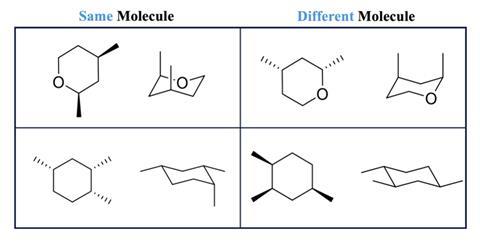
To answer this question, Popova and PhD student Audrey Gay recruited 86 undergraduate students enrolled in organic chemistry courses at a US university, 30% of whom identified as neurodivergent. The students performed a computer-based structural translation task, testing their ability to convert between wedge and chair representations across 40 different molecules. All participants completed the task in a similar time and with comparable levels of self-reported confidence but, on average, neurodivergent individuals achieved moderately less accuracy than their non-neurodivergent peers.
The team then conducted a follow-up interview, asking the students to talk through their reasoning process for eight of the questions. These discussions indicated that non-neurodivergent students were more likely to take a consistent and systematic approach that yielded a high level of accuracy. In contrast, the neurodivergent participants frequently relied on self-established rules, such as wedges always indicate an axial group, or switched between multiple strategies when stuck, more often leading to confused explanations and lower accuracy. ‘We found that a higher percentage of neurodivergent students fell into these inconsistent or unproductive reasoning profiles, but we also saw that they thought and reflected a lot about what they were doing and how they were reasoning, with more reliance on specific self-accommodating strategies to help them solve the problems,’ explains Gay.
Overall, the neurodivergent students reported perceiving notable differences in how they learned versus their non-neurodivergent peers. They also highlighted specific challenges such as attention span during long lectures and visual overload on crowded slides as significantly hurting their ability to assimilate new material. Many therefore developed behaviours like annotation systems, personal routines and use of online resources to compensate for these difficulties. ‘What people believe about themselves is a very powerful thing and they believe strongly that their identity is impacting how they’re learning,’ says Popova. ‘Ultimately, we want their hard work of thinking of these self-accommodation strategies to be matched with what the instructors and university administrators are providing in terms of resources.’
For Kevin Morgan, a chemical education specialist at Queen’s University Belfast, UK, this work is an extremely positive first step in an under-researched area. ‘This is what universal design for learning is about – it’s understanding that everyone has different challenges and barriers and trying to design your content and assessment in a way that allows for difference but doesn’t reinforce difference,’ he says. ‘The difference here certainly wasn’t in capability and I’d like to see this work expanded across other neurodivergencies, intersectionalities and over a larger cohort.’
References
A Gay et al, J. Chem. Ed., 2026, DOI: 10.1021/acs.jchemed.5c01720acac












No comments yet