
Many in Serbia’s academic community are hoping for a change of fortunes under the new government of the student-led movement, Studentska Lista.

The student-led political option won a majority in elections at the weekend, effectively ousting Aleksandar Vučić, whose last two years in office as president were marked by ongoing fights with universities and academics.
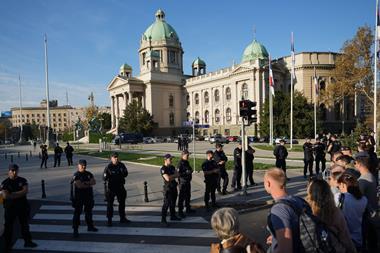
Vučić presided over a government which critics decried as corrupt and undemocratic. The government’s mishandling of the response to a train station roof canopy collapse in November 2024 that left 16 dead, led to nationwide student protests. Student demands for transparency and accountability resonated with others in academia, many of whom backed the protests. This drew reprisals from the government that included cuts to research time, docked salaries and delays in research fund dispensation. Some academics reported being fired for their support of the student movement.
The victorious student movement now promises to address these issues. Its manifesto is largely anti-corruption and pro-meritocracy, built around the promise of better education and healthcare, improved employment rights and stable funding for science.
‘The election results could create an opportunity to restore trust in Serbia’s universities and research institutions and place knowledge at the centre of the country’s development,’ the Student List press office told Chemistry World.
Many researchers, who have decried recent government policy, are now optimistic. Gazela Pudar Draško, a political sociologist and the director of the institute for philosophy and social theory at the University of Belgrade told Chemistry World that she hopes for ‘a fundamental change in the relationship between the state and universities’.
‘The priorities are clear,’ she says, ‘restoring institutional autonomy, ending political interference in academic governance, and ensuring stable, predictable funding for research. The Student List’s programme offers a promising starting point, including institutional research funding, greater independence for universities and research institutes, and measures to bring researchers back to Serbia.’
Ensuring young researchers stay in the country is one of the key priorities for the Student List. ‘The election result gives students, professors and researchers a real reason to stay in Serbia, or to come back,’ says Vladan Čokić, principal investigator at the Institute of Medical Research in Belgrade. ‘That alone is a major achievement.’
He says that he now wants to see colleagues who were dismissed for supporting the student protests reinstated and cases of obstructed careers or research examined fairly by independent bodies. ‘University ethics committees should also look into political influence in faculties,’ he says. ‘Academics should set an example of honour and justice for society.’
One of the academics who says she lost her job for backing students is Jelena Kleut, whose case is still going through the courts. She says the ‘emotions after the amazing result of the Student List are still very high’, especially for academics who felt threatened by the regime during the campaign. ‘Looking from inside academia,’ she says, ‘the elections were a choice between further diminishing the autonomy and integrity of the university, or a possibility to restore it. Now we have that chance [to restore it], and we will take it.’
Much of the detail about the next government is as yet unfinalised but one of the frontrunners for prime minister is Radomir Saicic, an organic chemist at the University of Belgrade.
Neven Isailović, a researcher at the Institute of History in Belgrade, notes that the student’s primary goals are ‘to restore democracy [and] seized state institutions and media, and to ensure rule of law and meritocracy’ rather than research. ‘Although science is not in its core programme, the fact [is] that the movement had staunch support by the majority of higher education and [the] science community in Serbia,’ he adds. ‘I expect that [the] science [brief] will be entrusted to a person from within the science community and that there will be significant efforts to improve both the position of scientists and of science itself.’






No comments yet