
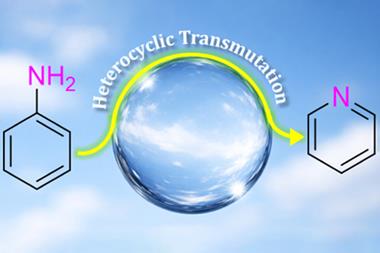
Finding a way to use a typically unreactive radical intermediate has allowed chemists to swap aromatic carbon atoms for nitrogen. The strategy adds to the skeletal editing toolbox and, as it works under mild conditions, the researchers say it offers a way to edit the structure of complex, reaction-sensitive natural products.

Replacing an aromatic carbon atom with a nitrogen is a key goal for organic chemists, as many pharmaceuticals and natural products have nitrogen-containing rings, such as pyridine.
Current strategies include exposing an aromatic azide to ultraviolet light to generate a singlet nitrene, which can then undergo ring expansion to incorporate the nitrogen atom. Oxidation then reduces the ring back to its original size. However, the singlet nitrene rapidly converts to the triplet state, preventing ring expansion, meaning that reaction yields of nitrogen-containing rings are often low. ‘The existing methods, despite significant progress in the last few years, are [also] unfortunately too harshly oxidising to routinely use on sensitive natural products,’ says Mark Levin at the University of Chicago, US.
Why has skeletal editing got chemists so excited?
Most organic chemistry reactions alter a molecule’s structure to some degree, such as by introducing a new functional group or forming a ring. Such reactions often create or build on a molecular backbone.
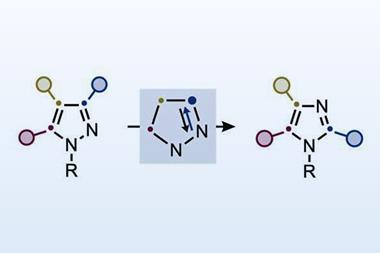
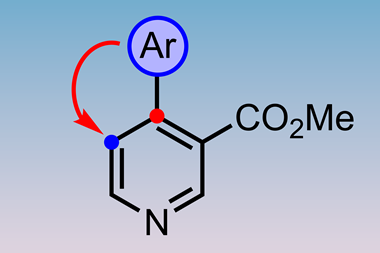
Skeletal editing reactions allow chemists to make atom-specific changes to the backbone itself, particularly during late-stage synthesis. These include adding, removing or switching out single atoms into rings. For example, researchers at ETH Zurich showed last year that they could swap a carbon for a nitrogen in indoles to form benzimidazoles. Equally, earlier this year, chemists developed a method that converted phenols into a range of nitrogen-containing rings of various sizes.
These reactions mean that chemists can start with an easier-to-make scaffold and then tweak the size and type of rings at a molecule’s heart, often speeding up the synthesis of a particular compound. Chemists can also experiment with different edits, which is useful during drug development to scan which variations give the best molecular properties. Equally, editing a common starting material removes the need to make each unique drug candidate from scratch, saving time and resources.
Rather than trying to limit the formation of the triplet state, Levin’s team is embracing this radical and has now developed an alternative way to insert a nitrogen atom into an aromatic bicyclic ring.
Reacting the triplet radical – generated from an azide-containing compound – with oxygen creates a nitroso oxide anion that can intramolecularly react to form a metastable nitrile oxide. Adding a thiourea compound then leads to a cycloaddition that generates an isothiocyanate, which reacts with an acid or base to reform the original ring, now with a nitrogen atom.
‘One of the key advances in the present report is that the most “challenging” reagent is molecular oxygen, making it much milder [than previous editing strategies],’ says Levin. The reaction works for a range of bicyclic rings, including indoles, indazoles and naphthalenes.
‘People who work on indole alkaloids have described to me their frustration about trying some of our earlier generation reactions and observing decomposition,’ says Levin. The team used their method to introduce a nitrogen atom into the alkaloid vinpocetine, which drastically improved the compound’s solubility and clearance. This route also takes fewer steps than previous syntheses to the same molecule.

However, Armido Studer at the University of Münster, Germany, who was not involved in the work, notes that this method can require chemists to first introduce an azide group – if not already present – which, during a late-stage synthesis, ‘is not that trivial’. He thinks that the technique is more useful for researchers studying the impact of regioisomers, by introducing nitrogen into different positions on a ring, rather than synthesising each compound from scratch.
Levin says that he is ‘excited to see what people can do now that a much milder protocol is available’. The team has already explored swapping the azide group for a sulfilimine (RNSR2), which reduces safety concerns associated with azide-containing compounds, and Levin notes that this could help scale this type of reaction.2
References
1 D-I Park et al,Science, 2026, DOI: 10.1126/science.aef3511
2 M Puriņš, J Hwang and M Levin,J. Am. Chem. Soc., 2026, 148, 31668 (DOI: 10.1021/jacs.6c10015)












No comments yet