
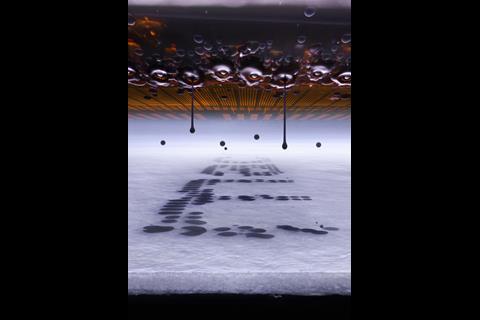
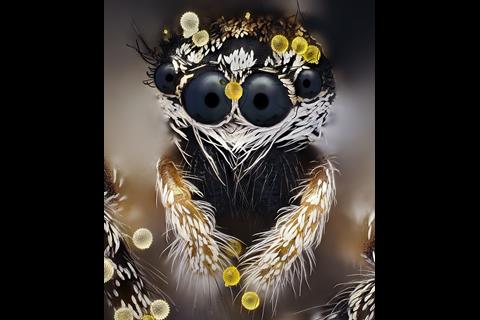
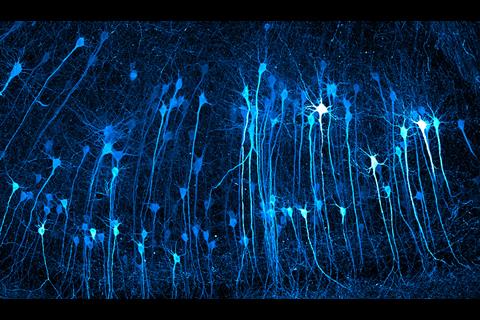
Capturing ink droplets inside an inkjet printer as it prints has won a German student first place in this year’s Nikon Small World photography competition, which awards creative photos shot through a microscope. Images of jumping spiders and neurons in mouse brains took second and third place, respectively.
Japanese optical instrument manufacturer Nikon also announced the winners of its related video competition earlier this year, but later had to disqualify the original winner, after finding that the creation of the video entry was assisted by artificial intelligence (AI).
Nikon started the Small World Competition in 1975 ‘to recognise and applaud the efforts of those involved with photography through the light microscope’. Since 2011, the competition has expanded to include entries that use video or time-lapse photography to capture the microscopic world in motion. Each top winner takes home a cash prize of $3000 (£2250), with smaller prizes for runners-up.
In September this year, Nikon announced that Ning Xiu at Tsinghua University in China took first place for his video that showed the movement of cilia in a patient with a rare respiratory condition.
Robert Hirst – a respiratory scientist at the University of Leicester in the UK – was one of the first to spot that generative AI may have been used in the video, leading him to question its biological accuracy. ‘The film risks giving a misleading picture of what [patients’] cilia and cells really look like,’ he says.
The organisers of the competition have now reviewed the video and its supporting materials, and said that it did ‘not comply with competition rules regarding generative AI’, which stipulate that ‘AI generated videos are not permitted’. Hirst says that there were AI watermarks in the movie file, adding that AI ‘was used to generate details that had never actually been observed’.
In a statement, the organisers said that their decision to disqualify the entry ‘is based solely on the submitted video’s eligibility under the rules outlined for this competition’. ‘It should not be interpreted as a judgment of the entrant’s professional reputation, scientific contributions, or intent,’ Nikon added.
The new first place video captures a single-celled organism playing with a roundworm, which was shot by Nguyen Nam Nhat in Vietnam using differential interference contrast microscopy – a technique that increases the contrast in transparent samples that are difficult to visualise using conventional microscopic methods.
Other top entries include sea slugs on the move, a pair of cells dividing in sync and jellyfish larva dancing in water droplets.
‘Winning films from the competition are used to educate students,’ says Hirst. ‘Material used to teach future scientists must show what was actually observed, not what AI imagined was there.’








No comments yet