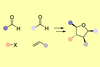
A surprise cyclisation offers a generalised route to heavily substituted tetrahydrofuran (THF) units. The stereoselective reaction combines simple building blocks to construct the densely functionalised ring in a one-pot sequence and is well-suited to applications in drug discovery and high-throughput synthesis, according to the researchers behind the work.
Saturated heterocycles are an important motif in pharmaceutical chemistry. Their sp3 architecture creates spatially diverse sites for molecular interactions with biological targets, and tetrahydrofurans – five-membered oxygen heterocycles – are just one such example. However, the synthesis of these structurally rich units remains complicated and most polysubstituted examples are produced on a case-by-case basis.

Consequently, it was with interest rather than frustration that Frank Glorius and his team at the University of Münster, Germany regarded the unexpected formation of a polysubstituted THF when studying a completely different reaction. The group were working on a silyl radical-mediated process to generate allylic alcohols from simple aldehyde and alkene building blocks. But trace silyl reagent remaining in the reaction mixture had rapidly cyclised this reactive unit to form a di-substituted THF as the major product. ‘It was very accidental but we realised it’s a much more general and more modular platform for the synthesis of this high-impact motif,’ says Yan-Bo Li, a postdoc in the Glorius lab, who worked on the project.
Investigating the mechanism further with the help of Kendall Houk at the University of California, Los Angeles, the team identified that by tweaking the conditions, they could generate three different tri- and tetra-substituted structures, incorporating one or two distinct aldehyde units and an additional alkene into the final product. ‘We observed a counterion effect where, depending on the corresponding anion of the photocatalyst we use, we could suppress the cyclisation step and accumulate the alcohol to derivatise it,’ explains PhD student Colin Stein, who also contributed to the project. The derivatised allylic alcohol then underwent a silyl-mediated rearrangement, before cyclising into a THF ring with complete stereocontrol.
The sequence proved remarkably robust, tolerating a wide variety of functional groups and a high level of structural complexity – the team were even able to incorporate aldehydes derived from drugs or natural products into the cyclised structure – all with respectable yields. ‘It’s an impressive piece of work. They have a modular synthesis and the chemistry is really quite dependable. This implies that a wide variety of people and a wide utility is available for this particular methodology,’ comments David Williams, an organic chemist at Indiana University in the US.

Keen to demonstrate the broad scope of the reaction, the team carried out a high-throughput screen, generating a library of 73 different polysubstituted THFs from a panel of 12 electrophiles. ‘I think that this will be where the real power of this methodology lies. They’re making a lot of bonds at once so they can screen a diverse space to see which substituents are best for drug discovery,’ says Sherry Chemler, an organic chemist at the University of Buffalo, US.
In a final proof-of-concept, the team completed a formal synthesis of the antifungal agent monocerin, generating the key intermediate in a single step with excellent stereocontrol. They are now working on developing an enantioselective variant using chiral ligands and hope that this generalised methodology will streamline efforts in both total synthesis and discovery chemistry going forwards.
References
Yan-Bo Li et al, J. Am. Chem. Soc., 2026, DOI: 10.1021/jacs.6c08584


No comments yet