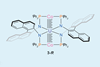
A uranium-based complex with 10 bonds across three atoms now holds the record as the first all-metal compound with the highest number of bonds between consecutive atoms.1 ‘Our work likely represents the limit of cumulative bonding in trinuclear systems,’ says Congqing Zhu at Nanjing University, who led the work, adding that it is ‘hard to imagine any atom forming more than 10 bonds with two neighbouring atoms’.

Complexes with multiple metal–metal bonds are rare because there needs to be the right balance of atomic size, electron configuration and available orbitals. In 1964, inorganic chemist F Albert Cotton synthesised a compound that had a quadruple metal–metal bond between two rhenium atoms, making it the first example of multiple bonding between metals greater than a triple bond.2 Chemists later extended this type of bonding after creating a complex featuring a quintuple bond between two chromium atoms.3
However, having a series of consecutive multiple bonds between three or more atoms –known as cumulative bonding – is more challenging. Cumulated dienes (C=C=C) or small molecules like carbon dioxide only have a bond order of two, while the uranyl ion ([O≡U≡O]2+) pushes this type of bonding to the limit with a triple bond between each pair of atoms.
Zhu and his team have now furthered this type of bonding by pinching a uranium ion between two cobalt ions, which are stabilised by a phosphorus-containing ligand, to create a complex with a total of 10 bonds across the three metal atoms (see video).
As each cobalt atom only forms two bonds with the ligand, ‘this leaves enough orbitals to interact with the d [and] f orbitals of the uranium’, says Zhu. He explains that this cumulative bond is made up of two σ bonds, four π bonds and four δ bonds – the latter formed by the four lobes of two d orbitals overlapping.
‘Uranium is quite an electropositive metal, so it’s not a natural bedfellow for bonding to other metals,’ says inorganic chemist Steve Liddle at the University of Manchester, UK. He says that the work by Zhu’s team ‘underscores the importance of ancillary ligand design, which here has helped to pin the cobalt atoms to the central uranium ion’.
X-ray crystallography of the complex shows that the U–Co bond distances are 2.1Å, on average, which is considerably shorter than a U–Co single bond, which is typically around 2.9Å. The ligand stabilising the near-linear metal chain is chiral, leading to a pair of stereoisomers that have slightly different cumulative bond lengths.

Zhu’s team was able to make the complex by reacting an octadentate uranium complex with cobalt dichloride, before reducing the intermediate to the final compound. ‘Given that this complex was already set up with such close metal–metal interactions, I also expect that [Zhu’s team] will be exploring its redox chemistry,’ says Polly Arnold at the University of California, Berkeley in the US. ‘[So], I would have loved to see more details of the electronic structure of the U(IV) starting material that they made,’ she adds.
Equally, Liddle says that he is ‘certainly curious to know what the [reactivity] of this new complex is’, and asks whether the compound is able to undergo cycloadditions or bond metathesis, for example. Zhu thinks that, as such complexes have high electron density between atoms and stronger orbital overlap, they could help create materials with better electron-transport properties useful in molecular conduction.
As such, the team is now looking to synthesise other complexes with quadruple and quintuple bonds using different actinide and transition metal atoms to enrich ‘the library of these novel, multiply-bonded systems’, says Zhu.
‘Molecules showing unprecedented bonding motifs [are] key to expanding our experimental toolbox and theoretical understanding of electronic structure,’ says Arnold. ‘This molecule represents exactly one of these milestone examples which will inspire chemists to challenge current models and discover new compounds.’
References
1 X Gong et al, Natl. Sci. Rev., 2026, DOI: 10.1093/nsr/nwag462
2 F A Cotton et al, Science, 1964, 145, 1305 (DOI: 10.1126/science.145.3638.1305)
3 T Nguyen et al, Science, 2005, 310, 844 (DOI: 10.1126/science.1116789)


No comments yet