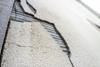
Damaged house

Source: © Thomas Lukassek/Alamy Stock Photo

Concrete in Ireland – mostly around Donegal – has been cracking up, something that homeowners have dubbed the ‘mica crisis’

In the early 2010s, homeowners in Donegal, Ireland, began noticing that the concrete in their homes was cracking. Hospitals, schools, libraries and petrol stations were also crumbling. The situation has since spread, with buildings throughout Ireland now dealing with the same issue in what has come to be known as the ‘mica crisis’. The Irish parliament was told by one politician in June that the cost to the country would be ‘on a scale with the bailing out of the banks and the bondholders’. Pádraig Mac Lochlainn told the Dáil that at least 20,000 homes are affected and that it could cost more than €9 billion (£7.7 billion) to fix – almost three times more than government estimates.

But why are concrete buildings in Ireland cracking, who is responsible and how are building owners dealing with the situation?

Why has the situation been dubbed the ‘mica crisis’?

When cracks started to appear, those affected by the defective concrete began working together with engineers to figure out the cause. Initial analysis of the concrete using x-ray diffraction revealed that the material contained high levels of muscovite mica – a silicate aggregate that thickens concrete.

However, excess mica decreases the strength of concrete, as these crystals have low compressive strength and bond poorly to cement paste. Many of the buildings affected contained concrete with up to 10% mica, with estimates suggesting that 1% mica can reduce the strength of concrete by 5%.

Figure

Source: © 2023 Andreas Leemann et al

Researchers have been taking samples from houses affected by the ‘mica crisis’ in Ireland to find out what has caused them to crumble

Excess mica can also make concrete difficult to pour, with manufacturers often adding extra water to compensate. Over winter periods where temperatures fluctuate above and below the freezing point of water, the water repeatedly expands and contracts. This freeze–thaw degradation then strains the concrete and widens micropores into visible cracks. An expert panel concluded in 2017 that excess mica, leading to freeze–thaw degradation, was the main cause of the concrete cracking. This led to the situation being dubbed the ‘mica crisis’.

Is mica the real cause of the cracking?

Pyrrhotite

Source: © De Agostini/Getty Images

Pyrrhotite is an iron sulfide mineral that has made its way into concrete produced in Donegal

Paul Dunlop, a physical geographer and environmental scientist at Ulster University in Ireland, is one of those whose house is cracking up from substandard concrete. ‘I became aware of it when I got my homeowner report back,’ he says. As he began investigating the issue he got together along with colleagues in Switzerland and Norway and they concluded that mica was not the culprit after all. The team conducted higher resolution spectroscopic and microscopic analysis of the affected concrete, finding that it also contained high levels of pyrrhotite – an iron sulfide mineral with the chemical formula Fe1-xS, where x is 0 to 0.17. The concrete often contained up to seven times the allowed sulfur level for pyrrhotite set by the European standard (0.1%).

He explains that it took a while for the Irish government to accept their findings, but a government-funded project turned up the same results. Comparing the concrete from three affected houses to one that was unaffected revealed that all houses had high levels of mica. ‘The main difference was that … the other three homes had iron sulfides,’ explains Dunlop. His team has also looked at winter temperatures over the past decade, finding that they did not vary enough for freeze–thaw degradation – thought to be caused by the excess mica – to be the root cause of the cracking.

The Irish government has now updated standards for evaluating affected buildings to include testing for pyrrhotite. ‘You could classify it as a paradigm shift in this whole thing because up until [now] everything was based on mica: mica campaigns, mica houses, mica testing,’ says Dunlop.

How do iron sulfide minerals like pyrrhotite weaken concrete?

NiAs structure of basic pyrrhotite-1C

Source: Courtesy of Ben Mills/Wikimedia Commons

The crystal structure of pyrrhotite (sulfur; yellow, purple, iron). Excess pyrrhotite in concrete can result in buildings crumbling as sulfur from the mineral can form sulfuric acid that damages the structure of the material

Over time, oxidation of pyrrhotite generates sulfur, which can then react with water to form sulfuric acid. The sulfuric acid then reacts with a cement hydrate called monosulfate to create a sulfate mineral known as ettringite. As ettringite has a higher volume than monosulfate, this causes the concrete to expand.

Once the monosulfate has been used up, explains Dunlop, sulfuric acid instead reacts with calcium silicate hydrate – which holds the concrete together – to form the calcium silicate, thaumasite. ‘[That] means that the thing that’s causing the concrete to be strong is being degraded, and the cement paste is starting to weaken away completely,’ says Dunlop.

Why is this happening to buildings in Ireland?

In Donegal, metamorphic rocks that contain pyrrhotite are a part of the local geology and Dunlop explains that ‘this is what has been quarried’ and used as an aggregate. However, he adds that iron sulfide minerals are widespread. In the US, for example, geologists have mapped the location of pyrrhotite minerals, finding that they are widespread throughout the country.

‘The key is to test the aggregates for [iron sulfides] so you don’t mix them into concrete where they go on to cause [damage],’ he says. ‘The Donegal quarry at the centre of the scandal has never been open about what it did or did not do, and what has become clear over the years has been the lack of enforcement of concrete regulations in the state,’ he says.

Over 2000 families are now taking a local concrete producer, Cassidy Brothers, to court for supplying the defective concrete. Dunlop says that ‘Donegal County Council, who did not do proper market surveillance … and the [National Standards Authority Ireland] who certified the quarry for concrete production’ are also being sued.

As for the rest of the country, the situation is more complex. Ministers have said that the materials and defective concrete blocks likely came from a Roadstone quarry. Roadstone is owned by CRH – one of the largest providers of concrete blocks in Europe. This could be a similar story of concrete suppliers not testing their materials sufficiently, but this has yet to be confirmed.

Many buildings in Ireland were built with concrete blocks during the country’s ‘Celtic Tiger’ period between the mid-1990s and 2008. This saw Ireland transform from one of the poorest economies in western Europe to one of the richest. Those affected are blaming ‘the light touch regulation of the Celtic Tiger period before the country’s economic crash in 2008 for their problems’, one BBC report notes.

Pyrite

Source: © lissart/Getty Images

Pyrite, perhaps better known as fool’s gold, is another iron sulfide mineral that has been linked to poor quality concrete

Dunlop adds that many of the affected buildings also contain high levels of pyrite (FeS2) – an iron sulfide mineral otherwise known as ‘fool’s gold’. While these buildings comply with the 1% sulfur limit for pyrite, Dunlop points out that there have been previous issues with excess pyrite in concrete and manufacturers ‘should have been more careful’.

In 2024, the European Commission began ‘legal procedures against the Irish government … based on its lack of having an active market surveillance system in place to check producers were following standards’, explains Dunlop. ‘This is not just one quarry having a failure. This is a systematic failure of manufacturing across the Irish state,’ he says.

How is the government responding?

Dunlop explains that ‘the only option to fix [the affected buildings] is to fully demolish them and rebuild from scratch’. In 2021, the Irish government set up a compensation scheme to help homeowners rebuild their houses. The scheme is capped at €420,000 per house, with the government having spent €264 million to repair around 300 homes so far. More than 3000 applications for support are currently being processed.

‘Everyone going through this scheme are reporting shortfalls of between €50–80,000 or above, depending on the size of your house,’ says Dunlop. He adds that people often have to pay the rebuilding costs upfront and later claim back costs from the government, which is not possible for many homeowners.

There is also a government grant of €16,000 to cover the costs of rental accommodation while homeowners’ houses are being rebuilt, Dunlop notes. However, this situation, as well as a general housing crisis in Ireland, means that rental prices are climbing. ‘This is a crisis within a crisis so your €16,000 just runs out fairly soon,’ says Dunlop.

How is this affecting building owners?

Dunlop, along with psychologists at Ulster, has now looked into how the stress of the situation is affecting people’s mental health. Of the nearly 400 people that they spoke to between March and September 2024, the team found that 30% had probable major depressive disorder and 26% had probable general anxiety disorder – three- and four-times higher than the general population, respectively.

‘What’s happening in Ireland is that I am turned into a project manager for a house. My 78-year-old neighbour is turned into a project manager for her house,’ says Dunlop. ‘We have no experience in this.’