Including a call for you to share your low-stakes mistakes
Seveso’s legacy
I beg to refer to the erudite feature by Jamie Durrani on the Seveso disaster. After the 1976 chemical explosion in Seveso, Italy, residents were exposed to high levels of tetrachlorodibenzodioxin (TCDD; dioxin), which led to the adoption of the EU Seveso Directive in 1982.
This innovative law shifted the EU from a reactive to a preventive safety culture, through stricter risk assessments, safer land-use planning, stronger safety management and better emergency preparedness. Group business operating facilities under the EU Seveso Directive are required to have dedicated process safety programmes in place; highlighting asset integrity, rigorous maintenance and emergency preparedness.
Process hazard analysis can be employed to identify hazards that could contribute to the occurrence of a major accident; the consequences of such an event and the controls necessary to both prevent the occurrence and mitigate the effects. The reliability of these layers of protection can be assessed and validated on a particular basis.
Safety critical equipment is tested and emergency drills are performed. Safety management programmes should be audited on a recurring basis by process safety practitioners with additional evaluations conducted by external parties as required.
Currently the Seveso Directive remains the backbone of the EU’s industrial safety framework, reducing the risk of accidents involving dangerous substances. The Seveso Directive covers 1000 industrial sites across the EU, including chemical and petrochemical plants, oil refineries, pharmaceutical production facilities, food and beverage industries and agricultural operations where huge quantities of dangerous substances are present. Firms are obligated to prevent major accidents and limit their consequences, while authorities ensure oversight and public safety.
Gerry Coughlan MRSC
Dublin, Ireland
Settling solubility
The article by Rachel Brazil discusses the problem of the solubility of polymorphs. I think it would be better to consider the solubility as the solubility product of a substance measured when the most thermodynamically stable solid form of the solid is suspended in water, rather than the solubility of a polymorph.
Experiments on the solubility of group II sulfates are interesting. There are broadly two ways to do the experiments. You can either combine solid barium or radium sulfate with water (an undersaturation experiment) and then gradually the concentration of the metal in the water will increase. Annealing the solid by heating before the experiment lowers the surface energy of the solid by removing defects and increasing the crystallite size.
Alternatively you can add a soluble radium or barium salt to a sulfate solution. The concentration of the metal will gradually decrease as the sulfate precipitates. As the solid ages the crystals will grow, surface defects will disappear and the surface energy of the solid will decrease. As a result the measured solubility of BaSO4 or RaSO4 will decrease with time. Given sufficient time the metal concentration in these supersaturation experiments will reach the same final value as the undersaturation experiments.
Crystalline solids can be damaged by radiation, the radiation can displace atoms from their positions and form other defects. I have seen radium sulfate once: it should be white but the sample was brown. I suspect that this was due to the decades of autoradiolysis.
It is interesting to look at the graph of the solubility product of thorium hydroxide against particle size. As the particles increase from about 3nm to 200nm the solubility product decreases by a factor of 10 million. Also as precipitated thorium hydroxide ages the solubility decreases.
Mark Foreman MRSC
Chalmers University of Technology, Sweden
Musing on the spheres
Regarding the statement that ‘chemists tend to idealise atoms as hard spheres’, atoms probably behave more like flexible or soft spheres.
The soft sphere approach allows internuclear distances in both ionic and covalent bonds to be calculated using very simple equations with results in excellent agreement with observed values (DOIs: 10.1039/C0DT00401D; 10.1039/C4DT00807C) and enables a set of covalent radii and metallic radii to be established. Bond dissociation energies and work functions can also be calculated reliably using the new radii obtained from this approach. Finally, Cordero et al proposed a complete set of covalent radii based on sound theoretical analysis and calculation and should be included in the part of the article on covalent radii which will make it more useful and comprehensive.
Peter Lang MRSC
Woodford Green, UK
Revising Reach
I think some facts should be checked before reporting verbatim from an ‘environmental group’.
While it is correct that the European Commission decided not to proceed with a major revamp of Reach (registration, evaluation, authorisation and restriction of chemicals) via its roadmap, it is not correct to state that the roadmap ‘effectively bans’ all of the substances listed. In particular, there was no action on PVC other than for a detailed study to be made, as outlined on the European Chemicals Agency website, with the report showing no actions.
This was an unusual case since as a pure polymer PVC is neither required to be registered under Reach nor is it classified as hazardous, as the report shows, so cannot be regarded as carcinogenic, reprotoxic or having allergenic effects. Moreover, as reported extensively, the work on the universal PFAS continues.
The claim of chemicals entering the environment as a result of these delays assumes that all worst-case situations take place and that modelled pollution figures in evaluations, which are frequently later disproved by actual measurements, are correct. For example, Table 2 of the report suggests that for one substance the emission to the environment is more than 10% of the annual EU production volume: clearly a situation that would make no economic sense let alone environmental sense.
While the Commission were approached, an approach to the European Chemicals Agency themselves may have clarified this issue.
Chris Howick FRSC
Via email
We want to hear your story
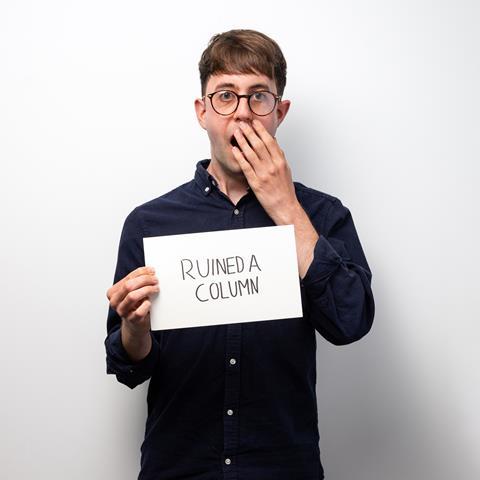
Chemistry World is producing a series of articles about the low-stakes mistakes we have all made at some point in our studies or careers. We’d love to hear about your own experiences.
If you have a story to share, from a lab mishap to a presentation pratfall, you can submit it by following this link. You can choose to share your story anonymously if you prefer.
We will publish some of these contributions in an article later this year. For now, you can read about mishaps that have befallen members of the Chemistry World team.
Chemistry World welcomes letters, which should be concise (normally fewer than 300 words) and timely. Those selected for publication are subject to editing for clarity and length. Letters should be marked ‘for publication’ and sent to chemistryworld@rsc.org
We do not routinely acknowledge letters.








No comments yet