
The winner of the 2025 Nobel prize in chemistry on books, porous materials and his mantra for success
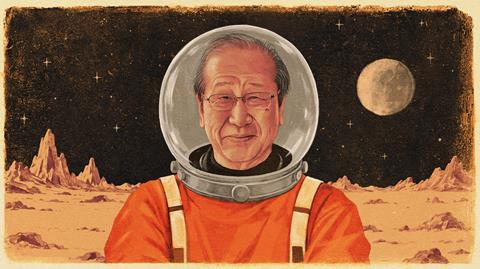
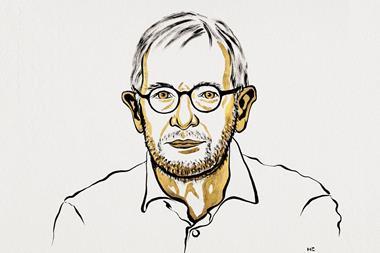
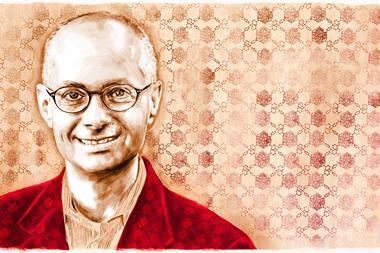
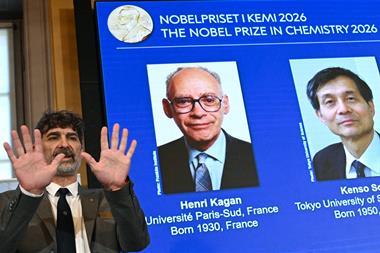
Susumu Kitagawa is a professor of chemistry at the University of Kyoto in Japan. He won the 2025 Nobel prize in chemistry, along with Omar Yaghi and Richard Robson, for his work on metal-organic frameworks (MOFs) and other porous materials.
I like reading. One person experiences only a narrow window of life but reading means that I have various types of experiences. As a kid, I would read all sorts. I liked the story of Einstein. I liked books by Hideyo Noguchi, who was a famous Japanese bacteriologist. These inspired me about science.
When I was a junior high school student, my friend read lots of science fiction stories. He introduced me to Fredric Brown. His science fiction is fantastic, and I’ve had a lot of ideas inspired by his work.
I remember going on an excursion with school. When I was in elementary school, it rained, and that made me sad. I wanted to develop scientific and technological innovations that could change the climate and weather. Through that desire, I realised that science could be very good for our society.
I studied engineering at Kyoto University. My cousin told me that as I was interested in science, Kyoto would be good as it has a strong tradition of teaching basic science.
I was initially very interested in physics. I studied quantum mechanics during my early years at university, and went on to study quantum chemistry. Through this experience, I learned that electrons play a crucial role in molecular structures and reactions, and I then developed an interest in chemistry – particularly in the synthesis of materials and the creation of new functions.
Chemists can recognise the difference between ethanol and methanol. Theoretical physicists and mathematicians cannot distinguish them – they only know after drinking methanol.
It is very important to ask questions and take time to digest information
After my PhD, I started researching copper(i) chemistry. It looks like that ion is very boring because it is not coloured and it has no magnetic spins. But that was very important because the electron configuration is a sphere. This makes it easier to obtain single crystals with a network structure formed by copper and organic molecules.
Our interest at the time was trying to make linear chain systems. While elucidating the network structure through x-ray structural analysis, as I was examining an intermediate structure, one of my students pointed out that these materials contained beautiful voids that could accommodate counterions and organic molecules. I thought to myself, ‘Ah, perhaps we could replace the guest molecules’. That was the beginning of my research into porous structures.
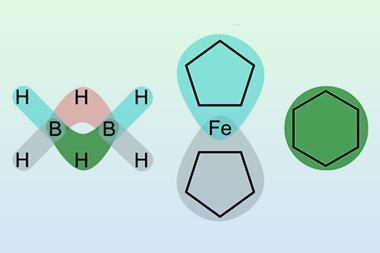
I am interested in properties. Anytime I think about that, I think it was because I was strongly influenced by Nobel laureate Kenichi Fukui, who looked at electron behaviour and came up with frontier orbital theory.
I tell my students three words: luck, stubbornness and perseverance. Or un, don and kon in Japanese.
For most people, luck is luck. They pray to get something. It’s not true. ‘Chance favours a prepared mind,’ Louis Pasteur once said. To cultivate that mindset, you should engage in discussions and conversations with as many people as possible while you’re young. Do interesting things with curiosity. Read widely.
Stubbornness is very important too because this is the ability to not accept everything immediately. It is very important to ask questions and take time to digest information. If you don’t understand something, take your time to think it over.
Persevere. Once you get started in science, you need to have a strong mind and attitude. Never give up – that’s important. Though it’s easy to say ‘persevere’ but difficult to do.
This interview has been edited for clarity and brevity.




No comments yet