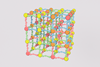
Frameworks built from multiple different metals and ligands are expanding the possibilities for materials that can do many things at once
Omar Yaghi is convinced that chemists should embrace complexity. ‘Right now, materials in general have one structure, one property, one operation,’ he says. ‘[Yet] it would be great if we could design materials… where several things are happening at once.’
This is surprising for a chemist who helped establish the field of metal–organic frameworks (MOFs), a contribution recognised by last year’s Nobel prize in chemistry, which Yaghi shared with Susumu Kitagawa and Richard Robson. Yet in recent years, Yaghi has moved away from creating conventional MOFs built from a single type of linker and metal node. Instead, he and other chemists have found ways to incorporate multiple organic ligands and different metal building blocks within a single structure.
It would be great if we could design materials… where several things are happening at once
This new class of materials – known as multivariate- or MTV-MOFs – drastically expands the scope and capability of porous frameworks. ‘[Chemists] look at [MTV-MOFs] and they say “Oh my God, this is just in one structure? You have too many things happening”,’ says Yaghi. ‘A lot of people shy away from it [but] I think that [it’s] a big opportunity to transform our chemistry.’
MTV-MOFs allow chemists to create materials that have pores of various sizes and chemistries, which often leads to structures with multiple functions. This could be, for example, a material that captures carbon dioxide in one part of a framework and then uses the bound molecules in a catalytic reaction in another region.
Yaghi notes that these materials take inspiration from nature, which thrives on combining multiple building blocks together for a specific function. Collections of different amino acids decorate an enzyme’s active site, for example, producing a finely tuned catalyst. Similarly, having a mixture of metals and ligands within an MTV-MOF could help control the function and specificity of these materials. Combining a range of building blocks also drastically increases ‘the possibilities of different compounds being made with different combinations,’ Yaghi explains.
Neil Champness at the University of Birmingham, UK, shares Yaghi’s enthusiasm for these materials. ‘There were already enormous numbers of MOFs, but [these multivariate materials] basically take the cap off… [it’s] essentially an infinite number.’ While for many chemists this may seem daunting, Champness thinks, like Yaghi, that chemists should embrace complexity. ‘You can make 1000 different MOFs until you’ve found the one which is right, or you [can] make a multivariate system that does the reaction anyway.’
Making MTV-MOFs
In 2010, Yaghi’s team at the University of California, Berkeley in the US produced one of the first MTV-MOFs by reacting zinc oxide clusters with functionalised terephthalic acid linkers. This led to a series of materials that had up to eight different organic ligands in one structure.1 ‘Typically in inorganic chemistry… when you have multiple building blocks coming together, you make multiple compounds,’ Yaghi explains. He describes realising that these framework materials don’t behave in the same way as a ‘big discovery’. This prompted Yaghi’s team to propose a new class of materials, which is when they coined the term MTV-MOFs to describe them.
Fifteen years later, his team has now created several MTV-MOFs, some of which have up to 36 different ligands.2 Yaghi’s group noted at the time that this particular material had a ‘record number of linkers and functionalities’ in a single framework. This may seem like an exercise in seeing just how complex these materials can become. But the team think that MTV-MOFs with this number of linkers could help chemists quickly identify which ligands or combinations thereof work best for a specific application. This drastically cuts the number of homogeneous MOFs that chemists would need to make, saving time and resources.
Yaghi’s team was able to synthesise such MTV-MOFs using similar methods to typical framework materials. This involves heating multiple linkers with metal building blocks in solution for several days, before repeatedly washing the crystals with solvent. Adjusting the ratio of the linkers and metals then allows chemists to create different MTV-MOFs.
However, this method doesn’t work for all MTV-MOF structures. For example, certain frameworks are challenging to make from scratch as introducing multiple ligands can affect their solubility or cause linkers to compete for interactions with metal nodes.
Chemists have since found alternative ways to synthesise these materials. Seth Cohen at the University of San Diego in the US says that as ‘these [framework] materials are just basically acting like big coordination compounds’, chemists can exploit this property to make MTV-MOFs. This involves swapping out organic linkers within a pre-made framework – a technique known as postsynthetic ligand exchange. Typically, this is limited to replacing one linker with an organic molecule of a similar length and connectivity, as this helps maintain the MOF’s overall structure. Cohen adds that this process usually occurs from the outside-in, which can create layers that have different linkers. Leaving the reaction for longer would eventually replace all ligands, creating a different but homogenous MOF, rather than an MTV-MOF.
His team showed that this technique could work back in 2012 by swapping out the brominated ligands in a zirconium-based MOF for an amino-functionalised linker.3 Reacting the homogeneous amino- and brominated-MOF structures together also led to a MOF containing both linkers, as the ligands of either MOF partially exchanged.
Rather than swapping out ligands, chemists are also able to chemically modify the linkers themselves. Cohen’s team, for example, was able to react amino-functionalised ligands with anhydrides of various chain lengths, with conversion rates ranging from 11 to 99%.4 ‘Basically, any time we had a post-synthetic modification reaction on a ligand that didn’t go to completion, by definition, we had created a multivariate MOF,’ says Cohen.
These modifications allowed the group to alter the hydrophobicity of a zinc-based MOF, as well as its internal surface area. Synthesising these materials in this way ensured ‘reliable access to a family of closely related MOFs,’ the group noted, which made it easier to compare material properties. Ligand modification also works for various other functional groups, including azide click reactions5 to incorporate fluorescent tags or Schiff base reactions with amines.6
What are multivariate metal-organic frameworks?
A quick introduction to why complexity is the next challenge for MOF materials
What is a metal-organic-framework (MOF?)
MOFs are 3D network materials made of metal ions or clusters connected by organic linkers. They are often highly porous, with voids that can capture molecules selectively, making them useful in a wide variety of applications such as separations, sensing, gas storage and catalysis.
What is a multivariate MOF (MTV-MOF)?
Conventional MOFs typically contain a single type of metal node and linker, but MTV-MOFs incorporate multiple linkers and nodes. The result is a material that combines an ordered framework with chemical heterogeneity.
How do you make MTV-MOFs?
The simplest way is to mix the metals and linkers in a solvent, then heat, just like a normal MOF. Researchers often select linkers with similar shapes but different functional groups, thereby introducing extra functionality without changing the framework structure.
You can also make a MOF first and then modify it in various ways:
- Ligand exchange can be used to replace linkers with new ones
- Metal exchange can swap out some of the metal ions with different metals
- Chemical modification can transform functional groups on some of the linkers
Why are chemists excited by these materials?
MTV-MOFs offer a way to introduce complexity into highly ordered materials, mimicking the kind of controlled complexity found in biological systems.
An MTV-MOF could, for example, capture a molecule in one part of the framework and transform it chemically in another, allowing several functions to operate within a single material.
Is that as simple as it sounds?
No, it’s much harder. The feature that makes MTV-MOFs attractive also makes them difficult to study: complexity.
Like conventional crystalline MOFs, MTV-MOFs retain an ordered framework, but there is chemical diversity within it, blurring the line between order and disorder.
The lack of uniform composition means they are also much harder to characterise – the local composition varies across the material in ways that can be hard to predict.
Give me some examples
MTV-MOF-74 is based on a framework in which divalent metal ions are linked by 2,5-dioxidoterephthalate. It can contain up to 10 different metal ions and chemists can tune its overall composition to alter its properties. For example, introducing Ni2+ or Co2+ into Mg-MOF-74 can improve its stability in water.
MOF-303/MIL-160 combines two linkers, 3,5-pyrazoledicarboxylic acid from MOF-303 and 2,5-furandicarboxylic acid from MIL-160, with aluminium-based nodes. MOF-303 provides high carbon dioxide uptake, while MIL-160 offers stronger carbon dioxide selectivity. By combining both features, the MTVMOF achieves improved carbon dioxide separation from methane compared with either parent material.
All pictures © SciComm Studio/Anna Tanczos
Mixing metals
‘Now, with [exchanging] metals, it’s a little bit different,’ explains Cohen. Metal ions have different sizes, coordination numbers and coordination geometries. To keep the MOF structure intact, chemists are often limited to exchanging metal ions with ones that form stronger bonds with a given organic linker. This typically follows the Irving–Williams series, such that Cu(II) ions can swap out Zn(II) ions, but not the other way around.
Natalia Shustova and her research group at the University of South Carolina in the US recently used this strategy to create a photocatalytic copper-based MOF from its zinc precursor.7 To do this, the team immersed a zinc-based MOF in a copper nitrate solution, resulting in around 95% of the zinc ions transmetallating with copper cations.
Exposing the mixed-metal framework to ultraviolet light caused electrons to transfer from a photoactive spiropyran linker to the copper cations. X-ray photoelectron spectroscopy revealed that the MTV-MOF had a combination of Cu(II) and Cu(I) cations. These metal sites were then able to work together to catalyse the coupling reaction between an aldehyde, azide and aminated pyridine to form a variety of commodity chemicals and pharmaceuticals, such as the drug zolpidem, which is used to treat insomnia. Achieving this would not have been possible in a zinc-based framework as its d10 electron configuration makes the metal catalytically inactive, Shustova says. However, synthesising the copper-based framework from scratch is challenging. Swapping out zinc ions for copper cations allows the team to get the desired catalytic properties from a known zinc-based material.
Champness’s group has also been experimenting with making framework materials with multiple metals. In a recent preprint, his team reported how it had introduced all the lanthanide elements into a single structure.8 ‘We were doing it purely from a curiosity point of view,’ Champness says. Even so, as lanthanides fluoresce in the UV, visible and near-infrared regions of the electromagnetic spectrum, these elements are useful as biological imaging agents, for example. Introducing multiple metals into a framework and varying their concentrations could create new materials with tuneable emissive properties, says Champness. Such materials combine the useful properties of multiple lanthanides, rather than being limited to MOFs with a singular function.
However, Champness explains that although the team reacted various lanthanide ions in a one-to-one ratio, this did not necessarily lead to the same metal ratios in the final product. Trivalent lanthanides have similar coordination properties, but they decrease in size across the period. This leads to a preference for smaller cations with higher charge density to the metal nodes within the framework, as they bind more strongly to the organic linkers.
Scanning electron microscopy helped Champness’s team probe which metals cations were in the structure, as well as their location, while advanced mass spectrometry determined their quantity. ‘How those metals order through the MOF is completely variable within our systems,’ explains Champness. ‘It’s entirely random as far as we can tell.’
Chemists can also use other techniques to probe the structure of these multivariate materials. High resolution solution and solid-state NMR can help determine the ratio of linkers, for example, while x-ray diffraction experiments reveal the material’s overall bulk structure. However, these analytical methods have drawbacks, such as overlapping signals from similar ligands. Reduced signal intensity, owing to less of each metal or linker in such frameworks, can also make it challenging to fully assign peaks and characterise these materials.
The experiments to characterise these materials can also be time consuming and difficult. For example, Yaghi’s team has previously used a technique known as atom probe tomography to map the metal sequences in mixed-metal MOFs.9 Laser pulses sequentially evaporate the ions at the material’s surface on to a detector, which then analyses the ion’s mass-to-charge ratio. This allowed the team to construct a 3D map of the framework. The team found that metals were, relative to each other, either randomly positioned, clustered or inserted sparingly throughout the framework, depending on the specific combination of metals and reaction temperature.
However, ‘shaving’ each of the layers of the materials, analysing them individually and using this technique for large numbers of materials is going to be difficult, notes Champness.
‘As scientists, we tend to like to know the answer to everything,’ says Champness. ‘[But] you could ask the question: ”Do you need to know what the [exact] structure is?”’ If chemists synthesise a multivariate framework with a specific property – perhaps one that catalyses a certain reaction or interacts with a specific molecule – and can reproduce the property each time, then knowing the local structure of these materials is less important, Champness argues. He likens it to polymer chemistry, where chemists don’t always know the exact ordering of monomers and instead care about the overall properties of the polymer itself.
‘There is essentially a cost–benefit analysis at some point,’ says Champness. ‘Working out local structure is time consuming and difficult, so there needs to be a reason for doing it… Sometimes there is [and] sometimes there isn’t.’ Understanding the local structure might be relevant if a material has an unusual or unexpected property, for example.
Computing complexity
Using computational methods to design, study and analyse MTV-MOFs could help researchers understand how multiple linkers and metal cations combine, without needing to carry out hands-on experiments. Yaghi points out that even a small set of metal nodes and linkers can generate an incomprehensible number of possible MTV-MOFs. Diversity arises not only from the choice of building blocks, but also from the many ways they can be combined. As a result, ‘we’re not going to madly be making one MOF after another’, he says.
Emma Wolpert at University College London, UK, explains that ‘computational models can generate different possible arrangements of metals, linkers, defects or domains, and then test which models are consistent with the experimental data’.
‘For example, we can compare simulated and experimental diffraction patterns, … spectroscopic signatures or measured properties. This can help distinguish between a truly random mixture, correlated disorder [or] clustering,’ she adds.
However, Wolpert recognises that while thermodynamics primarily guides the creation of such materials, solvent, kinetics and different crystal growth pathways all affect the final structure. ‘Computational methods can address some of these effects, but they are much more difficult, system-specific and not yet routine for high-throughput design,’ she says.
‘I would think that [artificial intelligence (AI)] for something like multivariate MOFs could be super valuable,’ says Cohen. He explains that AI tools could help chemists figure out synthetic conditions, synthetic strategies and ligand modifications that would create a certain structure. ‘AI can really find parameters and data that you wouldn’t think about being correlated with a certain property,’ he adds.
While computational and AI models will likely change how chemists study these materials, MTV-MOFs will also influence synthetic approaches. Yaghi notes that controlling the temperature, the quantity and purity of starting materials and other reaction conditions will be critical, for example. ‘[These multivariate materials are] going to require chemistry to be even more rigorous than we are [currently] to produce the same material [each time],’ he says. This will be crucial when scaling up and producing these materials at the commercial level, he notes.
Finding applications
‘A lot of very important chemical transformations, [like] the challenges of turning carbon dioxide into something useful, becomes an interesting possibility,’ with MTV-MOFs, says Yaghi. He points out the resemblance of these materials to biological enzymes, owing to the pores acting like active sites.
In 2016, Yaghi and his team were able to create an enzyme-like MTV-MOF, which could selectively cleave specific peptide bonds as efficiently as the enzyme TEV protease.10 Synthesising a magnesium-based MOF with protected amine groups allowed the team to introduce several tripeptide amino acid sequences into the MOF’s pores. The amino acids are similar to those found in the biological enzyme. ‘We just sort of threw [the amino acids] in there, onto the skeleton, and we found that this MOF does exactly what the enzyme does,’ says Yaghi.
The simplicity of the idea drags you in … and you get sucked into this whirlpool of possibilities
Aside from capturing biological-like activity in synthetic materials, Yaghi’s team has also created MTV-MOFs to harvest water from the atmosphere, even in desert regions with low humidity.11 The team has developed a series of aluminium-based MTV-MOFs by varying the ratio of two organic ligands during synthesis: a dicarboxylate thiophene and a dicarboxylate pyrazole. Increasing the proportion of pyrazole linkers makes it more energetically favourable for water molecules to adsorb at lower humidities. Equally, MOFs that have a higher proportion of thiophene can desorb water at lower temperatures, such as at night. Balancing the ratio of these linkers has led to an MTV-MOF with optimised properties, which the team has scaled up to produce several kilograms in one batch with yields reaching up to 90%. Yaghi’s team has recently filed a patent for this material.
For Yaghi, this water-harvesting material represents a shift from chemists simply making, characterising and studying a material, to pushing compounds ‘all the way to commercialisation’. ‘That would be what a chemistry lab would [now] be doing – not just making the molecule and the material but also integrating that material into a device.’
Expanding the scope of these multivariate frameworks is going to require collaboration between chemists, as well as material scientists, biologists, mathematicians and physicists. ‘I think the beauty of MOFs is that almost anybody with a chemistry degree can come up with an idea for a new [structure],’ says Champness. ‘The simplicity of the idea drags you in, and then there’s endless complexity, and you kind of get sucked into this whirlpool of possibilities.’ For Champness, ‘multivariate [MOFs] are just kind of an extension of that experience’.
References
1 H Deng et al, Science, 2010, 327, 846 (DOI: 10.1126/science.1181761)
2 M Burigana et al, Inorg. Chem., 2025, 64, 5561 (DOI: 10.1021/acs.inorgchem.5c00015)
3 M Kim et al, Chem. Sci., 2012, 3, 126 (DOI: 10.1039/c1sc0 0394a)
4 K K Tanabe, Z Wang and S M Cohen, J. Am. Chem. Soc., 2008, 130, 8508 (DOI: 10.1021/ja801848j)
5 X Zhang et al, J. Solid State Chem., 2017, 253, 277 (DOI: 10.1016/j.jssc.2017.06.008)
6 Y-P Wei et al, Dalton Trans., 2019, 48, 8221 (DOI: 10.1039/c9dt01767d)
7 M Naik et al, J. Am. Chem. Soc., 2026, 148, 22240 (DOI: 10.1021/jacs.6c05401)
8 A Ishaq et al, ChemRxiv, 2026, DOI: 10.26434/chemrxiv.15004498/v1
9 Z Ji, T Li and O M Yaghi, Science, 2020, 369,674 (DOI: 10.1126/science.aaz4304)
10 A M. Fracaroli et al, J. Am. Chem. Soc., 2016, 138, 8352 (DOI: 10.1021/jacs.6b04204)
11 Z Zheng et al, J. Am. Chem. Soc., 2022, 144, 22669 (DOI: 10.1021/jacs.2c09756)


No comments yet