
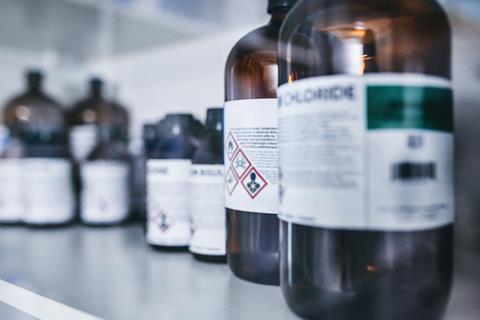
An analysis of the chemical processes described in four decades’ worth of US patents appears to show that chemists are failing to reduce their use of hazardous solvents. This is despite the growing awareness of the safety and sustainability issues that many solvents pose and the availability of safer and greener alternatives. The researchers behind the work warn that this overreliance on hazardous solvents in historic datasets could bias AI-based synthesis planning tools that are trained on them, which could in turn perpetuate hazardous practices rather than promoting sustainability.
Solvents make up the bulk of material used in, and wasted by, most chemical processes. For example, solvents account for around 80% of the total material used in the manufacture of active pharmaceutical ingredients. As such, reducing solvent use, and replacing harmful solvents with ones that are more benign, is one of the 12 core principles of green chemistry.
But new research suggests that, when it comes to phasing out harmful solvents, chemists are broadly failing to turn words into action. Green chemist Helen Sneddon from the University of York and Maarten Dobbelaere, a cheminformatics specialist now at EPFL in Lausanne, Switzerland, have analysed reports of 1.3 million reactions taken from 40 years of US patent data.
‘I’ve long been interested in the extent to which people are acting as purely rational beings and picking the solvent that’s going to be best for their reaction or for the wider environment, versus defaulting to what’s the precedent, what’s readily available in their lab, cheapest, etc,’ says Sneddon.
Classifying reactions
To dig into this problem, the researchers used an open-access tool called Rxn-Insight that Dobbelaere had developed during his PhD, which classifies all reactions in the US Patent and Trademark Office database from 1976–2016 into 500 reaction types. This enabled them to analyse solvent use across different stages of chemicals processes – reaction, work up, purification and analysis – as well as trends in how solvent selection has changed over time for specific reaction types.
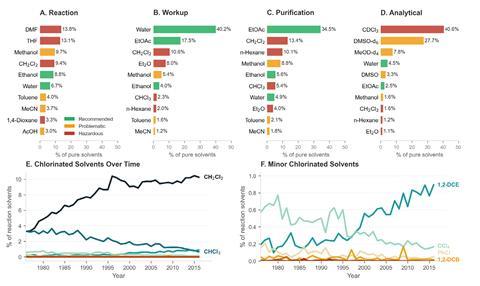
Using Rxn-Insight, Sneddon and Dobbelaere probed the changing use of solvents that are categorised as red (hazardous or problematic), amber (some issues) or green (preferred), according to GSK’s solvent sustainability guide. Sneddon notes that these categories are broad – a red solvent could be classified as such due to its high flammability, health or environmental toxicity, or difficulties associated with recycling it, for example. And chemists might have specific reasons for choosing a red or amber solvent in particular circumstances – perhaps they’re trying to stabilise a transition state, or they need the solvent to have a particular melting or boiling point, or to be transparent to specific wavelength of light.
But despite these caveats, Sneddon explains that using these categories helps to illuminate wider trends in solvent use. ‘It does give an interesting helicopter view oversight – interesting and not as encouraging as we would have liked to have found,’ she says. ‘It’s great because it can drive future research too. It highlights areas where we really need greener alternatives.’
Strikingly, Sneddon and Dobbelaere found that three of the four most commonly used reaction solvents – dimethylformamide, tetrahydrofuran and dichloromethane – are classified in the red or amber categories. Digging further into the data, they noticed that substrate solubility requirements don’t seem to correlate to the solvents being selected for particular reactions. This suggests that chemists are often choosing to use harmful solvents out of habit, rather than because of any solvation advantage that they offer.
‘I initially anticipated that … if you’ve got a really greasy substrate, you might be using this solvent rather than this one for this reaction type – you don’t see that at all. That was my own misconception,’ says Sneddon.
Additionally, Sneddon and Dobbelaere point out that while the use of some chlorinated solvents like chloroform and carbon tetrachloride has decreased over time, 1,2-dichloroethane has shown sustained growth. The researchers warn that this could indicate that restrictions on particular solvents may drive chemists to simply substitute them with another from the same hazard class, rather than prompting them to look for ‘structurally different, less hazardous alternatives’. This ‘lateral substitution’ was identified across all of the reaction classes that Sneddon and Dobbelaere examined.
According to Timur Madzhidov, a senior product manager for Elsevier’s Reaxys platform, with responsibility for AI applications in chemistry, the findings serve as a ‘warning sign’ for the chemistry community. ‘It is well known that solvents are the most important source of contamination and environmental impact from the chemical industry, and that’s why the mitigation of usage of unsafe solvents is absolutely needed,’ he says.
Inspired by Sneddon and Dobbelaere’s findings, Madzhidov explains that he ran an initial analysis of solvent use across the Reaxys database, covering reactions reported in millions of journal articles in addition to patent data. ‘I decided to check what we can see, on average, on the whole of Reaxys, and I would say the signs are even worse,’ he says. ‘According to my investigation, I see that the usage of red solvents – those that are considered most dangerous – is stuck at approximately the 50% level and it doesn’t decline over the years.’
Impact on AI chemistry software
Sneddon and Dobbelaere warn that the historic reliance on hazardous solvents could create new problems for future chemists. With an increasing interest in developing AI models to predict and optimise reaction conditions, there is a concern that biases in the training data could lead these tools to perpetuate the use of hazardous solvents.
Dobbelaere points out that this concern is similar to those seen in other areas of AI, for example the widely recognised gender and racial biases seen in many AI tools.
‘The idea for that came from other aspects of artificial intelligence – people are aware that there are biases in artificial intelligence based on what we train them on … so why would it not be in chemistry?’ he says. ‘There are already ideas of chemical bias that it’s towards specific substrates and so on. So with these solvents, based that they are on the colours red, amber, green, and we see that share of red growing, it’s very likely that they are also biased towards more red solvents.’
Madzhidov agrees that it is likely AI models trained on these historic datasets would be biased in such a way, but he is hopeful that it could be a straightforward problem to solve. ‘Yes, AI models are biased toward more popular conditions and that may introduce the risks that [Sneddon and Dobbelaere] raise,’ he says. ‘However, usage of additional input from the model users may help to overcome that bias. For example, users can give additional information like I want to avoid hazardous solvents, and since a model can predict many solvents, it can select you the optimal choice. So, currently, yes, models are biased toward predictions based on popularity. On the other side, it is fairly simple to shift this bias through user direction.’
Correction: This article was updated on 19 October 2026 to correct Maarten Dobbelaere’s affiliation.
References
M R Dobbelaere and H F Sneddon, Angew. Chem., Int. Ed., 2026, DOI: 10.1002/anie.1677569










No comments yet