
For the first time, researchers have discovered a microorganism that has made metal–organic frameworks (MOFs) and it appears to have been making them for millions of years. These supramolecular structures also have excellent conductivity and can transport electrons over distances spanning several centimetres, helping the bacteria survive the harsh environment on the seafloor. ‘It is a whole new type of [bio]molecular structure,’ says lead author Filip Meysman from the University of Antwerp, Belgium.
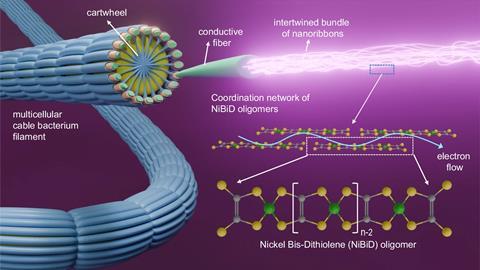
The basic building blocks the bacterium Candidatus Electrothrix gigas needs to make MOFs are strikingly similar to those used by chemists. However, while the metal core and connecting linkers remain the same, ‘the resulting supramolecular structure is very unique and novel’, says Meysman. These bacteria build bundles of intertwined MOF nanoribbons that are ‘unseen in human-made materials’. Such an architecture creates an excellent electronic environment for electrical conductivity, with conjugation and delocalisation to ‘enable electron transport over extremely long distances’, he adds. Bacteria capable of creating conductive cables ‘originated about 600 million years ago’, and have probably been making MOFs ever since, explains Meysman.
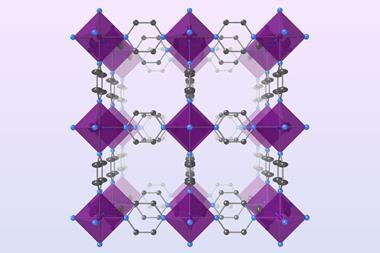
‘This is a great discovery,’ says Aitziber Cortajarena, an expert in biomaterials based at CIC biomaGUNE in San Sebastián, Spain. This is the first report of a MOF of biological origin, she explains, which ‘reveals a new set of [bio]tools to create conductive structures’. In this case, the MOF is nickel based and linked together by organic dithiolene ligands to form a complex that Cortajarena says closely resembles conductive polymers.
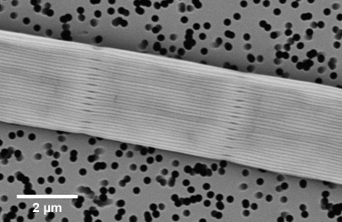
Moreover, the bacterium creates a MOF with ‘highly efficient electric conductivity … similar to the best synthetic polymers and exceeding most [synthetic] MOFs’, she adds. Meysman says that the conductivity of the MOF is ‘extraordinary’ adding that ‘it approaches the conductivity of metals’.
The bacterium investigated by Meysman’s team are part of a family commonly called ‘cable bacteria’ and they create these conductive structures to help them survive on the seafloor. ‘It’s an evolutionary advantage,’ says Cortajarena. Without the wires, a basic biological function would become impossible, she explains. These bacterial ‘cables’ dig deep into the sediment to access sulfides, which are then oxidised to release electrons for other metabolic reactions. This MOF allows the bacteria to access energy and electron sources that are ‘otherwise out of reach’. ‘They carry out redox reactions with electron donors and acceptors separated over centimetres,’ adds Meysman. This distance, only reachable thanks to the MOF nanoribbons, is approximately 10,000 times the length of a single bacterium.
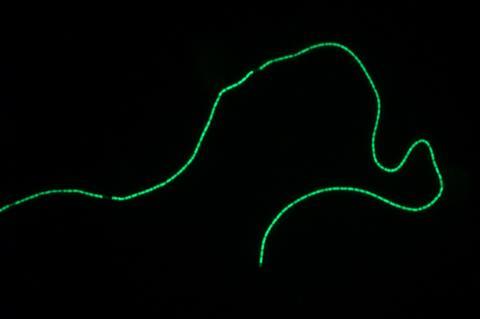
Researchers have identified 90 different bacterial species that employ conductive structures and they may all depend on these types of MOFs to survive. ‘The same spectroscopic signature was detected across cable bacteria … from different environments, suggesting the [supramolecular] structure is shared by many microorganisms’ in the same family, adds Cortajarena. ‘It is a strong inspiration towards … novel hybrid biomaterials.’
Meysman says that his group is ‘currently investigating how to produce these wires’, as well as ‘preparing a start-up’ to commercialise the conductive materials. The MOF supramolecular structures could stimulate ‘the design of sustainable and [efficient] electronic materials’, he adds.
References
F J R Meysman et al, Nat. Commun., 2026, 17, 8814 (DOI: 10.1038/s41467-026-76989-0)






No comments yet