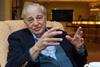
The Canadian-born American theoretical chemist Rudy Marcus, who won the chemistry Nobel prize in 1992 for his contributions to the theory of electron transfer reactions in chemical systems, passed away on 16 July – less than a week before turning 103 years old. He kept active in research and in his lab at the California Institute of Technology (Caltech) until the end of his life and is remembered as an extraordinarily generous and modest man, despite all his accomplishments.
Across the three US research institutions where Marcus taught and conducted research, Caltech estimates that he mentored more than 100 postgraduate students and postdocs, on top of hundreds more undergraduates.
‘Full of zest for research and solving problems, he remained active in his field and was hard at work on three scientific papers at the time of his death,’ according to a statement from Marcus’s family. Marcus had three sons, four grandchildren, a great-grandson, as well as longtime companion and colleague German physical chemist and biophysicist Maria-Elizabeth Michel-Beyerle. Laura Marcus, his wife of 54 years, passed away in 2003.
‘Rudy’s contributions are foundational,’ said David Beratan, a chemist at Duke University, US, who worked closely with Marcus as a graduate student at Caltech in the early- to-mid-1980s. ‘His discoveries continue to drive experimental and theoretical programmes in hundreds of laboratories across the globe,’ Beratan says.
Marcus, who was born on 21 July 1923 in Montreal, Canada, was the only child of parents who never graduated high school. He earned an undergraduate degree in chemistry from McGill University in 1943 and then completed a PhD in chemistry there in 1946. Subsequently, Marcus was a postdoctoral fellow at the National Research Council in Canada from 1946 to 1949 and then did a second postdoc at the University of North Carolina at Chapel Hill that was focused on theory. While there, Marcus met Laura Hearne, who was a sociology and cultural anthropology graduate student. They married just six months later.
The Marcus theory is born
Next, he took up an assistant professorship in the early 1950s at what was then known as the Polytechnic Institute of Brooklyn. At that institution, which has since been integrated into New York University, he developed what came to be known as his namesake Marcus theory of electron transfer. It is a mathematical model to describe the rates of electron-transfer reactions in solution that sheds light on why some reactions involving simple electron transfer happen quickly, while others take far longer than expected.

When recalling this work in 2011, Marcus said it took him just a month to produce the equation. ‘It was the fastest thing I’ve ever done before or since,’ the university quotes him as saying.
‘The importance of Rudy Marcus’s theory of electron transfer cannot be overstated,’ said Sarah Reisman, a Caltech chemist and the chair of the university’s chemistry and chemical engineering division. ‘It provides a simple theoretical framework for one of the most fundamental processes in chemistry and has been applied to understand reactions ranging from small-molecule catalysis to complex biological systems.’
At the Polytechnic Institute, Marcus became an associate professor in 1954 and a full professor in 1958, before moving to the University of Illinois in 1964. He joined Caltech in 1978 as a tenured chemistry professor and never left.
Beyond Marcus’s electron transfer discoveries, his many other achievements include co-developing the Rice–Ramsperger–Kassel–Marcus theory, which describes the rates of unimolecular chemical reactions.
He won the Wolf prize in chemistry in 1985 for ‘his contribution to chemical kinetics, especially the theories of unimolecular reactions and electron transfer reactions’, and the US National Medal of Science in 1989 for ‘his fundamental, far-reaching, and eminently useful developments of theories of unimolecular reactions and of electron transfers in chemistry and biochemistry’.
Just two years ago, Caltech honoured Marcus’s legacy by naming a new theoretical chemistry centre after him, following a $30 million (£23 million) gift from a husband-and-wife team who were postdocs in Marcus’ Caltech research group in the late 1980s.
The oldest chemistry Nobel laureate
He is the longest-lived chemistry Nobel laureate ever, with John Goodenough, who passed away at age 100 in June 2023, the second oldest. However, two winners in other science Nobel prize categories have lived longer – Chen Ning Yang, a theoretical physicist who shared the physics Nobel in 1957 and died last year two weeks after reaching 103, and Rita Levi-Montalcini, who shared the physiology or medicine Nobel in 1986 and was a few months from her 104th birthday when she passed away in late 2012.
Physical chemist Paul Weiss, presidential chair in chemistry at the University of California, Los Angeles, who worked with Marcus in the late 1980s, describes him as humble, warm, insightful and extremely encouraging. ‘One of the most surprising things about him was that, even though he was the world expert, he would ask questions and want to turn over ideas together,’ Weiss says.
Greg Voth, a chemist at the University of Chicago who was mentored by Marcus during his PhD in theoretical chemistry in 1987, notes that he maintained a small research group with four or five graduate students. ‘He was more focused on solving problems and did a lot of the work himself – not so much computer work but pencil and paper analysis – and so he felt a group of about five people – grad students and postdocs – was ideal for him,’ Voth explains.


No comments yet