Chemists reveal just how much angle – and proximity – matters for molecules to react when they collide
By  Tim Wogan2026-07-24T09:52:00
Discovery could one day allow chemists to create more efficient reactions that require less energy
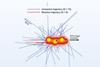
The likelihood that two colliding molecules react depends strongly on the angle, researchers in Europe have shown. The research could potentially be extended to study the effects of other variables on collision outcomes and, ultimately, to design more efficient chemical reaction pathways.
When atoms or molecules collide, the particles may simply bounce off each other. Alternatively, the collision can lead to bonds breaking or forming. The factors governing whether a collision is reactive or not are still not fully understood, however. In 2018, chemical physicists in the group of John Polanyi at the University of Toronto in Canada – who shared the 1986 Nobel prize in chemistry for work on reaction dynamics – aimed difluorocarbene molecules adsorbed onto copper at each other and used scanning tunnelling microscopy (STM) to show that they were more likely to react in the case of a head-on collision than a glancing blow.