

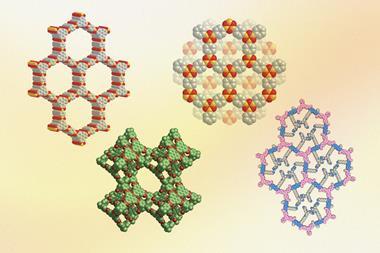
Covalent organic frameworks (COFs) can be used to rearrange water molecules, increasing the efficiency of the reduction of nitrate to ammonia, researchers in China have shown. This could both reduce the energy intensity of ammonia production and help to remediate water pollution.
The Haber–Bosch synthesis of ammonia, developed in the early 20th century, has helped enable Earth’s population to grow from around 1.6 billion in 1900 to 8.3 billion today. Global production is currently nearly 250 million tonnes per year, with 70% of this being used to produce fertiliser. More recently, ammonia has attracted interest as a carbon-free fuel.
The Haber–Bosch process, however, is far from carbon free: it accounts for 1.3–1.8% of global carbon emissions owing to the usually fossil fuel-derived hydrogen and extreme conditions required. A greener electrochemical synthesis is highly desirable. An additional downstream complication of ammonia is that fertiliser leads to nitrate runoff into the watercourse, where it disrupts ecosystems and can even harm human health. The electrochemical reduction of nitrate back to ammonia therefore offers a potential bipartite solution, remediating polluted water while providing a more environmentally benign source of ammonia.
The nitrate reduction reaction is a complex, multi-step process involving the coupled transfer of eight electrons and nine protons. It therefore tends to be kinetically sluggish and require a substantial overpotential thanks to repulsion of nitrate ions from the cell cathode. COFs are widely used in catalytic systems owing to their high surface area and several groups have explored them in the nitrate reduction reaction. However, sluggish kinetics has remained an intractable problem, largely owing to the fact that a catalyst does not work unless the reactant contacts it.
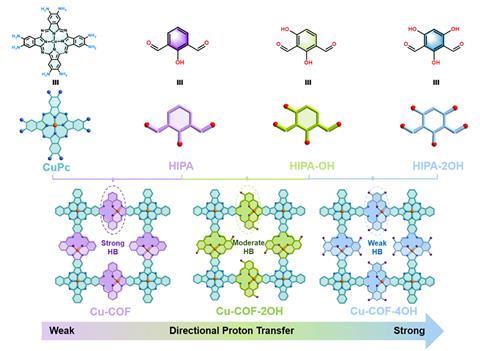
In the new work, Dengsong Zhang at Shanghai University in China and colleagues engineered a series of COFs containing copper phthalocyanine – a well-established catalyst for the reduction of nitrate – functionalised with varying numbers of hydroxyl groups. The researchers found that adding up to four hydroxyl groups to the phthalocyanine increased both the rate of ammonia production and the selectivity for the nitrate reduction over the competing hydrogen evolution reaction. Theoretical calculations suggest this is because water molecules adsorb onto the hydroxyl groups and rearrange into molecular wires. ‘The reconstructed hydrogen-bond network with two-dimensional connectivity provides a linear pathway for the interfacial transport of protons generated on Cu-COF-4OH, enabling directional proton transfer to the Cu active sites and thus boosting the efficient proceeding of [the nitrate reduction reaction],’ the researchers write.
‘We’ve had a lot of – maybe hundreds of – papers on nitrate reduction coming from the community, but I think this is a good one,’ says chemical engineer Ke Xie at Northwestern University, US. ‘It’s somewhat unique in that it’s using COFs and proposing some mechanism that’s using the linker surrounding the copper metal active site to maximise the nitrate adsorption.’ He cautions, however, that this work – like others presenting schemes for electrochemical nitrate reduction to ammonia – uses water containing orders of magnitude more nitrate than found in wastewater. ‘Either people should find a way to make their catalysis system work under a low feedstock concentration or they should find a way to concentrate this nitrogen source efficiently without using too much electricity,’ he says.
References
R Zhang et al, Proc. Natl. Acad. Sci. USA, 2026, DOI: 10.1073/pnas.2615084123








No comments yet