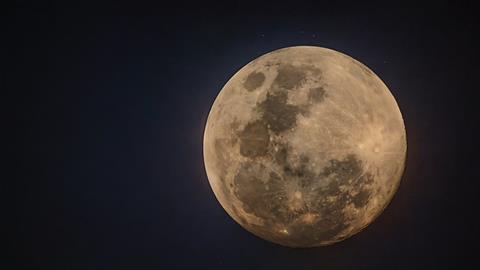

China’s Chang’e 6 lunar mission has returned lunar samples from impact craters that contain γ-iron – an allotrope normally stable only above 912°C. Researchers believe that the magnetic fields recorded in the particles could have been generated by lunar impacts and may explain areas of unusually high magnetic intensity on the moon.
Debate over whether the moon ever had a liquid metal core capable of generating strong magnetic fields, a so-called dynamo, and how long it lasted, has flourished since Apollo mission samples were found to be magnetic. This led to the theory of a historical lunar dynamo, explains John Tarduno, a geophysicist at the University of Rochester in the US who wasn’t involved in the analysis. ‘But there’s always been this looming issue … the lunar core is tiny and it’s very hard to generate a long-lived magnetic field in that tiny core.’
While large areas of the moon exhibit little or no magnetic field at all, the South Pole-Aitken Basin, where Chang’e-6 took samples, features anomalous, powerful magnetic readings. ‘When people have tried to model them, even with a dynamo, they have a hard time. They appear to be too strong,’ explains Tarduno. ‘Some of those anomalies are either directly associated with or adjacent to craters. So, this then raises the question of how did those anomalies form? Are they recording some ancient dynamo, or are they recording some impact process that could actually magnetise something.’
Iron occurs mainly in three crystallographic species: α iron or ferrite at low temperatures; γ iron or austenite above 912°C; and δ iron or delta ferrite above 1394°C. On the moon, α iron and iron–nickel alloys dominate but, for the first time, an international team of researchers has identified γ iron.
Using electron microscopy on samples of impact-generated glass scooped from the far side of the moon, scientists found abundant nanoscale iron spheres. X-ray spectroscopy confirmed the spheres’ primarily iron composition, with trace nickel present, and additional microscopic and spectroscopic analysis identified γ iron as the overwhelmingly dominant phase.
To explain γ iron’s stability at such low temperatures, researchers point to trace elements incorporated during iron formation that stabilise the γ phase. Based on meteorite composition and previous studies, the scientists hypothesise that carbon could be responsible. But, as Jin Ziliang, part of the research team, admits, ‘honestly, this is an inference rather than something we directly demonstrated’. The team chose not to perform a carbon measurement due to the high risk of sample contamination.
A stabilising element is not sufficient for γ iron formation without an extremely fast cooling event. Such rapid quenching inhibits the γ-to-α transition. Frequent impacts to the lunar surface generate enough heat and pressure to melt regolith, and the moon’s lack of atmosphere facilitates microsecond-scale cooling, the researchers argue.
Analysis of lunar samples revealed that the magnetic moments of the particles formed a clockwise helical pattern. The researchers believe that these are a signature of these impact-generated magnetic fields. This data could be used to separate impact-generated magnetism in lunar rocks from those caused by a lunar magnetic dynamo, helping scientists decide whether the moon ever had a molten iron core and when it cooled and stopped spinning.
Tarduno is most excited by the implications. In his eyes, these findings enhance the evidence for a lunar dynamo by offering ‘another mechanism where you can get an enhanced magnetisation to help explain some of these otherwise mysterious high moments’.
The researchers are now pursuing further experiments on the recording fidelity of γ iron nanoparticles. ‘These experiments are challenging because of the small particle sizes,’ explains Pengfei Liu, who worked on the project. ‘We hope to obtain more samples containing these materials from both already-returned and upcoming lunar sample-return missions.’
References
P Liu et al, Proc. Natl. Acad. Sci. USA, 2026, DOI: 10.1073/pnas.2608395123





No comments yet