

A novel technique allowing measurement of biological loss of fixed nitrogen using an unexplained anomaly in atmospheric dinitrogen’s isotopic composition has been demonstrated by researchers. The work could help to answer fundamental questions about the global nitrogen cycle and potentially tackle issues such as groundwater remediation.
Reactive nitrogen naturally enters the biosphere through nitrogen fixing bacteria or archaea, or occasionally through lightning. Humans add to this process using fertiliser, much of which leaches into watercourses and eventually into oceans. It is usually ultimately removed by anaerobic microbes that convert reactive nitrogen compounds back into either nitrogen gas or less benign species such as nitrous oxide. Quantifying biological dinitrogen production is therefore crucial to understanding Earth’s ecology and human influence on it.
Detecting biogenic nitrogen signals is exquisitely difficult, however, as Earth’s atmosphere is 78% nitrogen. A common technique involves taking argon as an inert reference standard for air and assuming that an increase in the ratio of nitrogen to argon reflects biogenic nitrogen production. However, argon is much more water soluble than nitrogen. ‘Once you inject bubbles of air into water, it will elevate that ratio just like if you were producing biological N2,’ explains geochemist Jiarui Liu of the University of California, Santa Barbara.
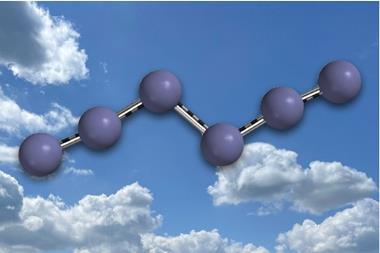
In 2017, researchers led by planetary scientist Edward Young at the University of California, Los Angeles used a newly-developed mass spectrometer called Panorama to show that dimers of two rare nitrogen-15 atoms were approximately 2% more common than would be expected by chance in atmospheric dinitrogen.2 Though not fully understood, this is thought to arise from photochemical breaking and reforming of triple bonds in the very high atmosphere. In contrast, isotopic pairing in biogenic dinitrogen is stochastic. The relative abundance of molecules containing two nitrogen-15 atoms therefore provides a reliable isotopic signal of biologically produced dinitrogen.
In the new work, Young and colleagues investigated this signal at various points on Earth. They were able to detect clear distinctions between the signatures in samples from two midwestern lakes – an urban one subject to nutrient pollution and a more pristine forested one – as well as a third, ice-covered one in Antarctica. They also detected the variation throughout the year in coastal basins of California, which are periodically refreshed with oxygen-rich water that suppresses water-column denitrification.
Only a few laboratories in the world can presently analyse samples with sufficient detail to perform these experiments, and no gas-source mass spectrometer matches the resolution of Panorama. Nevertheless, the researchers believe the technique could potentially have wide ranging implications for questions about whether or not the global nitrogen cycle is in balance. ‘Basically, the next step is to go out and sample more water to try to reduce the error bar on the loss,’ says Liu. The work could also have more concrete applications, he believes, for more reliable monitoring of nitrate removal in groundwater used for drinking water.
‘It’s a very exciting advance,’ says ecosystem ecologist Peter Groffman at City University of New York. ‘I’ve been chasing around after N2 flux for a very long time and it’s like the world’s greatest contamination problem… It’s a very clever and exciting advance that would allow us to measure denitrification to N2.’ He wants to see whether it might be applicable to his own work on the even more challenging problem of measuring biogenic nitrogen fluxes in terrestrial environments, although he says ‘I suspect that’s going to be challenging.’
References
1 J Liu et al, Science, 2026, 394, 207 (DOI: 10.1126/science.aei0940)
2 L Y Yeung et al, Science Advances, 2017, 3 (DOI: 10.1126/sciadv.aao6741)









No comments yet