
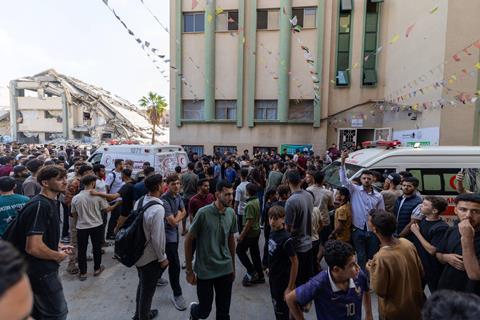
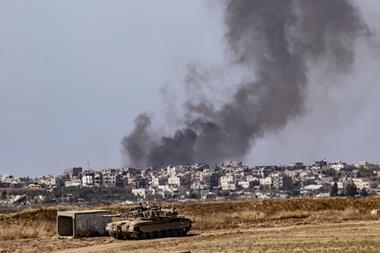
Buildings and scientific laboratories at the Islamic University of Gaza, historically a top research institution within the Palestinian region, were destroyed early in the Israel–Hamas war that began in October 2023. This week the university was due to finally restart basic chemistry research in newly restored lab space, but Israeli airstrikes that hit the campus on 25 October have led to that plan being indefinitely suspended.
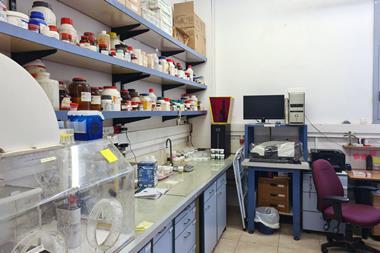
In this rehabbed chemistry lab, first-year undergraduate students were poised to conduct simple extraction experiments using common household products and scientific equipment that remained intact throughout the war. ‘We want to explain extraction experiments to our students and this normally needs organic solvents like carbon tetrachloride, dichloromethane, diethyl ether,’ Ramy Morjan, an organic and medicinal chemist at the university who became dean of its faculty of science in late September, explained just days before the attacks. ‘But because we don’t have these, and these materials are not allowed into Gaza, we just explain the idea behind the experiment using cooking oil and water.’
Morjan described this a ‘first step’ towards regular laboratory operations. ‘Hopefully, things will get better, and we will have our right to teach our students normal chemistry like all students around the world,’ he said.
Earlier this month, the university was able to refurbish some lab space to relaunch in-person physics research for first-year students, Morjan said. ‘This so far involves some simple experiments with tools that survived from the war,’ he stated. But that work is now halted as well, following the Israeli airstrikes on 25 October, which Morjan says killed three university employees and injured approximately 10 students.
Two buildings house entire university
During the bombing he was just a few metres away in his office located in one of just two buildings from which the entire university and its 12 departments – including the faculty of science – is currently operating.
These two buildings, which house the renovated research lab space, were not damaged during the attacks, but in-person chemistry and physics research is halted for now, as well as all in-person teaching. Students from various departments had been coming to campus for in-person classes twice a week, on a rotating basis.
Until this latest attack, Morjan estimates it had been about 18 months or longer since the last Israeli airstrikes on the university. After the ceasefire was announced in autumn 2025, the situation at the university improved. ‘The daily attacks reduced and this enabled us to fix these two buildings where we are receiving and teaching our students,’ Morjan recalled. ‘We are not talking about the ideal situation but today things are much better compared to two years ago when we were unable to arrive to the university and even had no chairs, but it still does not compare to the situation before the war.’
There has been no scientific research going on. ‘This requires a lot of infrastructure, a lot of instruments and chemicals, but we have nothing,’ Morjan stated. ‘We are thankful to be able to teach our students some basic theoretical or experimental science.’
Nevertheless, Morjan and colleagues published a review article last month that sets forth a plan to rehabilitate science, technology, engineering, mathematics and medicine in Gaza following the extensive destruction of higher education there during the war.
The article cites estimates from the Palestinian Ministry of Education and Higher Education that by June 2026 more than 1600 university students, academics and staff had been killed in Gaza and over 4500 injured. It also references United Nations Educational, Scientific and Cultural Organization (Unesco) data from last year indicating that among 21 higher education institutions across 38 campuses in Gaza, approximately 95% were significantly affected by the war. In total, 22 of those campuses were completely destroyed and another 14 sustained varying degrees of damage.
Unesco’s assessment noted that 620 specialised labs and facilities had been destroyed or severely damaged to the point of inoperability, and more than 1100 staff members out of over 5100 – 22% of the workforce – were killed, detained, or injured. Overall, the global agency estimated direct losses at approximately $373 million.
Research assistants lost to war
When Chemistry World spoke with Morjan two years ago, which was about a year into the war, one of his research assistants have been killed along with their whole family, except for an infant daughter. In the last year, two more of his research assistants have been killed during the war.
Morjan, his wife and four children lived in a refugee camp in Deir El-Balah, a city located in the central Gaza Strip, for about two years during the war. They were all living in a small room in his brother-in-law’s old house. Yet, Morjan was managing to teach five chemistry courses remotely.
Following the ceasefire, Morjan says he and his family returned to their original home in Gaza City in November 2025 and found it had been ‘completely burned’ by Israeli soldiers who had been living there. After fixing up the house his family moved back in.
The Islamic University of Gaza’s faculty of science had approximately 70 staff members the before the war, and about seven were able to leave the country during the conflict, according to Morjan. He says two have departed in the last couple of months to take up visiting research positions abroad and the rest are still in Gaza.
Scientists up for adoption
Last year, Morjan launched an initiative called Adopt a Scientist on LinkedIn and through that programme donors outside Gaza covered the student fees of about 13 undergraduates studying science at his university. Morjan issued another Adopt a Scientist call earlier this month, which he hopes will attract even more donations.
He notes, however, that transferring such funds to cover university student fees remains a significant obstacle. ‘People are willing to contribute but they normally face some problems when they try to transfer the money to the students – this is actually a big issue,’ he states.
Meanwhile, Morjan is adamant that he will remain in Gaza and help rebuild the scientific research infrastructure there. ‘If I wanted to leave Gaza, I would have done this before – my plan is just to stay here,’ he says. ‘A lot of countries are offering visiting research positions outside of Gaza, but because I’m not interested.’
Morjan urges the international community to support scientists like him who remain in Gaza. ‘The international community, if they want to help us, must put pressure on Israel to allow things to get in,’ he states. ‘We need support; we need chemicals, we need scientific instruments, we need everything,’ Morjan continues. ‘We need essential infrastructure for our students like computers; we need our students to study in with dignity.’













No comments yet