Positrons can improve molecular stability through a unique chemical bonding mechanism, quantum Monte Carlo simulations show. Andrés Reyes at the National University of Colombia and colleagues say their findings challenge conventional understanding of chemical bonding.1

Positrons (e+) are the antiparticles of electrons, sharing the same mass but carrying an opposite charge. When positrons and electrons collide, they annihilate each other. A positron’s lifetime can be as little as 10-1 to 102 nanoseconds. During this brief lifetime, positrons can form bound states with electrons, atoms or molecules. Traditionally, theoretical chemists have focussed on positron bonding between repelling anions, where thermodynamically stable complexes can form.2 However, this new work from Reyes and co-workers has uncovered positron bonding between neutral atoms.

Molecules

Source: © Andrés Reyes

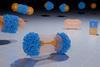
Theoretical research suggests how positron-driven bonding could entirely supplant conventional electronic interactions in the Be2 dimer

Neutral atoms typically form electronic chemical bonds and are not expected to favour weaker positron bonds. However, alkaline earth metal atoms form extremely weak dimers, making them good candidates for investigating positron binding. Since positrons are difficult to treat with standard computational techniques, Reyes and their colleagues used the highly accurate, but computationally demanding, quantum Monte Carlo method to examine whether a positron could bind two beryllium atoms. Their simulations mapped how positron attachment transforms the potential energy curve, including its equilibrium distance, bond strength and vibrational features.

Initially, the team expected the positron to simply strengthen the existing weak electronic bond between the two beryllium atoms. Instead, they observed two unique positron bonding mechanisms. At longer Be–Be separations (3.5–4.0Å), the positron concentrated in the internuclear region and effectively replaced the electronic bond. ‘It turned out that the positron took charge of the binding completely, Reyes told Chemistry World.

But the biggest surprise emerged at shorter distances (less than 3.5Å): ‘as the [internuclear] distance got shorter, the weirdest thing happened – the system became more stable,’ he continued. In this system the positrons moved into the outer region of the atoms, rather than the internuclear region, pushing the nuclei together and forming a much stronger bond – a mechanism not previously observed.

Theoretical chemist and quantum Monte Carlo expert Dario Bressanini of the University of Insubria in Italy says ‘We are learning that when positrons are involved, we need to rethink what a bond is. Their finding is exactly the kind of counterintuitive phenomenon that makes this field so exciting …positronic compounds continue to surprise us with unexpected behaviour that goes against conventional chemical wisdom.’

Although the study is purely theoretical, the neutral beryllium dimer stands out as a promising candidate for experimentally detecting a positron bond, due to its relative stability at ultracold temperatures compared with anionic systems. ‘The problem is these [positronic] complexes will live for nanoseconds,’ notes Ken Jordan, a computational chemist from University of Pittsburgh in the US. Capturing such fleeting interactions would require cryogenic conditions and a sophisticated combination of experimental techniques.