
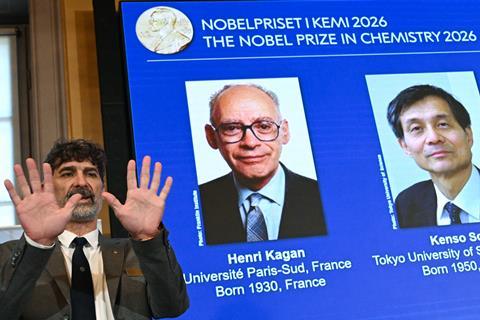
The 2026 Nobel prize in chemistry has been awarded to Henri Kagan and Kenso Soai, ‘for the discovery of non-linear effects and autocatalysis in asymmetric organic synthesis’. The prize recognises the pair’s contribution to understanding the very fundamentals of how we can influence and control the handedness of chiral molecules.
Asymmetric synthesis is a cornerstone of modern drug development, as well as being important for flavours, fragrances and agrochemicals. But chiral molecules also crop up in liquid crystals, polymers and optical materials, as well as across various classes of speciality chemicals. Almost all these products rely, at some point, on catalysts that can transform achiral or racemic molecules into products in which one enantiomer is massively – if not exclusively – dominant.
When you’re aiming to make chiral molecules for commercial sale, an efficient synthesis has a significant effect on cost – and hence profitability. Cleaner reactions mean less wasted materials, as well as less time and resources spent on separation and purification. Understanding how to create more effective catalysts, which can drive higher yields and selectivity, can translate into a huge competitive advantage.
Henri Kagan and his team’s insight into the intricacies of how catalysts can be manipulated to drastically improve their performance underlies all this development. Likewise, there are different approaches to enantio-enrichment, as Kenso Soai and his team’s autocatalytic experiments showed.
This year’s laureates didn’t invent asymmetric synthesis, but filled in some key aspects in our understanding of how it works and how we can do it better. This fundamental research has naturally stimulated many other researchers to ask further questions, digging deeper into how these reactions work and further advancing our understanding of chirality and catalysis.
That, in turn, shows up in the applications: new and better catalyst systems have allowed us to build ever more complex molecules in more efficient ways, and directly enabled the wide commercial availability of chiral reagents and chemical building blocks. A fact that’s worth remembering next time you’re browsing through a catalogue, planning your next synthesis.









No comments yet