A question that is not the same as asking whether something is alive

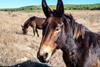
Mule

Source: © Jose A Bernat Bacete/Getty Images

Some definitions of life exclude individual mules

Asking ‘what is life?’ is a good way to start arguments in science. As a recent informal poll suggests, no two individuals are likely to give the same response, the differences perhaps being even more marked the more the respondents have pondered the issue.1 Some say it’s just a sterile (that would be ironic) or semantic question.

But here’s another way to approach it. What can life do without? The recent discovery of a weirdly minimalistic organism – an archaeon given the grand name Candidatus Sukunaarchaeum mirabile – offers the surprising answer that metabolism might be expendable.2 Apparently symbiotic with algae, this little critter looks almost more like a virus than a cell-based organism, having genes only for the proteins it needs to reproduce. It can’t build any of the other molecules it needs to survive and grow, outsourcing them to the host. Unlike actual viruses, it can replicate by itself, but that’s about it. It can’t live independently, and it’s not clear if it is truly a symbiont (conveying some benefit to the host) or a mere parasite.

Given that dependency, is Sukunaarchaeum alive? Perhaps a better way to think about the matter is to say that, when it comes to entities this small, minimal and ‘primitive’, what we call life is manifested at the level of the ecosystem and not the individual. Metabolism might then be considered an aspect of that phenomenon, but not one that each individual need exhibit themselves.

Life and living

That point of view highlights an ambiguity in seeking definitions of life: it is by no means clear that the phenomenon as such maps onto the issue of whether discrete entities are alive. Another attribute commonly considered a sine qua non for life is replication (or reproduction). But that obviously is not a requirement for individuals: I don’t suppose anyone doubts that mules are alive, say. The process that makes mules possible demands replication, not just in evolutionary but also in developmental terms. But the life in the organism itself is another matter, involving complex non-equilibrium chemistry among which the capacity to pass on genes is evidently dispensable.

Nasa’s definition of life as ‘a self-sustaining chemical system capable of Darwinian evolution’ goes further in suggesting that not only is replication necessary but it must include mutation/variation and selection. This is an article of faith. It’s true that we know of no process except Darwinian natural selection that could produce the kind of life we find on our planet – but it’s far from clear that this is the only possibility.3

A computational model of the evolutionary process no more generates life than chatbots exhibit sentience

No fundamental law prohibits Lamarckian evolution (echoes of which can be found in our biosphere). And it’s conceivable that organisms could decide to invest in longevity – for example, sophisticated DNA repair mechanisms, as found in the Asgard archaea – rather than relying on constant replication. Could some non-replicating but persistent, self-maintaining entity self-assemble spontaneously? That seems unlikely. Could one be made synthetically? That’s far less implausible. Would it be alive?

We can turn this around and ask whether a ‘system capable of Darwinian evolution’ is by definition alive. Those working on replicating computer algorithms sometimes seem to imply as much – that, if their code is not literally alive, then at least it mimics the key feature of life. My own view is that this is far too narrow a criterion for life: creating a simple computational model of the evolutionary process no more generates life than chatbots exhibit sentience. There is no reason to suppose that such evolutionary algorithms could ever lead to the complexity we see in the living world.

For your information

But not everyone takes that view. When I recently asked if ‘a system that can self-replicate and is capable of mutation in a way that can respond to selective influences’ displays all the requisites of life, information and complexity theorist Chris Adami of Michigan State University argued that there’s nothing obviously missing. For Adami, it’s not about the ‘life’ we might attribute to the individual (like a mule) but the informational process that life on Earth embodies: ‘the individual is a means to an end, which is the indefinite persistence of information,’ he says.

I think my difference with Adami here gets to the heart of the matter. His is basically the gene-centric view of life in which it is all about the indefinite replication of what Richard Dawkins has called the ‘immortal gene’. But as philosopher of biology Daniel Nicholson has pointed out, that view asserts primacy to the levels – the gene and the population – either side of the very things we regard as alive: the organisms, in all their complex and dazzling splendour.