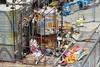
A runaway polymerisation raises questions about safety measures and their backups

Garden Groves chemical incident

Source: © Jeff Gritchen/MediaNews Group/Orange County Register/Getty Images

Concerns about runaway polymerisation in a tank of methyl methacrylate led to emergency cooling measures and 40,000 people being evacuated from their homes

In the suburban Los Angeles city of Garden Grove, California this past May, there was a rather unusual chemical manufacturing incident at GKN Aerospace. This facility housed large tanks of methyl methacrylate (one tank containing 24,700 litres), the monomer form of polymethyl methacrylate, a commonly used polymer. GKN management and Orange County first responders believed that the tank was overheating, and that it was reaching the temperature that methyl methacrylate would begin polymerising (over 40°C). That polymerisation is exothermic – that is, as those monomers were beginning to stitch themselves together in the tank, they were releasing heat. GKN could not empty the tank, nor stop the polymerisation. A chemical catastrophe was in the making.

As those who have run a Grignard reagent formation and added the alkyl bromide to their magnesium and tetrahydrofuran a little too aggressively know, the making of the organomagnesium halide releases heat, which causes the reactants to react faster and release more heat. If you continue to add the alkyl halide, you can get some pretty enthusiastic boiling of your reaction as you reach the boiling point of the solvent. (Hopefully you have a condenser!) If you’re running this at 500ml scale in your hood, you can get a labmate to get you some ice to cool down your reaction. The worst case scenario involves boiling solvent all over your hood and a possible solvent fire. To prevent this from happening, I recommend monitoring the internal temperature of your reaction, deciding at what temperature you will stop adding the product and adding the alkyl bromide in portion-wise. This is slower, sure, but you’ll spend less time cleaning the ceiling of your hood.

Preparing for the worst

The scenario Orange County authorities were concerned about involved the runaway polymerisation of the contents of the tank. The worst case scenario would have been quite disastrous. The contents would have ultimately spewed out of the tank, possibly catching fire. While polymethyl methacrylate is not particularly toxic, methyl methylacrylate definitely is – a hot cloud of the vapour would have been deadly, especially since the facility is very close to residential areas.

The authorities chose to constantly spray water on the outside of the tank to cool it. As large chemical storage tanks are both outdoors and have relatively little surface area, this certainly did not guarantee success. So, over 40,000 nearby residents were evacuated for several days, until the tank somehow cooled.

The purchase of methacrylate products (which I have been a part of) comes with a thorough technical data package from manufacturers like Dow. They emphasise that the methacrylate esters polymerise exothermically. Because of this, these are shipped with stabilisers that inhibit any radicals that start the polymerisation process. Oxygen also (surprisingly) helps react with radicals and generate hydroperoxide radicals that are inhibited by the phenolic or hydroquinone-based stabilisers.

The Dow safe handling information indicates that the most common causes of polymerisation incidents involve heating outside the safe temperature (and thus depleting the stabiliser), a lack of oxygen, which would prevent stabilisation, depletion of the inhibitor after storing for a very long time, and then contamination or corrosion causing reaction initiation.

The reputational damage to GKN Aerospace in that community will last decades

We still don’t know for sure what caused this incident or what could have been done to stop it, once started. As this was late May in southern California, I would be very interested in understanding the cooling system that was used to keep these tanks at a stable temperature. Did it have a backup? Were the backups regularly checked? Were the primary and secondary cooling systems truly independent, or did they actually rely on a single point of failure?

There were news reports of failed attempts to add what’s called a ‘shortstop solution’, which is typically phenothiazine, which can inhibit free-radical polymerisation in progress. The failure was because of some stuck valves, undoubtedly blocked by polymerised methyl methylacrylate. I am curious to know how often those valves were checked, and if there was a backup fail-safe method to pump or pressurise the phenothiazine solution into the tanks.

The reputational damage to GKN Aerospace in that community will last decades. There are already class-action lawsuits against the owners of the facility. It is a genuinely hard thing to relocate a chemical facility – such relocations are expensive, require additional construction and will negatively impact manufacturing, unless you’re able to stockpile product for customers. Then again, it’s probably cheaper than lawsuits and having your permits revoked.

It’s too easy to tut-tut at GKN and say ‘this would never happen at my plant’. Rather, the global chemical industry should learn from these lessons (treat acrylates and methacrylates with extreme respect, and maintain the storage equipment faithfully). It’s my hope that government investigators and journalists get as many facts out to both industry and the general public soon so that similar incidents can be avoided.