
As Philip Ball, handling editor of Kensō Soai’s 1995 paper reveals, sometimes you’re oblivious to it
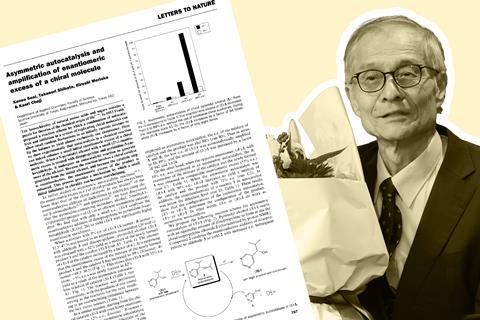
Who can recognise a Nobel-worthy paper when they see it? Not me, evidently. When the 1995 paper central to this year’s award of the chemistry prize to Japanese chemist Kensō Soai arrived on my desk as an editor of Nature, I wasn’t sure what to make of it.1 The reaction it described, in which autocatalysis enabled the amplification of a small excess of one of two chiral enantiomers into a much larger imbalance, seemed intriguing but also rather complicated and not easy to follow. Might this process tell us anything about the homochirality of life – the fact that the chiral molecules that constitute proteins and nucleic acids are uniquely of one handedness? That was far from clear, given how different this organic chemistry seemed from that through which such building-block molecules might have been generated on the prebiotic Earth. Could the reaction be useful for preferentially synthesising just one enantiomer of a drug? Again, that wasn’t obvious.
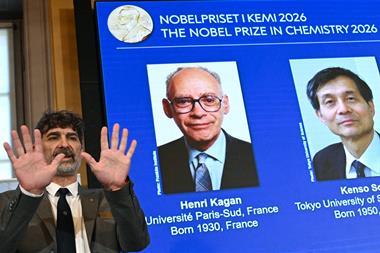
I don’t recall what the reviewers of the paper said (although I think I remember who they were), but evidently it was sufficiently supportive to warrant publication. (I’m saddened to realise now that such information may be lost forever, unless Soai has kept it, since in those days everything was done on paper that went eventually into the bin.) I must confess to finding the paper something of a curiosity; it’s only over the intervening years that the ‘Soai reaction’ gained currency in research on homochirality and asymmetric catalysis, culminating in the Nobel committee’s commendable decision to give the prize to Soai and another pioneer in the field, Henri Kagan. But I console myself with the knowledge that I don’t believe anyone else really noted the paper’s significance at the time either.
Overlooking greatness
Well, there have been worse failures to appreciate at once just how important a scientific idea was. The awarding of this year’s physics prize to Francis Halzen for his central role in the development of the IceCube neutrino detector in Antarctica reminds me that one of the most egregious oversights in the Nature offices – long before my time, I’m happy to say – was the decision in 1933 not to publish Enrico Fermi’s paper postulating the neutrino in the first place. Admittedly, Fermi was making a bold speculation for which there was then no good empirical evidence. But calls like this in support of speculative yet potentially productive hypotheses are (or should be) a part of an editor’s job.
Even worse, I think, was the shrug that apparently greeted Charles Darwin when in 1858 his paper describing the theory of evolution by natural selection was read at the Linnaean Society in London. In his end-of-year address, the society’s president noted with disappointment that the year ‘has not been marked by any of those striking discoveries which at once revolutionise… the department of science on which they bear.’
It troubles me sometimes that science doesn’t seem terribly efficient at spotting breakthroughs in discovery or theory. Imagine the Nobel committee deciding in 1921 that no advance in physics that year had been striking enough to warrant a prize, only then to somewhat grudgingly give that award retrospectively the following year to Albert Einstein for his work on ‘the law of the photoelectric effect’ – a citation that seems perversely determined not to acknowledge how his 1905 paper on the topic had in fact launched quantum theory. Einstein’s special and general relativity never got a Nobel at all.
Instant impact
Yet there were times too during my days at Nature when you did feel the excitement of previewing something truly special. When in 1990 Don Huffman and Walter Krätschmer sent us their paper describing the bulk synthesis of C60 from arc-vaporised graphite and the consequent crystallographic confirmation of its spherical structure,2 it seemed pretty clear that these carbon molecules were about to hit the big time – a road that led eventually to Nobel prizes in 1996 for C60’s discovery in 1985. And when a year later Japanese microscopist Sumio Iijima sent us his report of nested ‘tubular fullerenes’,3 quickly dubbed carbon nanotubes or buckytubes, it was equally obvious that the door to a new science had been opened. Soon enough nanotubes eclipsed fullerenes as the poster child of the nascent field of nanotechnology.
Not all of the greatest hits that resonated on first listen led to Nobels, but many could have done. I believe Ned Seeman’s DNA cube was a baffling oddity to my biological colleagues who handled the paper,4 as it was not the DNA they knew – but it launched another fertile area of nanotechnology still vibrant today. For some years, the mesoporous silica MCM-41 announced in Nature in 1992 by Charlie Kresge and colleagues at Mobil would be tipped for Nobel recognition,5 and it was obvious why: by exploiting self-assembly of a surfactant template for crystallisation, the researchers boosted by an order of magnitude the scale of pore widths available in zeolite-type materials for catalysis and molecular sieves. And when IBM’s Don Eigler and his team wrote their company’s logo using just 35 xenon atoms positioned with a scanning tunnelling microscope,6 it was obvious right away that the paper flipped a switch in our capabilities to manipulate matter.
You win some, you lose some, I guess. But what a privilege it was to have guided those masterpieces into the light of day.
References
1 K Soai et al, Nature, 1995, 378, 767 (DOI: 10.1038/378767a0)
2 W Krätschmer et al, Nature, 1990, 347, 354 (DOI: 10.1038/347354a0)
3 S Iijima, Nature, 1991, 354, 56 (DOI: 10.1038/354056a0)
4 JH Chen and NC Seeman, Nature, 1991, 350, 631 (DOI: 10.1038/350631a0)
5 CT Kresge et al, Nature, 1992, 359, 710 (DOI: 10.1038/359710a0)
6 DM Eigler and EK Schweizer, Nature, 1990, 344, 524 (DOI: 10.1038/344524a0)






No comments yet