
Chemists are closing in on alternative compounds to protect tyres against ozone damage while causing less harm in the environment. The search has been on since 2020, when rubber additive 6PPD was finally identified as the cause of mysterious extensive salmon deaths in the western US.
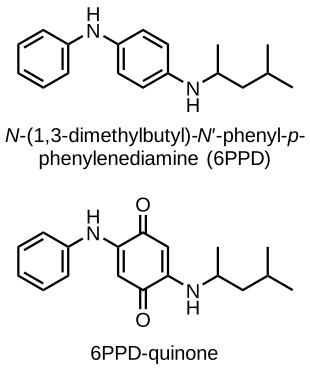
6PPD, or N-(1,3-dimethylbutyl)-N’-phenyl-p-phenylenediamine, is oxidised by ozone into a quinone (6PPD-Q). This quinone is particularly toxic to adult Coho salmon and some related species such as rainbow trout. Both 6PPD and 6PPD-Q can be present in tyre wear particles that are washed into streams and rivers, where 6PPD can continue to be oxidised to the quinone, which can kill fish even at tiny concentrations.
The precise mechanism of toxicity remains uncertain, nor is it clear why some species are much more sensitive than others. ‘We don’t know what it is about that specific quinone moiety that causes toxicity in 6PPD-Q sensitive species,’ says Hannah Byun, an environmental chemist in Hui Peng’s lab at the University of Toronto, Canada.
6PPD has been added to rubber tyres since the 1960s, comprising up to 2% of their content. It prevents cracks and improves tyre durability by reacting with ozone at the surface of the tyre, thereby protecting the C=C double bonds in rubber. The additive disperses throughout the tyre but provides protection by diffusing to the surface, generating a range of transformation products that can react further with ozone. ‘Its aromatic rings and long alkyl tails help to solubilise it in the rubber matrix,’ says Pranav Nair, a synthetic chemist at the University of Toronto. ‘While the central electron-rich phenylenediamine scavenges ozone.’
Any replacement for 6PPD requires these same properties, and there are options available. The Peng lab investigated the effect of seven PPD-quinones on sensitive rainbow trout and reported no toxicity for six of them, despite similar structures. Only 6PPD-Q was lethally toxic. ‘The other PPDs currently used in industry are potentially viable replacement candidates,’ says Nair. ‘This might mean the tyre industry wouldn’t have to go on an extended campaign to try find an alternative.’
We need to understand PPDs as a familly […] because they are used in a lot of different types of products, not just tyres
The tyre industry accepts the need to replace 6PPD. The US Tire Manufacturers Association (USTMA) requested the California Department of Toxic Substances Control to prioritise a review of its use in tyres under consumer safety regulations at the end of 2020. It created a 36-member consortium to identify potential alternatives in 2024, and initially suggested several p-phenylenediamines as the most logical and possibly most straightforward alternatives to 6PPD, with other options ‘likely to pose greater challenges in incorporating in tyre chemistry.’
The USTMA’s initial 7-member candidate list included four p-phenylenediamines: 7PPD, IPPD, 77PD and CCPD; alongside specialised graphene particles, octyl gallate (a former food additive) and nano calcium carbonate with surfaces modified with gallic acid.
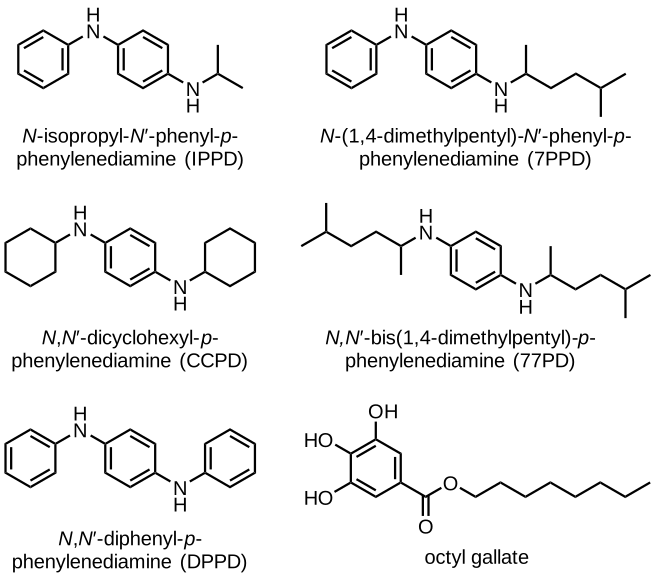
The consortium’s 2026 annual progress report outlines considerations on these and a further 70 compounds and combinations, of which 38 have been eliminated based on their performance in rubber testing. Nine of these are PPDs or combinations of PPDs, including N,N’-diphenyl-p-phenylenediamine (DPPD) and combinations of 77PD with either 7PPD or IPPD, although 7PPD and IPPD are still being considered individually. That leaves 39 chemicals or combinations under consideration, for which the consortium will begin aquatic toxicity testing.
Recently, specialty chemicals company Lanxess in Germany launched CCPD as an alternative to 6PPD, reporting that its quinone showed no acute effects in Coho salmon testing. The company has registered the chemical under EU Reach (registration, evaluation, authorisation and restriction of chemicals) regulations for use on the European market. ‘In terms of reacting with ozone, most p-phenylenediamines will be fairly similar, depending on their side chains,’ says Nair. IPPD is already used in the rubber industry, though it can cause allergic contact dermatitis, while DPPD has a more rigid aromatic structure and is used in high-temperature applications such as aircraft tyres and specialised plastics.
Nevertheless, the discoveries around 6PPD and its toxic quinone took time and came with surprises. There are worries that other PPDs might spring new environmental worries. Depending on the environment, most 6PPD is not oxidised to 6PPD-Q but is quickly hydrolysed. ‘When 6PPD enters the environment, only perhaps 1% is transformed to 6PPD-quinone,’ says Thorsten Reemtsma, analytical chemist at the Helmholtz Centre for Environmental Research in Germany. Even when 6PPD-Q is formed, it can quickly break down. ‘Under oxidising conditions, it is also not very stable. The ring is opened and further oxidation products form.’
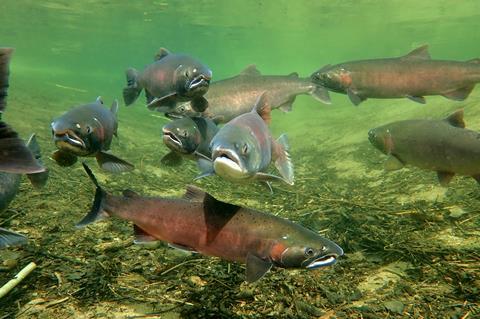
This rapid degradation led to assumptions about 6PPD’s safety. ‘The parent product was so short-lived that [it was assumed] you didn’t have to worry about it much. That assumption was poorly placed,’ says Edward Kolodziej, an environmental engineer and chemist at the University of Washington and part of the team that identified 6PPD-Q as the killer of coho salmon. Further investigation revealed that the lifetime of 6PPD-quinoine is longer in the absence of oxygen, such as in river sediments. ‘Under anaerobic conditions, the half-life goes beyond 100 days,’ says Reemtsma. Also, tyre debris can travel to waterways within hours, and even tiny quantities entering rivers can lead to fatal concentrations of 6PPD-Q. ‘The regulatory community seems to be converging on 10–12ng/l as a screening value or toxicity threshold,’ says Kolodziej.
Washington state has introduced measures to capture type particles before they reach salmon habitat. The state also funded studies to evaluate 6PPD toxicity and assess alternatives. Federally, the US Environmental Protection Agency is gathering evidence about 6PPD and its quinone under the Toxic Substance Control Act. Meanwhile, Canada has prioritised 6PPD and related PPDs for assessment under the Canadian Environmental Protection Act. In Europe, the Netherlands and Austria have proposed restricting the use of 6PPD and related compounds under EU chemical regulations.
The Netherlands, Austria and Canada take the view that PPDs as a group are concerning. ‘6PPD is just one of several chemicals in that class that may be affecting the health of fish and maybe people too,’ says toxicologist Susanne Brander at Pew Charitable Trusts. ‘If we’re just looking at the potential to cause lethality and not looking at sublethal harm, then we may make decisions not based on the entire story.’ This could lead to regrettable substitutions in which the replacement is more problematic than the original chemical. The USTMA has highlighted that it would be impractical for manufacturers to use different 6PPD alternatives in different jurisdictions, and is therefore following these regulatory developments closely as it continues to evaluate alternatives.
Little safety data exists in the public domain for the various alternatives under consideration. ‘We need to understand PPDs as a family. We need to know how to manage them because they are used in a lot of different types of products, not just tyres,’ says Kolodziej. ‘Toxic attributes pop up throughout the PPD family.’
Flexsys in Ohio says it has identified two viable candidates to replace 6PPD that sit outside the PPD chemical family, do not form quinones and will now be tested for aquatic toxicity in collaboration with the US Geologial Survey before commercialisation. Chinese company Sennics has also announced an antioxidant suitable for rubber tyres that is not a PPD, although few other details on these proprietary compounds are available.
Tyre particles get dispersed throughout the environment and deserve special attention, say the researchers who have investigated 6PPD in waterways. Still, Kolodziej is optimistic. ‘Tyres should have a pretty high bar in terms of our knowledge of what’s in them. The chemicals used should be nontoxic,’ he says. ‘We have some of the best chemists in the world. We can make a great tyre rubber composition with nontoxic chemicals if we really want to.’












No comments yet