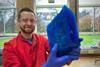
Top tips from David Boyce and his class, who have cultivated a 3kg single copper sulfate crystal

A classic school experiment involves growing copper sulfate crystals. Allowing water to slowly evaporate from a saturated copper sulfate solution is the main way to form regular crystals. Yet, if you want a particularly large single crystal, this method can take a while – for example, some natural crystals found in caves grow over thousands of years.
David Boyce and his students at Queenswood School in the UK have developed a different method, using it to grow a copper sulfate crystal that measures around 15cm in length. While this may not be the biggest – a title that goes to the 70kg copper sulfate crystal grown by a class in Germany – Boyce’s is supposedly the largest single crystal.
But how big can you grow such crystals? Boyce shares his tips below.

Make sure you’re prepared
Starting off the crystal is the main trick. Boyce explains that they suspended a smaller single crystal in a deep tray containing room temperature copper sulfate solution, before adding a second container of hot, saturated solution. He adds that the ratio of these solutions should be around two to nine.
‘The temperature instantly drops down, so the crystal is not exposed to high temperature, but the solution is now supersaturated, so it instantly deposits all the copper sulfate onto the crystal.’ Repeating this process regularly will slowly build up the crystal.
But also think about how safe it is to have large amounts of saturated solutions in the lab and where you’ll grow the crystal. Boyce suggests a fumehood so ‘no dust settles on the top [of the crystal], but there’s an airflow, which enables the [solution] to evaporate.’

Tending to the crystal
Copper sulfate contains around 1% sodium chloride, meaning that if the solution evaporates too much, the salt can crystallise out as copper chloride, explains Boyce. This can turn the crystal green. Continually monitoring the crystal and topping it up with fresh saturated solution every few days should overcome this issue.
‘About once a month or so, I tip all the copper sulfate [solution] out into a bucket, and then I bash off all the [polycrystalline] copper sulfate crystals that have grown on the side,’ says Boyce. He recommends redissolving these crystals to avoid wasting material.
If you have to leave the crystal for an extended period, Boyce advises taking the crystal out of solution and hanging it just above to avoid the crystal redissolving entirely.
Fixing issues
When the crystal reaches a certain size, it can be tricky to stop the crystal from touching the sides of the container, where unwanted polycrystalline crystals may grow. Fix a retort stand horizontal to another stand and secure something like fishing wire to the horizontal stand to wrap around the crystal and lift it away from the sides. The base of the horizontal retort acts as a balance to the weight of the crystal, like a crane machine.
However, the wire may interfere with crystallisation and seed the growth of other crystals. To prevent the formation of a polycrystalline structure, Boyce suggests replacing the wire if this happens.
Be patient
Growing such a large crystal takes time. ‘Over the course of the year, we’ve grown [the crystal] to about three kilograms,’ says Boyce. He adds that the crystal measures about 15cm by 15cm in length and width, and about 10cm tall.
‘I think a limiting issue [will be] when I’ve got so much copper sulfate in the bath that I can’t easily move it,’ says Boyce. Currently, there is around 10kg of copper solution in the container, which Boyce says has cost him nearly £100 over the course of the experiment.
Think about how to preserve the crystal

‘When [the crystal] comes out of solution, it might start to dry out naturally and start to get white as it becomes anhydrous,’ says Boyce. ‘I think we may have to look at how to store it in a way where it doesn’t dehydrate,’ such as in a vacuum sealed jar. This will also help keep the brittle crystal safer from accidental knocks.
‘I think the giant blue crystal will probably stay as a giant blue crystal sitting on a shelf somewhere, pride of place.’


No comments yet