
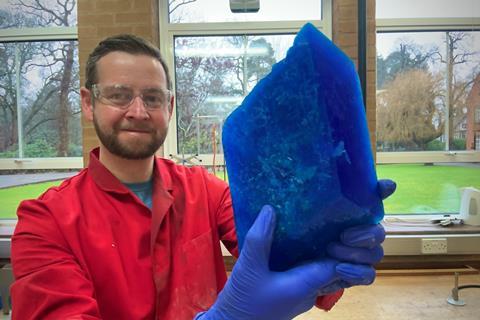
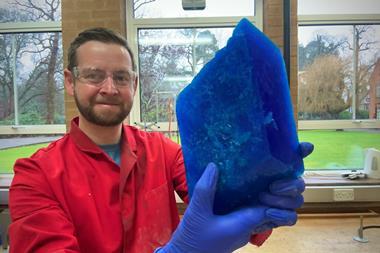
David Boyce and his class at Queenswood school in the UK are growing what they’re calling the world’s largest single crystal of copper sulfate. The crystal weighs around 3kg so far and has taken over a year to grow.
Crystals start to form as molecules aggregate together in solution. These small ‘seeds’ dissolve and reform until they reach a critical size, the point at which the overall energy in the crystalline core overcomes the energy needed to add molecules to the crystal’s surface. Growing crystals is a slow process, building up the regular crystal structure layer by layer, with temperature, concentration and impurities in the sample all affecting the rate of growth.
Naturally existing crystals have sometimes had thousands of years to grow, many becoming much larger than Boyce’s. But what are some other record-busting crystals found in the world?
1 Copper sulfate
While Boyce’s crystal may be the largest single crystal of copper sulfate, students at the Kurfrüst-Ruprecht-Gymnasium in Germany hold the record for overall size. Their polymorphic crystal reached a weight of nearly 70kg and was awarded a Guinness World Record in 2010.
2 Gypsum
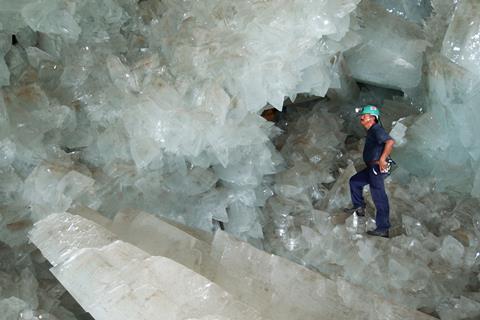
The ‘cave of crystals’ found below a mountain in Naica in Mexico houses extraordinarily large crystals of gypsum, otherwise known as calcium sulfate dihydrate (CaSO4·2H2 O). Discovered by the mining company Industrias Peñoles in 2000, the milky-white crystals reach up to 11m in length and weigh 40–50 tonnes. Researchers suggest that these would have taken around a million years to grow.
3 Scheelite
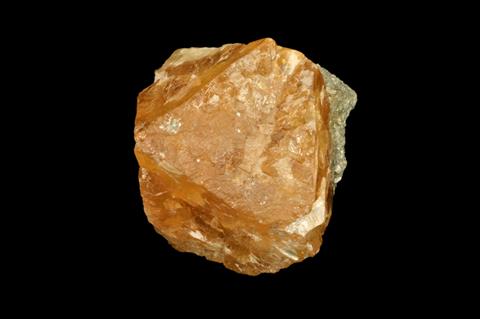
At 0.4m long, 0.3m tall and 0.15m thick, the biggest scheelite crystal – made from calcium tungstate (CaWO4) – is stored at Shandong Tianyu Natural History Museum in China.
4 Snow way!
Kenneth Libbrecht photographed the largest snow crystal ever recorded during a gentle snowfall in Ontario, Canada in 2003. From tip to tip, the snowflake measures 10mm in length, about half the width of a US cent coin.
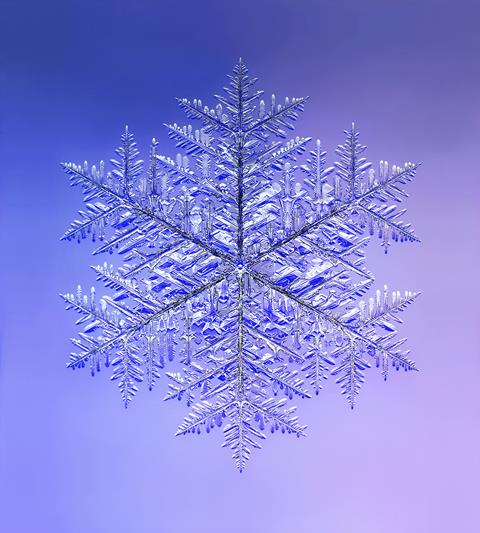
Bigger snowflakes have been reported but these are made of individual snow crystals clumped together – the largest reported cluster was 38cm wide and 20cm thick.
5 Quartz
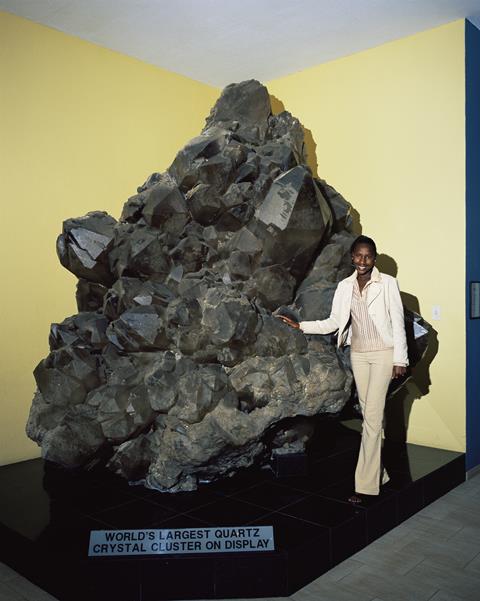
Fine grains of silicon dioxide crystals, otherwise known as quartz, cover beaches the world over. Unlike typical sand crystals, a 14 tonne quartz crystal measuring 3m long and 3m high takes the trophy for the world’s largest quartz crystal on display. It supposedly took over three years for miners to excavate it from a mine in Namibia.
6 The world’s biggest?
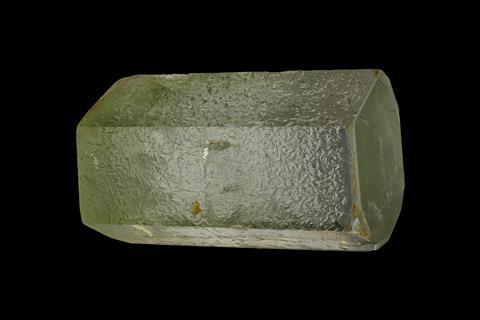
An 18m long and 3.5m deep, the beryl (beryllium aluminium silicate) crystal found in Malakialina in Madagascar, weighing approximately 380 tonnes, is one of the largest crystals ever found. Beryl crystals are highly valued gemstones but are also one of the main sources of beryllium.
And finally an honorable mention…
Crystallographer Robert Krickl made the largest model ever constructed of sodium chloride’s lattice structure in 2015 using nearly 40,000 plastic balls. While not a crystal itself, the cube structure has a length of over 3m and uses enough connecting sticks that, when placed end-to-end, collectively measure over 10km.
The model replicates the ionic structure found in a crystal of salt 0.0000096mm across. Krickl’s crystal structure model of sodium chloride can be seen in an interview with the AFP when his construction was put on display in Vienna.



No comments yet