Artificial intelligence (AI)
The latest chemistry news and research on artificial intelligence, including cheminformatics, quantum chemistry simulation and property prediction, from the Royal Society of Chemistry's magazine, Chemistry World
-
 Research
AI helps chemists consider more options when it comes to picking the best reactants for an experiment
Algorithm can standardise substrate selection to improve performance and structural diversity
-
 Opinion
Scientists must be trained to work without AI, as well as working with it
As AI and autonomous labs become more capable, human reasoning must be preserved
-
 Research
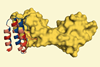
Tagging AI-generated proteins during design process will let scientists know who made them
Google DeepMind researchers who developed the method say that this will help uphold scientific integrity and prevent misuse of protein designs
-
 Webinar
El Agente: ask me anything! A live demonstration
Join us as we tackle your chemistry challenges live with the El Agente team on 24 November
-
 News
NewsGoogle DeepMind’s mutation Atlas shines a light on our dark DNA
AI’s predictions on the impact of changing each and every base of the human genome will help scientists understand genetic basis of disease
-
 Opinion
Feeding AI’s appetite for data
Tapping companies’ archives makes for better predictions of how proteins bind drugs, but any data inputs need to be transparent and attributed
-
 Research
Benchmark flaws may be distorting AI drug-discovery leaderboards
Audit identifies subtle but consequential issues, such as conflicting labels and train–test leakage, in numerous benchmark datasets
-
 Opinion
Artificial intelligence or clever artifice?
It’s important to be realistic about what AI can, and can’t, achieve, across the chemistry enterprise
-
 Business
Combining AI with experiments to solve real-world materials problems
CuspAI’s Materials Foundry partner network includes 45 technology, data and materials chemistry companies to make and test its predictions
-
 News
NewsUS National Science Foundation putting $380 million into building ‘self-driving’ labs
North Carolina State is one of the institutes receiving a $20 million grant aims to advance an autonomous chemistry lab
-
 Feature
How AI is transforming the world of analytical chemistry
Analytical chemists have been using machine learning long before ChatGPT made headlines. Now, as generative AI enters the laboratory, the discipline faces both opportunities and risks
-
 Research
Protein wrappers designed by AI solve membrane proteins’ solubility problem
Protein sheaths encapsulate membrane proteins while preserving their structure and function making them easier to study
-
 Opinion
Could AI undermine our (belief in the truth of) scientific theories?
Artificial intelligence models that make predictions based solely on data present problems for philosophers
-
 Research
AI model fills in the gaps in crystal structures by placing missing hydrogen atoms
Model may help fix existing structures in the database or better simulate new materials
-
 Feature
AI agents accelerate catalyst discovery from simulation to scale-up
Artificial intelligence tools are transforming catalyst research, with new AI agents capable of completing in minutes what once took computational chemists days. Andy Extance explores how all scientists can benefit, from small groups to those at tech giants like Meta, Google and Nvidia
-
 Research
Could AI research assistants speed up scientific discovery?
Google’s Co-Scientist and Futurehouse’s Robin can help scientists generate hypotheses, design experiments and analyse data
-
 Research
‘Human-in-the-loop’ approach could cut costs of robotic labs by 90%
Reducing costs may democratise field by making self-driving labs more accessible
-
 Opinion
Why data visualisation is so important in the age of AI
Machines don’t need to draw charts and plots to work with data, but humans will still need datavis skills to work with machines.
-
 Research
Machine learning cuts complexity of computational calculations in catalysis
Software simulates 370,000 steps in under 100 hours, potentially cutting demand for time on supercomputers by orders of magnitude
-
 Podcast
AlphaGenome & the RNA world hypothesis
In this episode, we discuss Google DeepMind’s latest deep learning model AlphaGenome, dissect the origins of life from chemicals to complex lifeforms, and hear the latest headlines.