
There are many benefits to participating in extracurricular activities with colleagues
Sarah Jenkinson, an organic chemistry lecturer at the University of Oxford, UK, was asked to start a departmental choir in 2012, soon after Gareth Malone’s TV series The Choir: Sing While You Work first aired. The show highlighted the benefits of creating a staff choir to bring people together across an organisation. The Oxford department of chemistry choir – Keytones – is still thriving today.
‘Our repertoire is a real mix,’ says John Walsby-Tickle, a mass spectrometry services manager who joined the choir in 2016, when he first arrived at Oxford to start a PhD. It includes a cappella, jazz, popular music and Christmas carols. ‘We’ve also sung songs that have been composed or arranged by members of the group,’ he adds. This includes a piece composed by Nick Green, a professor of chemistry, for the Dyson Perrins lab’s 100th anniversary celebration in 2016. The Keytones give an annual carol performance, during a departmental Christmas social event, and normally put on at least one other performance a year, usually at a charity event such as a bake sale.
The choir practices once a week at lunchtime. Keytones members include academics, professional staff, postdocs, PhD students and fourth year undergraduates (who spend the year embedded in research teams doing their final year projects). ‘Jenkinson is the choirmaster and there are currently around 10 regular members, says Walsby-Tickle. ‘There are a few people that are super talented and pitch perfect but most of us just enjoy singing,’ he explains.
One of the benefits of being a choir member is getting to know people in the department that he doesn’t work with, says Walsby-Tickle. Jenkinson agrees: ‘It has been great for meeting people in research groups that I wouldn’t routinely connect with any other way,’ she says.
A harmonious community
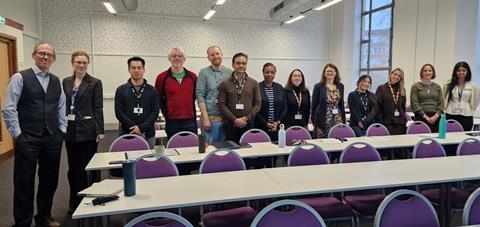
Similarly, Ian Craddock, head of the School of Civil, Aerospace and Design Engineering (Cade) at the University of Bristol, UK, established a staff choir in September 2025 as a means of fostering greater community between the academic and professional staff in his school. ‘I started as head of school two years ago and inherited a post-Covid employment situation, with a lack of opportunities to engage face-to-face with colleagues,’ he says.
Craddock searched for an activity with wide appeal that was also logistically easy to execute. ‘The idea of a choir came up because it was an activity that we could do without needing specialist facilities … and there’s a relatively low bar to participation – [choir members] don’t need to read music,’ he says.
Cade hires a professional singing teacher as the choirmaster. The choir meets on Wednesday lunchtimes and has 30 members, including Craddock, with 10–15 attending on an average week. The group sings light-hearted pop music with harmony, Craddock says. Its first performance, during a staff social event in December, was Merry Christmas Everyone by Shakin’ Stevens. ‘We are currently doing Praise You, which is Fatboy Slim,’ he adds.
In December, Craddock surveyed the choir to see if he was meeting his community strengthening goals – 24 choir members responded. ‘People described social benefits in terms of [the choir being] this melting pot of staff who did not necessarily really know each other, [and that] making those connections gives them benefits during the rest of the working week.’
Richard Corsi, dean of the school of engineering at the University of California, Davis, US, also realised that the pandemic had reduced interactions between his academic and professional staff. As a life-long music lover, he settled on the idea of forming a faculty and staff band to play at social events, as a way to increase attendance. The result was the Technically Hip, a band that plays a mix of alternative and indie rock, funk, Latin, pop and blues. There are currently seven regular band members and a few ad hoc members, including Corsi who plays guitar and sings backup.
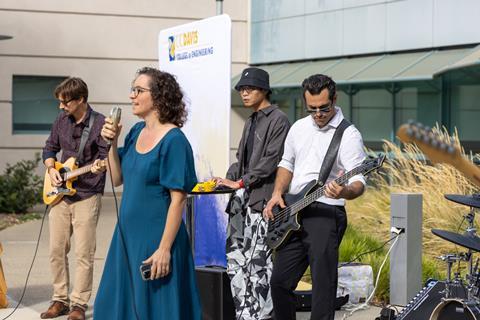
Technically Hip played its first gig in the autumn of 2023, with Marina Radulaski, a professor of quantum nanophotonics joining as its lead singer in early 2024. The band gives about five performances per year and practices 1–3 times before each one. ‘We play to audiences ranging from 50 College of Engineering colleagues to several thousand basketball fans at UC Davis stadium,’ says Radulaski. ‘The last five years have been hard with pandemic and people … not used to coming together anymore. Having this very positive thing is really helpful in terms of people feeling good about their workplace.’
Sports teams
Sports teams are another common way of fostering community at work. Marc Le Boursicaud, a postdoc in combustion science, set up a postdoc bouldering team soon after moving from France to Singapore to join the Cambridge Centre for Advanced Research and Education (Cares), a University of Cambridge decarbonisation research centre. The centre has around 150 academic and professional staff, with the postdocs working in project teams without much professional interaction between them – something that is common at many universities.
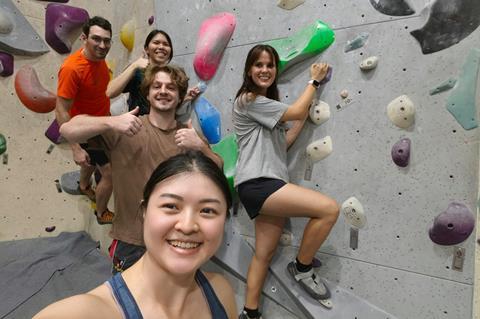
Established in autumn 2025, the bouldering team goes to an indoor bouldering centre weekly after work. It currently has seven members who work in four different Cares research teams. Since the bouldering team started up, Le Boursicaud says the atmosphere in the open plan lab at Cares has felt ‘more warm and welcoming’. Lex Lim, a chemical engineering postdoc and bouldering team member agrees: ‘this extracurricular activity is one of the only times that we get to work on the same objectives with people in other teams.’
Forging links between people who wouldn’t otherwise interact was the goal of Daniel Karadzas, a final year biochemistry PhD student, when he established the Gibbet Hill Rovers in 2023. This mixed football team is made up of PhD students, postdocs, academics and professional staff based at the University of Warwick’s Gibbet Hill life sciences campus in the UK. ‘Normally, when you join a research group, you meet the people in your group and the people in the surrounding groups, but you never really meet people over in the building across the campus,’ says Karadzas. ‘I love football, as a lot of people do, so it seemed like a [good activity] to get people to meet each other and build a community.’
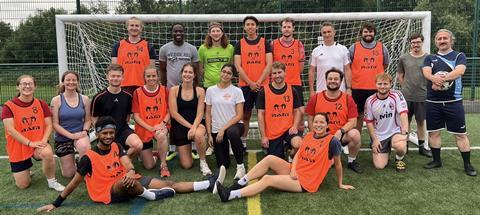
The Gibbet Hill Rovers meet on a Tuesday evening on an astro pitch on campus, which the department pays to hire. On an average week, 10–20 people turn up to practice and play games between themselves. Karadzas also organises occasional matches against other departments. ‘We’ve played against statistics, economics, physics and the estates team,’ he says. Every six months or so, the Gibbet Hill Rovers play a student versus staff match. ‘We had one just before Christmas, it was two all, and the staff won on a penalty shootout at the end.’ A star player on the staff side was Karadzas’ PhD supervisor David Roper, who is ‘famous for his sliding tackles’, Karadzas says.
Universities are hierarchical organisations and extracurricular teams that include a broad range of employees can help build bridges between levels. ‘We have lots of perceived barriers between academic and support staff. [It’s important] to find activities where it doesn’t matter whether you’re a fellow of the Royal Academy, a new academic or a new admin assistant, you are able to do something together as equals rather than as part of an organisational hierarchy,’ says Craddock. ‘It’s nice having that slightly different interaction with students,’ Walsby-Tickle agrees. ‘In the choir, it’s not the tutor-student dynamic, we’re just peers together – we’re all in the same boat’. Karadzas says his PhD supervisor playing for Gibbet Hill Rovers has benefited the dynamics in their research group: ‘my boss is the PI who comes most regularly, and this creates a bit more banter at work.’
Personal advantages
The advantages of doing an extracurricular activity with work colleagues extend beyond creating a more enjoyable, cohesive working environment. Craddock says most of his survey respondents mentioned that the Cade choir contributed to their personal wellbeing by reducing stress. Comments in the survey responses included mentions of dopamine hits and feeling happier leaving choir practices than when arriving. ‘It’s nice to have something to go and do at lunchtime to take the stress off for a bit,’ Walsby-Tickle says about the Oxford Keytones. For the sports teams, increased physical fitness is an additional bonus.
Taking part in extracurricular activities at work also helps develop professional skills. The Cade choirmaster, for example, teaches voice training in the weekly choir sessions. ‘Many of [the singers] have jobs that involve talking to larger audiences, so developing vocal strength is not a bad idea,’ Craddock explains. Radulaski says that singing with Technically Hip is increasing her confidence at work. ‘It is making me feel more bold and brave in my choices in science, because there’s some creative synergy between music and science.’ Showing vulnerability on stage also boosts confidence, she adds.
Karadzas says organising the Gibbet Hill Rovers has improved his people management and organisational skills. ‘On an average week, we have 10–20 people turning up, and we’ve got to be organised. We can’t be letting people down when they’ve made arrangements around it,’ he explains. Lim, meanwhile, says that finding achievable routes up bouldering walls teaches the art of approaching problems from different directions. ‘This influences us in our work to think from multiple directions, instead of just from one,’ he says. This is an important skill to have as ‘in research, not everything works the first time’.












No comments yet