


When to reuse plastic pipette tips and how to overcome psychological barriers to recyling single-use items
Chemistry has a plastic waste problem. In 2015, the University of Exeter estimated that global bioscience research produces 5.5 million tonnes of plastic waste annually, and while the exact figure for chemistry is unknown, it’s likely to be similarly damning. Unfortunately for chemists, the essential lab plastics are typically challenging to either recycle or reuse: the possibility of exposure to harmful chemicals from used gloves, pipette tips and syringes make commercial recyclers unwilling to accept these products, while concerns around sample contamination prevent most lab users from reusing cleaned items.
The sheer scale of the problem can be incredibly daunting, but, says Helena Rapp Wright, an MRC early career research fellow at Imperial College London, UK, ‘even a tiny action can still be valuable and have a big impact, especially when it translates across the community.’
Rinse and reuse

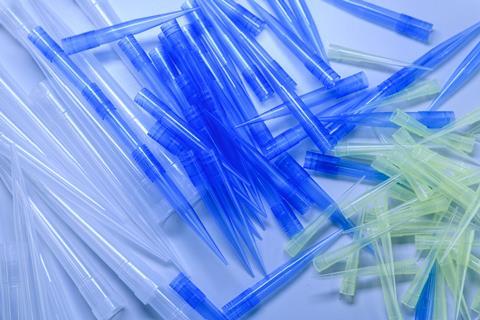
For Rapp Wright, this small action was changing her group’s approach to pipette tips. Working in an environmental lab, the team handles thousands of analytical samples every year, each prepared with a disposable plastic pipette tip to avoid cross-contamination. But, if they could devise an appropriate method to reuse even a proportion of these tips, it would slash the group’s overall plastic footprint.
With support from the Royal Society of Chemistry’s Sustainable Laboratories grant, Rapp Wright began a comprehensive study to determine the practical and environmental feasibility of a reuse approach. Pipette tips of varying types were first contaminated with a panel of around 140 chemical compounds – including pesticides and pharmaceuticals typically found in the lab’s samples – and washed with one of 11 solvents. Liquid chromatography–mass spectrometry confirmed that this straightforward washing procedure completely decontaminated the tips and Rapp Wright then conducted further tests to evaluate the performance of these cleaned consumables.
‘We wanted to make sure that the tips work after you wash them and that washing doesn’t interfere with the analysis – for example, changing the inner surface of the tip,’ she explains. ‘We did calibration checks to make sure they were still dispensing the right amount, we performed scanning electron microscopy to make sure the surface wasn’t degraded and we investigated carryover for [over] 100 chemical compounds using mass spectrometry to make sure that there was no potential contamination.’ These same parameters were evaluated over multiple successive use cycles, with some solvents permitting reuse up to 40 times before the tips began to fail the calibration checks.
But plastic waste isn’t the only sustainability issue and the team were keen to ensure that this reduced plastic demand didn’t come at the expense of a higher carbon footprint. For each chemical and solvent combination, they conducted a lifecycle assessment to compare the percentage of carbon emissions saved by reuse versus using a new tip. ‘For some solvents, the carbon emissions from washing pipette tips can exceed those from buying new ones,’ Rapp Wright explains. ‘But for solvents that are more environmentally friendly, we saw that you save emissions by reusing pipette tips, so it does depend a little bit on what you’re doing.’
Rapp Wright has already shared these insights in a publication and created a calculator to enable other groups to adjust this method to their own particular samples and systems. Meanwhile, her lab has received the Leaf Gold Award in recognition of their sustainable changes and the accolade is inspiring researchers across the department to find even more small ways to continue addressing sustainability in their research.
Behavioural barriers
But, according to Catherine Naughtie, not all researchers feel so empowered to initiate change, no matter how strong their motivation. A psychology PhD student at the University of Bath, UK, Naughtie partnered with the chemistry department and lab plastic recycling specialists LabCycle to investigate attitudes towards and barriers to plastic recycling in the research environment.
‘Lab users are aware that single use plastics are a problem, but they find it really difficult to know how to address that problem,’ says Naughtie. ‘There are lots of technical solutions, but one of the biggest issues is actually getting lab users to recycle, and getting lab managers and the people responsible for procurement to obtain more sustainable products.’
Sample contamination was unsurprisingly a big concern for researchers, accounting for the high consumption and low reuse of plastic consumables. Surveys among stakeholders from across the department also revealed a lack of awareness about both alternative products and existing processes that could help mitigate the impact of this workflow.
It’s not about changing people’s attitudes – they are keen to do this
Catherine Naughtie
However, ignorance is not indifference and the overwhelming majority reported being willing to change their behaviour in the interest of sustainability. ‘About 80% said they were happy with integrating a recycling process and using recycled plastics, but that [the processes] needed to be streamlined and practical,’ Naughtie says. ‘A big barrier we’ve identified is that recycling processes are cumbersome, but that if you can swap an alternative into the existing workflow, people would be really keen.’
LabCycle is now using the insights from Naughtie’s study to trial a pilot scheme of plastic recycling across the chemistry department at the University of Bath, making this sustainable solution as easy as possible by tailoring the process to each individual lab. Meanwhile, addressing the issue at the procurement stage could also make a significant impact on virgin plastic demand, suggests Naughtie. ‘Finding a way to make the most sustainable option (eg recycled tips) the natural first choice product takes that decision away from procurement and takes the friction away from everyone down the process,’ she says. ‘It’s not about changing people’s attitudes – they are keen to do this. Largely it’s about the nitty gritty of these processes!’
Tips to start reducing plastic consumption
- Start small. Even a little change can have a large cumulative impact over time.
- Consider contamination. Could your item be safely recycled with ordinary plastics?
- Find out about existing sustainability initiatives available in your university or region.
- Make connections across university departments and external collaborators. People with other specialisms may have a different perspective on the problem.




How chemists are making laboratories more sustainable
A collection of articles sharing tips from researchers who reduced their environmental impact with support from the RSC’s Sustainable Laboratories grants
- 1
 Currently
reading
Currently
reading
Sustainable laboratories: Reducing plastics
- 3
- 4
- 5
- 6
- 7










No comments yet