


How to identify an efficient heating mechanism and implement energy-saving measures across the lab
Chemistry is an inherently energy-intensive discipline. Power underpins every aspect of practical work, from heating and cooling to the carbon footprint embedded in reagents and consumables. Identifying the greenest solution often involves many different considerations and unsurprisingly, many lab users struggle to know how to tackle their energy consumption. ‘There are lots of offhand conversations between researchers along the lines of “we never know which is more sustainable, X or Y,”’ says Christina Picken, a postdoctoral researcher at the University of Manchester, UK. ‘I’ve noticed that so many people have questions and are willing to do the right thing, if only they knew what the right thing was.’
Creating general guidance
Inspired by this casual lab chat, Picken devised a series of short projects to answer these sustainability questions and, funded by the Royal Society of Chemistry’s Sustainable Laboratories grant, hired a student intern, Yu Chen, to investigate the energy footprint of different heating mechanisms. Most labs use a combination of oil baths, bead baths and drysyn blocks depending on members’ personal preferences or equipment availability, with no consensus on which is most efficient.
Approaching the question systematically, Chen heated water to 80°C under reflux using each of these methods, holding the system at this temperature for an hour. She recorded the ramp time required to reach temperature and the energy use of the hot plate over that period, performing a lifecycle assessment to compare the overall impact of each setup. ‘We evaluated it over 2400 uses, which is the equivalent of using that setup for one hour each day, five days a week, for 48 weeks of the year, for 10 years. We also calculated the [life cycle assessment] for whether or not you use foil,’ explains Picken.
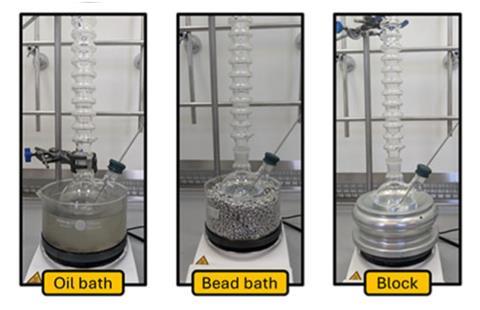
Interestingly, the pair found that oil baths were the most efficient, regardless of whether they were insulated by foil. But, while using a foil surround showed a clear energy saving in terms of heating, the carbon footprint embedded within the material means that in many cases, it’s more sustainable to go without. ‘If the foil becomes contaminated and is then disposed of as hazardous waste, the combined carbon footprint (in global warming potential) of using foil increases approximately three-fold, so it must be reused 4–10 times to recover the embedded carbon,’ explains Picken. ‘As guidance, only use foil to insulate reactions if it can be reused multiple times or has limited risk of hazardous contamination and can be recycled.’
Most lab users want to work more sustainably and providing this kind of general rule is a key step to facilitating that, she says. ‘People are trying, but they don’t always have time to do these types of experiments. Particularly where they are doing lots of repeats of the same experiment – like teaching labs – this guidance can then become embedded in general practice.’
Small shifts, magnified
Tweaking these general lab behaviours can have a substantial cumulative impact, especially when targeted towards students. For organic chemist Dawid Zych, the Sustainable Labs grant offered a rare opportunity to completely overhaul the green credentials of his own lab at the University of Opole in Poland. A sustainability audit of his group had revealed that one area where they could improve their practices was the use of energy.
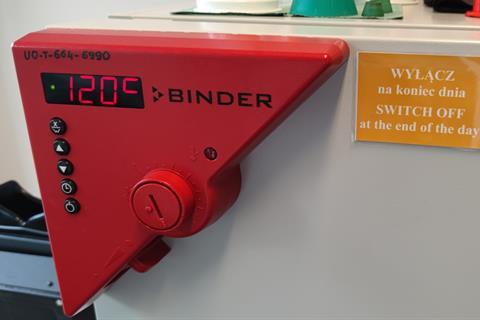
Simple changes such as reminding lab users to switch off equipment are an easy place to start, he says. Zych created a traffic light system for the lab’s different electronic items – green for devices such as hot plates which should be switched off after use, yellow for equipment like balances to be turned off at the end of the day, and red for appliances such as fridges that should always stay on.
Meanwhile, modifying the way equipment is used or set up can significantly improve operational efficiency while it is on, he adds. For example, adding water bath balls to rotary evaporators. ‘Normally the water evaporates all the time so you have to keep adding more and it needs a lot of energy to create and maintain the bath temperature,’ he says. ‘With the balls, I can see the reduction of energy is high and the baths don’t need to heat so often.’
Involving students in both the discussion and implementation of these small initiatives is vital, not just as part of their chemical education, but in ensuring sustainability considerations become a part of future lab practice. Throughout the lab overhaul, Zych worked closely with Corona, the university’s student scientific group, and believes the resulting dissemination of green ideas among the next generation of scientists has been one of the most impactful outcomes of the project.
I think the biggest achievement is that the students now have this knowledge too
Dawid Zych
But sustainability isn’t just about general practices and Zych was keen to explore how alternative techniques and methods could streamline the chemistry itself. With the remaining grant money, he was able to invest in a second-hand microwave reactor, slashing the time, temperature and energy demand of much of the group’s synthesis. ‘If we compare, for example, a coupling reaction, the reaction normally might take 48 hours, but in the microwave synthesiser, it’s 25 minutes or less. It’s easier, faster, and of course better for the environment,’ Zych explains. ‘I think the biggest achievement is that the students now have this knowledge too. They have the skills that, during the planning of chemical synthesis, they can look in the literature and know what they could change to use a greener technique such as microwave.’
Tips to start reducing energy consumption
- Start small. Even reminding colleagues to switch off equipment can build up into a big impact.
- Treat it like an experiment. Control the variables and collect data in triplicate.
- Take these casual questions seriously. Researchers in the lab are best placed to identify gaps in green practice.
- Talk about what you’re doing with other researchers. Sharing your ideas can help spread the impact.




How chemists are making laboratories more sustainable
A collection of articles sharing tips from researchers who reduced their environmental impact with support from the RSC’s Sustainable Laboratories grants
- 1
- 2
- 3
 Currently
reading
Currently
reading
Sustainable laboratories: Reducing energy
- 5
- 6
- 7










No comments yet