


How to identify greener replacements for DMF and recover ITO from glass substrates
Solvents and substrates are the bread and butter of wet-lab chemistry. But the sheer diversity of research activities, be it synthesis, polymer engineering or photovoltaic design, makes it extremely difficult to develop any generalised guidance for sustainable best practice.
In response to this challenge, University College London (UCL) launched the Laboratory Efficiency Assessment Framework (Leaf) in 2018, providing support, advice and recognition to labs seeking to improve their sustainability credentials and creating a standard against which their achievements could be measured. ‘To increase accessibility, the bronze level is quite generic: focusing on reducing waste and energy. But as you progress, it becomes a little more niche and encourages you to think what you could be doing that’s specific to your lab – the solvents you use and how you run experiments,’ explains Christina Picken, who was involved in the pilot scheme as a postdoc at UCL.
Switching solvents
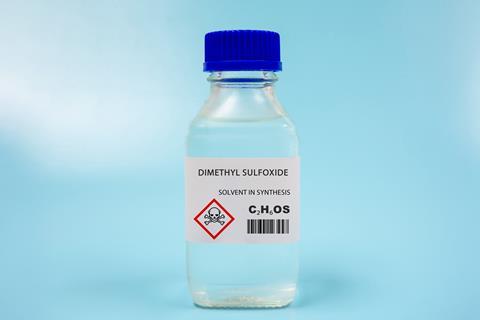
After moving to the University of Manchester in 2020 to take up a position as a postdoctoral researcher in polymer chemistry, Picken was eager to apply this green experience in her new lab. Starting small, she began to explore replacing dimethyl formamide (DMF) – a toxic and volatile polar solvent – in her experiments with a greener alternative, namely gamma valerolactone. ‘But my research only uses about 3mL maximum at a time,’ she says. ‘The majority of the DMF that we buy in our lab goes onto our GPC (gel permeation chromatograph) so if we’re thinking about our lab as a whole, that would be where the greatest potential gains are.’
With a project in mind to overhaul the group’s chromatography methods, Picken used funding from the Royal Society of Chemistry’s (RSC’s) Sustainable Laboratories grant to hire a student intern, Yu Chen, who systematically evaluated the efficacy of greener solvent alternatives such as dimethyl sulfoxide (DMSO), anisole and dimethylimidazolidinone for the analysis and characterisation of different polymer backbones.
‘We did a literature review looking at which green solvents might be suitable: those with similar polarities, viscosities and cost efficiencies,’ Picken explains. ‘Then we ran those on a series of different polymers: some were calibrants and very clearly defined, others common polymers that we had in the lab, and more niche samples we’ve described as challenge polymers.’
This solvent switch involved a surprising number of factors. The team had to ensure that all test polymers were suitably solubilised and stabilised before beginning the analysis. Solvent mixtures proved most effective in this regard and a 50:50 blend of DMSO and anisole not only increased polymer solubility but also resulted in reduced environmental impact according to lifecycle analysis. Picken and Chen are now collating the findings of the investigation for publication and hope that other polymer chemists can ultimately use these insights to modify their own GPC methods for greener separations.
Recovering substrates
The LEAF framework also provided the seed of inspiration for organic electronics researcher Julianna Panidi and research technician Pabitra Shakya Tuladhar to trial different approaches to make cleanroom operations more sustainable in the chemistry labs at Imperial College London.
An easy first step after securing funding from the RSC’s Sustainable Laboratories grant was to replace conventional solvents with bioderived alternatives wherever possible. The specification of these substitutes is exactly the same as the original but without the carbon footprint and it was a simple matter to swap these into all cleaning procedures. ‘The price was quite high but by working closely with the supplier, we made a very good deal that enables us to purchase in bulk at a more affordable cost, and stagger delivery,’ says Shakya Tuladhar.
However, the main focus of their efforts was using these greener solvents to develop a straightforward and general method to recycle the key substrate used in organoelectronic devices such as semiconductors and photovoltaics. ‘The common starting point for these devices is a glass substrate with an indium tin oxide coating (ITO),’ explains Panidi, who has since moved to the University of Edinburgh. ‘At the end of an experimental run, these substrates end up in the bin. But given the scarcity of indium, we wanted to trial different methods to recycle/reuse them.’
The device performance was not affected when we used recycled ITO/ZnO substrates
Julianna Panidi
The devices themselves are often fairly complex, comprising multiple sequential layers to modulate the properties and performance of the final device for different applications. Simply washing with acetone and isopropyl alcohol removed the majority of these added components, although the electron transporting zinc oxide layer, often applied directly onto the ITO surface, proved more of a challenge. ‘As the oxide layer is very difficult to remove, we looked at depositing another layer on top to effectively restore it rather than beginning from fresh ITO-coated substrates. We found that the device performance was not affected when we used recycled ITO/ZnO substrates,’ says Panidi.
However, evidencing that the substrates are clean and undamaged is equally important to ensure that researchers trust that they can reuse these materials, she adds. Focusing on accessibility, a key part of the puzzle has therefore been finding a simple and inexpensive technique that will give scientists confidence in their recycled substrates.
Ultimately, Panidi and Shakya Tuladhar plan to share this method through publication and hope that the success of this project will inspire students to challenge existing practices and propose more sustainability initiatives in the department going forwards.
Tips to start swapping solvents and substrates
- Involve as many people as possible. Understanding researchers’ reservations and getting everyone invested in new protocols will help changes stick.
- Investigate alternative products. There are often greener options for standard consumables.
- Talk to your suppliers. Discussion and negotiation can help make any product swap happen more smoothly.
- Don’t underestimate the impact of a small change. 3ml less of DMF is a small gain, but repeated hundreds of times is a huge cumulative saving.




How chemists are making laboratories more sustainable
A collection of articles sharing tips from researchers who reduced their environmental impact with support from the RSC’s Sustainable Laboratories grants
- 1
- 2
- 3
- 4
 Currently
reading
Currently
reading
Sustainable laboratories: Cleaner solvents and substrates
- 6
- 7











No comments yet