


How to encourage better environmental practices across a department and influence the next generation of researchers
Sustainability encompasses many different aspects of practical work, including the consumables we buy, the power we use and how we handle waste. But while most researchers have the best of intentions, it’s easy for bad habits to creep in. Maybe it’s changing gloves more often than strictly necessary, not checking the inventory before purchasing a new chemical, or leaving equipment on after use. Awareness of these tiny mistakes is a key first step towards transitioning to greener working practices.
The transformative impact of tiny changes
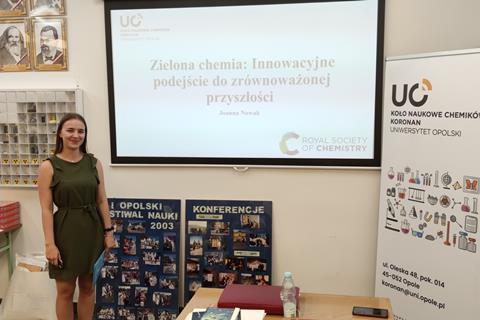
Conscious of some of these ingrained behaviours in his department at the University of Opole in Poland, Dawid Zych was keen to address the problem at its root. He had applied to the My Green Lab certification, an international framework that helps scientists integrate sustainability into their everyday workflows. ‘In the beginning, they conducted a survey of all the people who work in the same laboratory: our habits, our attitudes, behaviours, laboratory meetings, synthesis, even the fridges and other laboratory equipment. Based on our answers, they wrote a feedback report and we were brown , scoring 46% on the certification assessment,’ explains Zych.
Crucially, the report highlighted the areas in which the group could improve their activities, from resource management to waste reduction, and they were given six months to implement changes.
This clear feedback and impending deadline prompted a whirlwind transformation in Zych’s lab. With funding from the Royal Society of Chemistry’s (RSC’s) Sustainable Laboratories grant, he made several key purchases, including a second-hand microwave reactor for greener synthesis and air condensers and chillers to reduce water use. Meanwhile, small-scale behavioural changes, such as recycling lightly contaminated solvent through distillation and providing in-lab reminders to help people optimise equipment use, were cheap and effective ways to create a big impact.
It was important to Zych that this attitudinal shift had an impact beyond his lab. He involved the student scientific club, Corona, in devising and implementing these changes and created two department-wide initiatives to improve resource management. ‘We created a chemical inventory for the whole faculty. Now we know exactly where every substance we have is and people can borrow chemicals, rather than duplicating purchases. We spent a lot of money on chemicals before, but now this is reduced by about 80%,’ explains Zych. He also established a chemistry swap shop – an area of the department where people could take unwanted equipment, chemicals or even packaging for other people to reuse.
The cumulative impact of these small measures was substantial and in their second evaluation Zych’s team achieved the top certification, scoring 98%. His success has inspired others in the department to follow his lead and he hopes that his students will carry this forward with them as they progress through their scientific careers. ‘If we show the students that we can change our attitudes and our small environment, maybe they will do the same in future,’ he says.
Placing education first
For Silvia Gross, Mauro Carraro, Paolo Dolcet and their multi-institutional team of colleagues, emphasising the importance of best lab practice to the next generation of chemists is key to creating a lasting impact.
Focusing first on undergraduate students, the team created a collection of best-practice resources explaining how to reduce waste and reduce the consumption of water, energy, solvents and consumables. ‘We noticed that the students had no idea about reducing their impact. They make huge use of disposable plastics and have no care about saving materials, energy, water or avoiding waste,’ says Gross, who is based at the University of Padova in Italy.
At the beginning of the academic year, students completed a survey probing their knowledge of sustainable issues in chemistry. This was followed by a two-hour teaching session about how to reduce their impact in the lab, supported by a laboratory sustainability handbook and a series of videos created by the team. The students then completed a second survey at the end of the academic cycle to evaluate how effective the new teaching measures and resources had been.
We had great feedback and the students really enjoyed it
Paolo Dolcet
‘We also made a parallel activity for monitoring the consumption of consumables in order to detect unusual behaviour and make them aware about the irregular amount of [items they used],’ adds Carraro, also based at the University of Padova. ‘Putting everything together, we observed more awareness about green chemistry in the lab and sustainability [after these interventions].’
The team has since expanded this project and is now reviewing undergraduate practical procedures to try to reduce or substitute toxic or damaging chemicals in teaching experiments. Final-year students have been encouraged to make suggestions to improve existing procedures and Gross’s team ultimately hopes to share the revised practical course with other teaching labs through publication.
Gross and colleagues also wanted to create an educational resource for PhD students and established chemists who tend to have more awareness of green fundamentals. In February 2025, the University of Padova, alongside collaborators at Monash University in Australia and the University of Bath, UK, launched the first winter school for green chemistry, part-funded by the RSC’s Sustainable Laboratories grant. The five-day programme of lectures and events covered all aspects of green chemical synthesis including alternative techniques like microfluidics and mechanochemistry, practical considerations such as solvent selection and sustainable process design, and the wider impacts and industrial applications of this knowledge. ‘We had great feedback and the students really enjoyed it,’ says Dolcet, also at the University of Padova. The team ran a second winter school in Padova earlier this year.
Tips to start improving general lab practice
- Involve students in the project. Teaching best-practice as early as possible will ensure they carry these ideas forward through their careers.
- Gather data. Knowing where there’s room for improvement will help you make the most impactful changes.
- Remember, no change is too small. Even something as simple as a sticker reminding someone to turn off equipment can have a big cumulative impact long-term.
- Consider second hand equipment. Not only are you reusing what would otherwise go to waste but it can also make sustainable upgrades more affordable.



How chemists are making laboratories more sustainable
A collection of articles sharing tips from researchers who reduced their environmental impact with support from the RSC’s Sustainable Laboratories grants
- 1
- 2
- 3
- 4
- 5
- 6
 Currently
reading
Currently
reading
Sustainable laboratories: Best lab practice









No comments yet