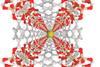
MOF-5

Source: © Ramon Andrade 3DCIENCIA/Science Photo Library

MOF-5 was one of the metal–organic frameworks whose synthesis can be sped up by electric fields

By applying an alternating electric field to the outside of a reaction vessel, chemists have dramatically cut the time it takes to synthesise a range of metal–organic frameworks (MOFs). The researchers behind the work say that this simple method reduces reaction times to less than an hour, without the need for heat or additional catalysts.

Chemists typically make MOFs by reacting dissolved metal salts and organic linkers in a sealed container. However, such solvothermal methods can be energy-intensive, require reactions to be left overnight and lead to the buildup of potentially dangerous pressure in the reaction vessel.

Researchers in China have now taken a different approach by wrapping two ring electrodes around the outside of a glass test tube and applying a voltage. The generated electric field accelerates the formation of various well-known MOFs, such as UiO-66 and MOF-5. Reactions took between 15 and 60 minutes, depending on the metal and organic linker used, cutting the energy and time needed to make these highly porous materials.

Irradiating the reaction mixture of a known zirconium-based MOF with a laser allowed the team to determine the rate of MOF formation and subsequently the activation energy barrier. Analysis revealed that the presence of the electric field reduced the apparent energy barrier by around 20%, compared with traditional synthesis methods. The researchers suggest this is due to the electric field making the reactants more reactive and lowering the energy required for the two reactants to mix.

The team also found that first activating the metal salt with the electric field before adding the organic linker led to the MOF forming instantly.

Although this method so far only works up to a gram scale, the researchers say that using flat-plate electrodes or multiple electrodes could help further scale up this technology.