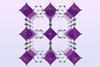
Scientists have created a metal–organic framework (MOF) that is strongly magnetic but generates no external magnetic field. The researchers behind the work say that this is due to magnetic moments inside the structure that point in different directions and cancel each other out. This creates a material with little magnetic ‘noise’, which may be useful to create more energy-efficient electronics.
Strongly magnetic materials often produce stray magnetic fields that interfere with or demagnetise nearby magnets. This makes it difficult to use such materials in spintronics, an advanced class of electronic materials that uses the charge and spin of electrons to transfer information.
Materials that are strongly magnetic but have little external magnetic field – known as compensated ferrimagnets – can overcome this issue. However, such materials tend to only have this property at specific temperatures, often significantly below room temperature.
Researchers have now created a magnetic MOF material that has a near-zero external magnetic field over a wide temperature range. Chromium(III) ions coordinate to planar pyrazine molecules to create a cubic, perovskite-like structure, with the pyrazine linkers existing as radicals with one unpaired electron.
The magnetic moments of the individual chromium cations and pyrazine linkers are oriented in the opposite direction to the magnetic moment caused by the interaction between the species. This causes the magnetic moments to essentially cancel each other out.
Experiments revealed that the material’s external magnetic field is negligible and remains stable between 3 and 300K. The researchers suggest that the MOF’s magnetic stability could make it suitable for a range of room temperature electronic and spintronic materials.
References
F Aribot et al, Nat. Chem., 2026, DOI: 10.1038/s41557-026-02131-8


No comments yet