Iron-rich cells in the liver could be the mechanism that enables pigeons’ to detect magnetic fields
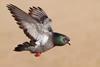
Scientists in Germany have shown that liver macrophages – the white blood cells that destroy pathogens and help clear cellular waste – could play a role in giving pigeons a ‘gut feeling’ to find their way home. The work could help explain how some animals are able to navigate by sensing magnetic fields.
Many animals are thought to use the Earth’s magnetic field as an internal compass, particularly in low-light conditions or at night when they can’t rely on visual cues and the sun to orient themselves. However, this magnetoreception ability is not well understood and studies in birds have proposed different mechanisms to explain how animals are able to detect magnetic fields, such as light sensitive proteins in the eye, iron ions in birds’ beaks or cellular ion channels that change in response to magnetic fields.
Clivia Lisowski and her team at the Institute for Molecular Medicine and Experimental Immunology have now proposed a new mechanism for magnetoreception, based on iron nanoparticles that are found in macrophages in the liver.
Ferritin for direction
Macrophages accumulate iron as they process spent red blood cells, which they store in a protein complex called ferritin that can contain clusters of up to 4500 iron ions. The team’s previous work showed that these macrophages are superparamagnetic because ‘they harbour a huge amount of these nanoparticles,’ says Lisowski. The unpaired electrons within the clusters can interact with one another through dipole–dipole coupling, and this collective interaction gives a population of such cells a sensitivity to magnetism that could potentially be involved in magnetoreception.
To test their theory, the team administered the drug clodronate, which depletes macrophages, to a group of pigeons prior to releasing them 19km from their roosts on a cloudy day. The birds in that group took much longer to find their way home than those in a control group, and followed highly erratic flight paths. When the test was repeated on a sunny day, however, the birds without macrohages were able to find their way home as normal. ‘Imagine being dropped in a forest with fog above, no sun anywhere – but you know you are west of your cabin. It’s hazy, white-out conditions. If you have a magnetic compass, you can walk east and find your cabin. If you don’t have a magnetic compass, you will try to walk east, but after some 50–100 meters, you will turn ever so slightly and lose your way. You continue searching but most likely you will not find your cabin. This is what our birds did, apparently,’ says Lisowski.

Homing pigeons also circle in the air before they set off, and the team theorises that this behaviour helps to imprint magnetic information on the unpaired electrons in ferritin in a uniform manner. This alignment then induces changes in cellular organisation, which is consistent with known macrophage responses to mechanical stimuli, and could transmit the magnetic information to nearby nerve cells. ‘It’s the macrophages that activate neurons via inter-cellular signaling,’ Lisowski explains.
Pascal Malkemper at the Max Plank Institute for Neurobiology of Behaviour, Germany, who was not involved in the work, is surprised by the results: ‘The idea that it’s a gut feeling, that the signal comes from an internal organ is unexpected. And [the fact] that’s supposed to be coming from the macrophages, which had previously been ruled out as a source of a magnetic signal, is even more surprising.’
Lisowski ‘s team is currently investigating exactly how this magnetic sensing in macrophages is translated into a cellular signalling mechanism. Their work could then potentially help explain how other animals, such as sharks or bats, use magnetoreception to navigate.
References
C Lisowski et al. Science, 2026, 392,985 (DOI:10.1126/science.ady2486)
No comments yet