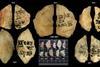
Quarts backed microliths

Source: Isaksson et al., Sci. Adv. 12, eadz3281

Closeup of the five quartz-backed microliths from Umhlatuzana Rock Shelter that contained traces of buphandrin and epibuphanisine alkaloid toxins

Pleistocene-era humans hunted with poisoned weapons, according to new chemical analysis that found toxic plant-derived alkaloids on 60,000-year-old stone age arrowheads. ‘This discovery shows that people were using bow and arrow earlier than we assumed, and that they did this quite efficiently by poisoning the tips,’ explains Femke Reidsma, a bioarchaeologist at the University of Leiden who was not involved in the study.

The oldest direct evidence of humans using poisoned arrows was in the Holocene, which began 11,700 years ago. Bone arrow points that were coated with cardiac glycosides were excavated from Kruger Cave in South Africa and dated to about 6700 years ago. However, indirect evidence led scientists to suspect that hunting with poisoned arrows began much earlier.

The arrowheads analysed in this research were excavated from Umhlatuzana Rock Shelter in South Africa in 1985 during road construction. Taken to the KwaZulu-Natal Museum, they sat untouched until 2005, when researchers selected 10 quartz arrow tips with visible residue for chemical analysis.

Using GC-MS, the team found plant-based toxic alkaloids on half of the analysed artefacts. Most notably, they found buphanidrine and epibuphanisine, toxins found in the roots of Boophone disticha, a plant well documented for its use as arrow poison.

Buphandrine and epibuphanisin

‘I was initially concerned about the time depth and the age of the samples, and I did not expect to find any detectable traces,’ says Sven Isaksson of Stockholm University, Sweden, who was part of the research team. ‘When the mass spectra of buphanidrine and epibuphanisine could be verified, checked and double-checked in five of the samples, it was perhaps not a Eureka moment, but certainly a “Yes!” moment.’

As a control, the scientists also analysed residues from known poisoned arrows collected in the 1770s, as well as a modern extract of B. disticha. All tested samples contained buphanidrine.

‘[B. disticha] is one of the most well-known plant ingredients used by the Bushmen in the 18th–20th centuries for hunting poisons,’ explains Justin Bradfield, who studies poison residues on stone age weapons at the University of Johannesburg. ‘It also has a host of other applications.’ Locally known as gifbol (poison bulb), its leaves and outer scales were used medicinally or as preservatives.

The authors theorise that the buphanidrine molecules were able to resist degradation for so long thanks to the stable and dry conditions of their deposition site, and their chemistry.

‘[Buphanidrine] contains five hydrogen bond acceptors, no hydrogen bond donors and only two rotatable bonds. The presence of hydrogen bond acceptors suggests that buphanidrine can interact with mineral surfaces, such as silica, getting adsorbed and thus protected,’ explains Isaksson. ‘The absence of hydrogen bond donors results in relatively low water solubility and also makes buphanidrine less susceptible to oxidation and hydrolysis, thereby enhancing its chemical stability under a range of conditions.’ The alkaloids also have antibacterial properties.

These findings challenge the prevailing conceptions of Pleistocene-era humans’ intelligence and level of technological development, says Reidsma. ‘[The results] show that people had a good understanding of the chemistry of these poisonous plants and how to use them to hunt more efficiently. Preparing the poison without poisoning yourself can be quite tricky. They would’ve also been adept at tracking prey because large animals don’t instantly die from the poison.’

Bradfield agrees. ‘It also shows advanced planning, strategy and causal reasoning – something that is very difficult to demonstrate for people living so long ago, but for which the evidence is nevertheless increasing every year.’