But I found something precious in the department archives that will last for generations

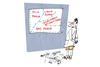
Man looking at graph

Source: © M-H Jeeves

Not all discoveries should be repeated

You all know that this story is heading for disaster – but I promise that hidden behind the pain is some consolation.

With a rich history dating back to the 1880s, the materials science and metallurgy department at the University of Cambridge, UK, has been the source of advances in many fields, including metallurgy, corrosion and electron microscopy. On my first day of a summer internship, where I would be documenting this history as a museum curator, I had big dreams. It’s a shame I would then add my own mercurial mark.

The founders of the department, Charles Thomas Heycock and Francis Henry Neville, were inorganic chemists who studied bronze alloys using light microscopy, trying to understand how the phases changed with different compositions of copper and tin.

At the time, phrases we now take for granted in metallurgy – like liquidus, solidus and Gibbs free energy – hadn’t been formalised. The chemists’ solution was simple but painstaking: record thousands of microscope images and assemble what we now know as a phase diagram. Their work received acclaim across the community, which they leveraged to form the department.

So I’m sure we can all agree that the thermometers used to measure the alloys’ melting points are of utmost historical importance. I wonder where they are and how they’re doing?

Right, well… I can explain.

It’s my first day and I’m eager to see the department archives. I had a brief glance before summer, so I knew what I was in for: filing cabinets of dusty textbooks, lecture notes and private letters. I also knew we had a set of 15 mercury thermometers used by the department’s founders.

It was a bad day to wear shorts

Unfortunately, the archive was hidden in the plant room, only accessible by authorised people like my supervisor and the facilities manager. So, since my supervisor was busy in meetings, I tried to get the facilities manager to let me in. After lunch, he finally had time, and I showed him around the archives as a thank you.

As I was discussing the craftsmanship behind one of the handmade glass thermometers, I gestured to the other ones explaining that they were part of a set. On hearing this, the facilities manager lifted another thermometer while it was still in its case. Then, in slow motion, the cap fell off – a consequence of gravity – followed closely by the mercury thermometer. By the time I could even react, there was mercury all over the floor. It was a bad day to wear shorts.

Not an ideal start. What followed were some heated exchanges on the handling of mercury in non-laboratory settings, all very fair given the facts. I also felt partially responsible, since I knew the caps weren’t on too tight and I did it without my supervisor present. And so, following my rather expensive first day, I was hoping the rest of the internship would take a more positive turn.

It did.

Spending time in the archives was a surreal experience. By immersing myself in the letters, diaries and lab-books, it made me appreciate the individuals behind the research. Like a drop in the ocean, one person’s contribution may feel small. However, the collective movement of the drops forms the waves and tides. Without the drops, the waves wouldn’t exist – and without individual researchers, the department wouldn’t have the reputation it does.

So even if the thermometer itself is broken, the connection to the people who used it isn’t. Exploring the archives and putting on exhibitions revitalises those connections and brings them to a new audience. If offered, I would definitely do it again. Only this time, I might stay away from fragile objects…