What new species remain to be discovered in the lab?

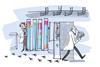
The chemist anthropologist peers through the line of glassware that shields him from the wild chemist. It is here on the interface between the inorganic chemistry uplands and the organic chemistry grasslands that new classifications are most likely to be found. He is in luck! A previously unseen chemist emerges. Their work looks similar to an organic chemist – there is the IR spectrometer, the silica loaded column… but what’s this? Metal doping to enhance yield? Perhaps this is a new type of chemist worthy of classification.
The subcategories of chemistry have always fascinated me. It becomes pretty clear early in a degree course that organic, inorganic and physical are categories so vague and intermingled as to be downright unhelpful. By the time you have taken half a dozen advanced modules you realise that there are only slightly fewer categories than most chemistry departments have staff.
Sometimes you get to see a new category emerge: I took the first module of ‘synthetic biology’ at my institution, which had just emerged as a distinct field from biochemistry, microbiology and computational chemistry. The course was fresh and exciting as a brand-new field. I wonder if it still feels that way now?
Defining a new category
I think there are two main prerequisites for a new subspecies of chemist to reach critical mass: a journal exclusively for your field and or a national meeting.
I myself have been part of two almost entirely unrelated subcategories; the educational chemists and the safety chemists (see anthropologists notes). Although the character of both was wildly different they both held lively national meetings, which involved as much socialising as academic content. I thought this was the norm until I described the experience to a biochemist friend of mine who had only ever experienced serious, studious conferences with only token socialising at the conference dinner.
The Royal Society of Chemistry publishes 58 journals, of which 3 are ‘Materials A,B & C’, so that gives us at least 56 sub-fields of chemistry. Broadening the lens, there are around 180 chemistry journals, so even allowing for a certain amount of overlap we can be fairly confident that there are more than 100 different types of chemist.
I don’t really care how many categories of chemist there are – I am just glad to be part of them
Is it even possible to state where sub-fields of chemistry end and other disciplines begin? Chemistry’s place as the ‘central science’ has long situated us in the middle of the discrete fields of physics and biology. Even then it is not so simple, as our shared borders with disciplines such as medicine, environmental science, computing and education have led to new fields emerging. Indeed, interdisciplinary work has often been a key driver of research and innovation.
Beyond academia, I assume the world of industry has a similar level of complexity. Scrolling through my contacts from university I seem to now be acquainted with industrial chemists of many flavours – from drug manufacturers and materials scientists to those who work in mysterious redacted facilities whose work I can only guess at!
I think this is wonderful. With each of these categories comes community, ownership and a sense of contributing to a wider effort. I don’t really care how many categories of chemist there are – I am just glad to be part of them.
But what of our chemist anthropologist? After days of careful study they leave their glassware-concealed hide. The careful observations were clear: this was not a new subspecies of chemist at all, just a run-of-the-mill organic catalysis chemist who had wandered away from their usual hunting ground. Perhaps the foothills of the physical chemistry mountains will be more fruitful in their ongoing search.
Anthropologist’s notes
Safety chemists
The safety chemist is normally solitary, existing in a liminal space in any department or business large enough to support one. They are not overly social, but tend to attach themselves to other subspecies whether they want them there or not. They can be lured out of hiding by staging a laboratory accident or by commissioning an audit (though be warned that they will be deeply suspicious of anyone asking to be audited). When grouped together they vie for supremacy by comparing their most lurid horror stories.
Educational chemists
Educational chemists are not to be confused with teaching chemists, which is less of a subcategory and more of a niche filled (with varying degrees of enthusiasm or reluctance) by chemists of all types within the university environment. Educational chemists have emerged after years of mixing between teaching chemists, education researchers and practitioners from the higher, further and secondary educational environments. They are highly social but non-competitive: ideas are shared freely, reinforcing social bonds to the benefit of their local educational environment.
No comments yet